Motherhood and Beyond
‘At the Seashore,’ by Anna Bilińska-Bohdanowicz. 1886. Oil on cardboard. Public domain.
A clear question about motherhood can only be asked through a conscious act that rests on the belief, perhaps an illusory one, that a final, certain answer exists; an answer that places itself above all the questions that refuse to be resolved. Perhaps the only certainty we can hold onto, as we set out on one journey or many to think through motherhood, is this: that there has long been a vested interest in shaping a single, controlled image of the mother, an image that literature and art have returned to, and continues to return to, across time.
Across the fourteen chapters of my book Womb of the World: Transnational Motherhood, the texts I explore show that there is no single version of the mother. Mothers are many, and even this difference resists neat definition. Motherhood, understood as an action, a role, and a lived practice, does not exist in isolation. It is shaped, willingly or under pressure, by the relationships and circumstances that surround it.
Those who view motherhood as an instinct strongly reject this idea. Instead, they frame motherhood as something rooted in universal laws, moral values, and social traditions, presenting it as an innate force embedded in women’s inner lives.
What stands out, however, is how quickly feminist perspectives are dismissed by this group and others like them. Feminist analysis is often portrayed as something imported from the white Global North, imposed on women in the Global South and disconnected from their social realities. This objection rests on a flawed assumption: that feminist thinking always comes from elsewhere.
This is where intersectional analysis becomes especially important, as it considers how different social, cultural, and economic factors shape power and lived experience. While intersectional feminist approaches can be flexible and inclusive, motherhood seems to trigger a breaking point. The mother is almost always blamed, whether for not fulfilling her role properly, for challenging rigid expectations, or for failing to balance paid work (seen as secondary) with raising children (treated as the ultimate responsibility).
Meanwhile, the father largely disappears from the picture, as if children arrive into the world without him. And when fathers do appear in literary scenes, they are often portrayed as violent, threatening, or marginal figures. When a father is present in a caring or active way, it is usually treated as an exception rather than the norm.
Framed by the tension between norm and exception, I am deeply preoccupied with the figure of the patriarchal mother, the mother who stands guard at the gates of the system, ensuring its continuity and reproducing it in her sons and daughters alike. In a striking way, Gabriel García Márquez manages to paint this model in his work "Big Mama’s Funeral", where the matriarch rules the kingdom of Macondo for ninety-two years. As her death approaches, we are told that ‘she needed three hours to list everything she owned in this world.’
Through Big Mama, Márquez condenses metaphor into a powerful image: the mother shifts from a body and an individual into an authoritarian patriarchal symbol. In her actions and in her language, she embodies a model of motherhood that exercises control and domination. These repressive maternal practices draw their legitimacy from the long span of time over which they operate, becoming deeply rooted in the collective mind. This is precisely how dominant narratives of motherhood gain their authority and endurance, so firmly embedded that any alternative or opposing narrative is easily dismissed or rejected.
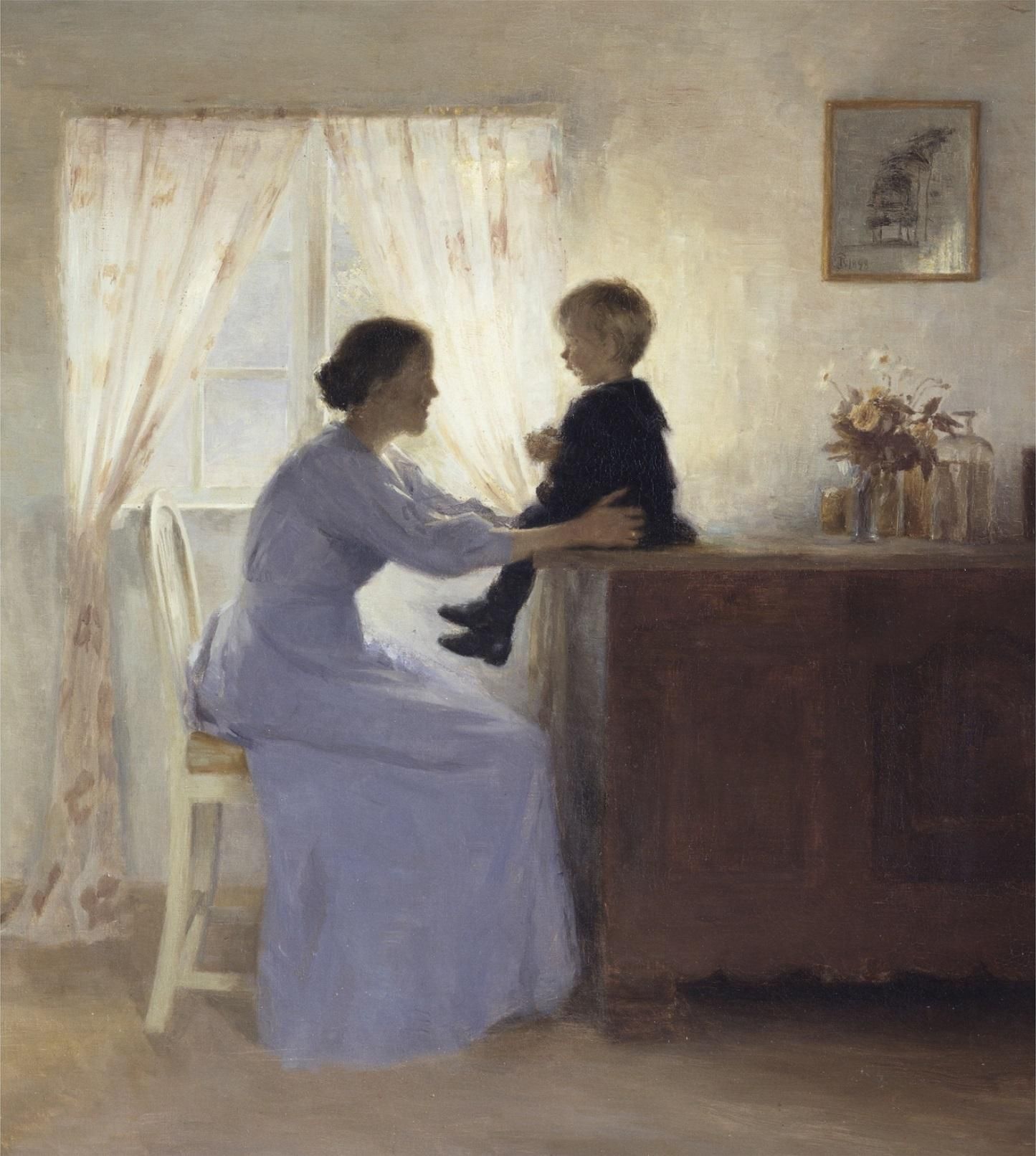
‘A Mother and Child in an Interior,’ by Peter Vilhelm Ilsted. 1898. Oil on canvas. Public Domain.
Reading the mother or the daughter’s forms across culturally diverse texts and literary genres opens a window onto the different systems through which motherhood is shaped in various societies. These systems define the mother’s role, the patterns of her relationship with her children, and the influence of the wider community on how these relationships are formed and sustained. From outside the literary or artistic text, cultural differences may appear pronounced, each society seeming distinct and self-contained. Yet this view only scratches the surface.
Beneath these differences, the texts reveal shared threads that bind cultures together—threads that reinforce the idea of motherhood as inseparable from women’s identity. They show how women are encouraged to find meaning and fulfillment in this role, to the extent that any departure from the culturally sanctioned model of motherhood is treated as an anomaly, pushed to the margins as an exception. But if all alternative practices of motherhood in literature are dismissed as mere exceptions, a crucial question arises: what, then, is the dominant model endorsed by culture? Whose experience defines it? And which experiences are rendered invisible in the process?
These questions are less about finding final answers than about opening the door to more questions. Why do societies feel the need to fix motherhood into a single, rigid form? And what happens to the deep differences between women’s lived experiences—differences shaped by place, history, psychological time, class, education, and social and political conditions? From this understanding, it becomes clear how gender is narrowed into a closed circle, with women’s roles defined primarily through their place within the family. When we take these causes seriously, motherhood emerges as a deeply personal experience, one that is shaped by difference and cannot be reduced to a single form. Yet civil and religious laws often turn motherhood into an institutional practice, governed by rules rather than lived realities.
From here, we can begin to understand the pressures faced by mothers who do not conform to dominant expectations, and the tension between a society that enforces fixed ideas of motherhood and individuals who attempt to step outside those fixed paths.