The Image of Motherhood in Arabic Poetry
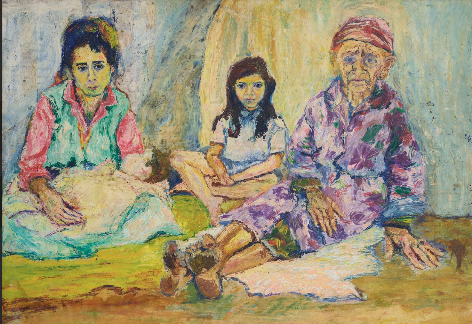
'Untitled,' by Attyat Farag. 1959. Oil on canvas, 67 x 82 cm. This art was part of ‘Horizon in Their Hands’ exhibition in collaboration with Barjeel Art Foundation held at Ithra. Courtesy of Ithra.
It is often said that the first sound spoken by humans was “Ma/Um,” a simple, primal sound connected to human beginnings and a deep longing for motherhood and warmth. In many cultures, “Ma/Mama/Um”” is considered sacred, linked to the earth, to human origins, and to our emotional and physical roots.
As language developed, motherhood moved from myth into everyday social and religious life and gradually became a strong poetic symbol. In Arabic poetry especially, the mother appears so often that it is hard to find a poet who has not written about her. Poets return to their mothers as symbols of care, generosity, and devotion, using the language and images of their own cultures to express that bond.
What is remarkable is that the image of the mother in Arabic poetry never seems to run out. Sometimes she is the main subject of a poem, and at other times she appears quietly within verses written for other themes, adding warmth, beauty, and emotional depth.
The image of the mother in poetry has changed many times over the years. In pre-Islamic poetry, women were often spoken of indirectly, yet the mother held a special place. She was linked to the idea of refuge and safety in a harsh desert world, and described through qualities such as patience, loyalty, and resilience. Many poets openly expressed pride in their mothers. One of them was Antarah ibn Shaddad, who spoke of his mother, Zabibah, with defiance, responding to those who mocked him because of her:
I am the son of a dark woman,
raised like a hyena among ruins undone.
If I am a slave among slaves they name,
my will still rises beyond the stars’ flame.
In the Islamic era, the mother was regarded as a doorway to Paradise and a path to spiritual redemption. In this spirit, Imam Al-Shafi‘i said:
Bow to your mother, seek her grace,
For turning from her is pride’s disgrace.
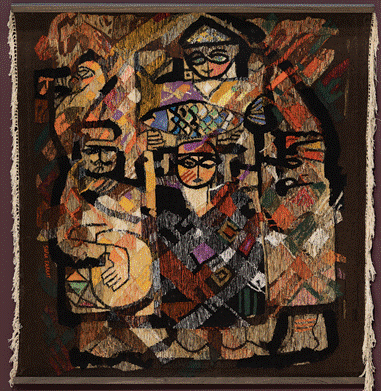
'Mère et Enfant (Mother and Child),' by Safia Farhat. 1970. Tapestry, 151 x 124 cm. This art was part of ‘Horizon in Their Hands’ exhibition in collaboration with Barjeel Art Foundation held at Ithra. Courtesy of Ithra.
In modern times, shaped by sweeping social and demographic changes caused by forced migrations, wars, displacement, and exile, traditional narratives began to fracture. Amid these upheavals, poets reimagined the mother. She was no longer seen only as a biological figure, but as a presence rooted in nature itself, enduring, life-giving, and in a constant state of rebirth. This transformation is most powerfully evident in elegiac poetry, which has moved beyond conventional mourning to a deeply personal and symbolic expression.
A notable example is the poem “Fatimah” by the Saudi poet Abdullah Al Saykhan, written in memory of his mother. In its opening, he writes:
As if all women were born of water’s flow,
but Fatimah alone from sleet.
As if her braids were falling stars outspread—
if she comes not home, no one returns instead.
In this passage, Al Saykhan, devastated by his mother’s death, raises her memory to the level of legend, someone no one can ever resemble. She is purer than water, like "sleet", and at the same time stronger and more vividly present. Although the simile “as if” suggests something dreamlike rather than real, and deepens the feeling of loss, the poet returns to affirm her warm and glowing presence through the image of her braids/falling stars. At the same time, he denies any real or physical presence of the other people in the house after her absence.
He continues, describing time as distorted and out of place since his mother’s passing:
It was said that those who came two days
after they had buried her in the earth,
found in that place,
a moon rising behind her henna,
a moon of tenderness.
A hand rested, half-loosened.
God drew from its stain a thread of red away.
from that thin line of blood there grew,
a tree, still green,
and Fatimah was the name.
In this passage, Al Saykhan finds comfort in the idea that the mortal body does not simply disappear but turns into a lasting light. The image of “a moon rising behind her henna” suggests warmth and tenderness that soften the darkness of loss. Her henna-ed hand becomes a thin thread of blood, as if it connects death to life. From that thread grows a green tree, a clear sign of renewal and survival. Through this vision, the poet moves toward a spiritual, almost mystical space that rises above the laws of nature. He takes us into a world of quiet wonder, where the mother keeps her presence alive on the earth through the tree that bears her name.
When a poet turns a mother’s embrace into a memory filled with vivid scenes and shaped like a complete dramatic work, the result is a poem too expansive for a single article and too meaningful to reduce to a summary. It is layered with deep metaphor, and although it carries a powerful sense of orphanhood, it rises above mere emotional appeal or personal grief. Al Saykhan ends with a sweeping tribute: “I was not her son alone… I am the son of every woman who resembles her… and she is my mother, the closest among them.”
Throughout the poem, he makes it clear that the mother does not disappear. She continues to exist through her symbolic presence in nature and through the traces she leaves in the everyday lives of her children. From the pain of loss, he creates a modern, thoughtful, and original reflection on one of the oldest themes in Arabic poetry.
In another example from contemporary Arabic poetry, this time written as prose, the Saudi poet Ahmed Al-Mulla expresses his deep pain over losing his mother. In his poem “Aisha’s Grave,” he writes:
I do not know my mother’s grave.
I kiss her only in dreams.
Loss still covers my heart.
Her call
a slow blade,
widening longing.
If only a knock at dawn.
If only a sign at the door.
I would have followed.
I would have carried forgetting
like mercy,
sealed the cracks with it.
I would have written the nights
into my skin.
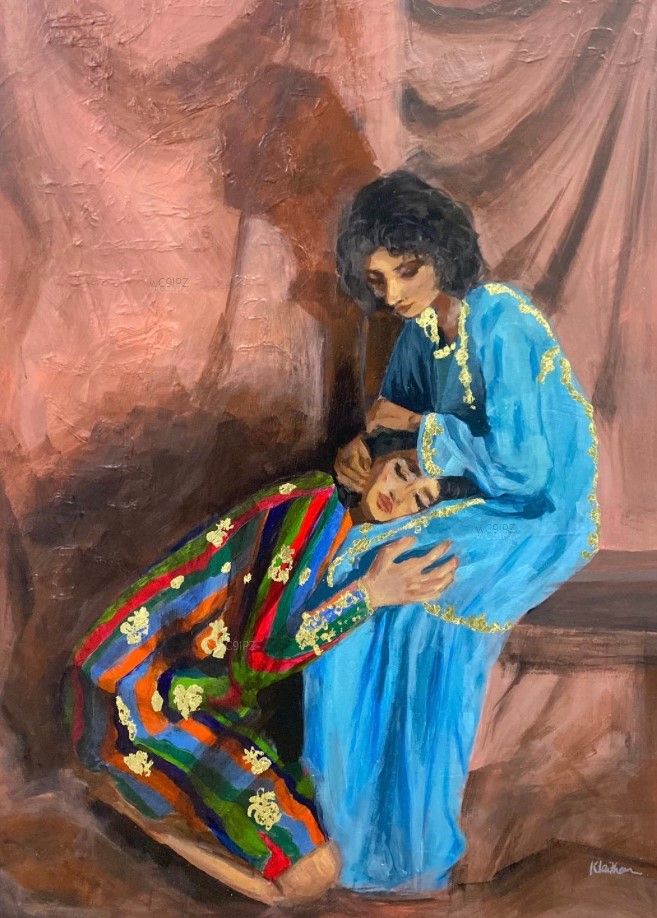
'Scéne de familli (Family scene),' by Zina Amour. 1967. Oil on wood panel. 72 x 92 cm. This art was part of ‘Horizon in Their Hands’ exhibition in collaboration with Barjeel Art Foundation held at Ithra. Courtesy of Ithra.
In the poem, Al-Mulla’s sense of loss has more than one level. His mother is gone, and there is no grave he can visit, which makes it harder for him to say goodbye. So, he creates an image of a dome for her in his imagination, and this imagined picture only increases his pain. His grief feels not only emotional but almost physical. He describes it as a spear stuck deep inside him, moving slowly and making his longing hurt even more.
The irony is that the mother’s call, something that should feel safe and comforting, becomes a source of pain. It makes him imagine different possibilities and repeat a series of impossible wishes. He says “if only” again and again, answering himself and suggesting things he wishes he had done, as if they could help him fight the deep sense of being orphaned that was forced on him. He says, for example, “I would have faced absence and overcome it,” or “I would have carried forgetfulness with care and sealed the cracks with it.”
In the second part of the poem, the poet changes direction. He begins using command-like verbs that sound more like prayers or requests, and he says:
Come back… leave your scent on the road,
morning and henna in your wake,
so I can follow.
Or light your lost grave with a small candle,
that I may rest in your glow
and sleep.
Here, the poem turns into simple, familiar details that remind him of his mother: henna in her hands and the dress patterned with trees. In his culture, these are gentle, everyday signs of womanhood and warmth. He focuses on scent because smell is the sense most closely tied to memory. For him, it would be enough to catch her fragrance in the air, the hint of henna in her hair and palms, or the soft smell of her bright, patterned dress. These scents stand for the color and warmth that left his life when she did.
In the end, he returns to the pain of not even knowing where her grave is. Without a place to visit, he feels unanchored. So, he asks for even the smallest light from her, just a candle’s glow. He wants to rest his head on that gentle light of motherhood, to sleep, and to feel safe again.
From the very first sound, “Ma/Um”, to this day, no matter how languages change or ways of speaking evolve, motherhood remains one of the highest human values. A mother’s embrace is still a place of safety: the child clings to it, and the adult quietly longs for it. In the face of such greatness, even words fall short.