The Gold-Bearded Prince of Arabian Horses
A watercolor by Count Wacław Seweryn Rzewuski. It is included in the correspondence and papers of Rzewuski regarding the purchase of Arabian horses for the Württemberg and Russian courts. 1817-1825. Image credit: polona.pl
He swims in the desert sea, my stallion,
Carving the waves of sand.
Snowy peaks he plows
As a dolphin plows the breakers,
Ever faster, still faster,
Skimming over the gravelly footing.
Higher, still higher,
He soars from the dust like a cloud—
A storm-cloud—this stable stallion of mine.
The star on his forehead gleaming like the dawn,
He tosses his ostrich-feathery mane to the wind.
Fly, white-legged kite, oh fly!
Vanish, footpaths; forests, recede!
— From the poem ‘Farys’ by Adam Mickiewicz (1798 - 1855), written in tribute to Count Wacław Seweryn Rzewuski
For every dreamer who has ever gazed upon the endless golden dunes and felt the pull of the unknown, the desert offers either oblivion or immortality. It strips away certainty, rewards only those willing to surrender to its vastness, and for that it has long drawn strangers searching for something beyond themselves. Few had answered its calls as completely as the Polish nobleman Count Wacław Rzewuski (pronounced Vatsuaf Zhevusky), who crossed into the untamed expanses of Arabia in search of horses, but found a new identity and planted long-lasting roots in the shifting sands.
"My dear Count," wrote Prince Eustachy-Erazm (1768 - 1845) to Count Rzewuski. "I tell you the simple truth, that no eye has yet seen in our country such Arabian horses, nor has the ear heard of such as I now possess."
Wacław Rzewuski, a Polish count and traveler, born in Lvov in 1785, needed no persuasion from this Prince or any other. He was already on his way to the Arab world, a land that has fascinated him since childhood. In 1817, at the behest of Tsar Alexander I of Russia, Rzewuski went to the Middle East to collect purebred Arabian horses to replenish the Tsar’s and military stables, which had been devastated after the Napoleonic Wars.
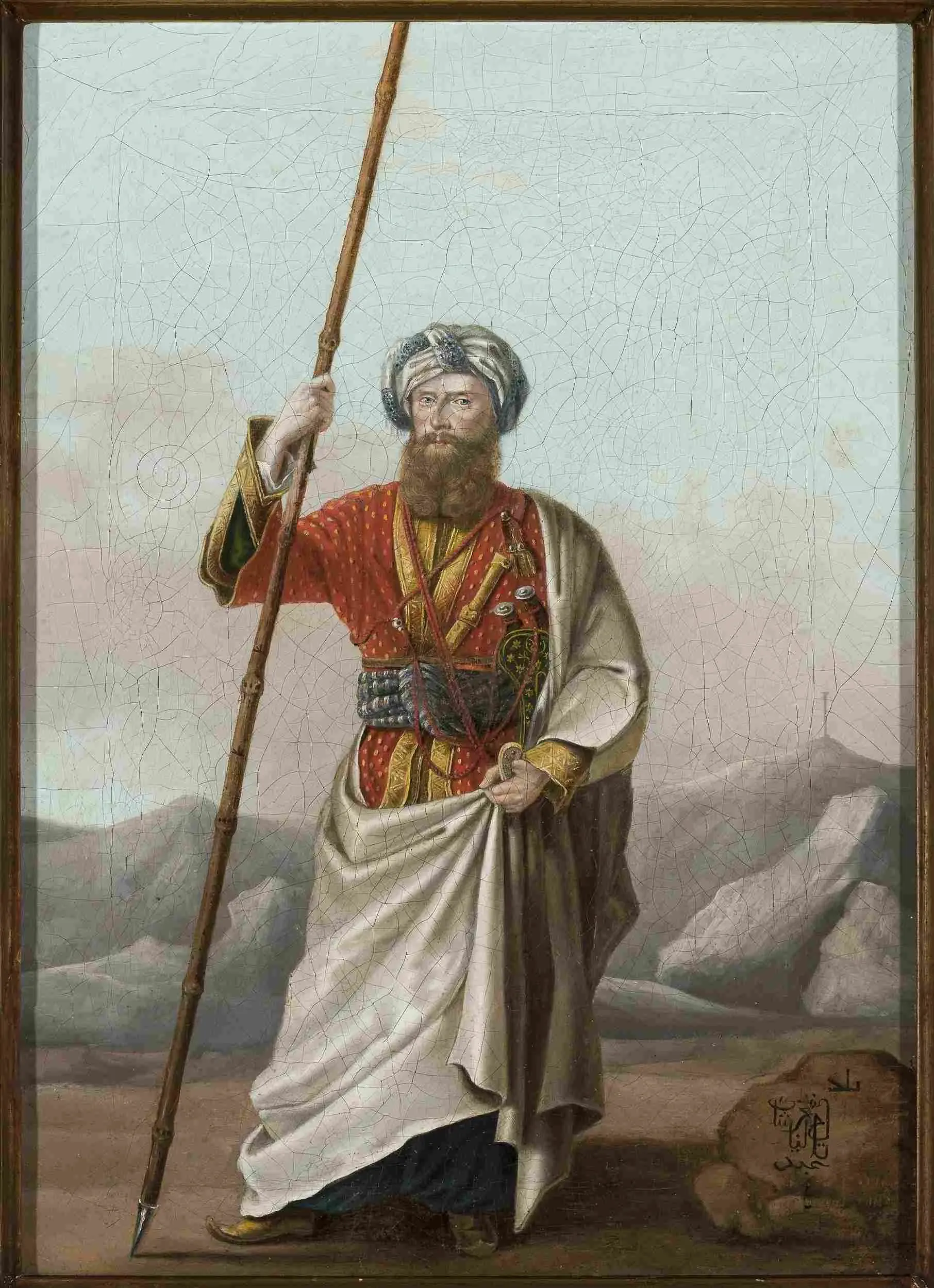
Portrait of Wacław Rzewuski, nicknamed "emir." 1825. Credit: National Museum in Warsaw.
Between 1818 and 1820, he journeyed through Syria, Iraq, Lebanon, Palestine and the Arabian Peninsula, including the lands of present-day Saudi Arabia. His preparation for the journey became legendary. He is said to have toughened his stomach by eating raw meat and spoiled food, offered only water and pipes to guests, ate and slept beside his horse, studied the Quran, immersed himself in Arabic literature and wrote in Arabic.
What drove this obsession? It is said Rzewuski believed that his aristocratic Polish family descended from Arab tribes. Another enduring legend held that he was, or claimed to be, a descendant of the legendary Zenobia, the third-century queen of the Palmyrene Empire in Syria.
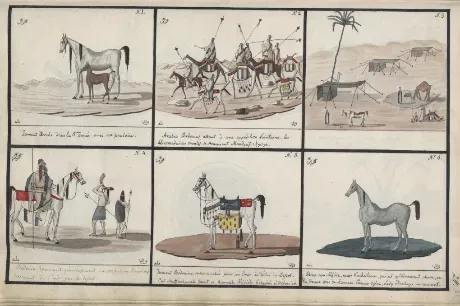
An excerpt from Count Rzewuski’s Sur les Chevaux Orientaux et Provenants des Races Orientales ("Concerning the Horses of the Orient and Those Originating from Oriental Breeds"). 1820 - 1830. Source: polona.pl.
In his mind, the journey to the Arab world was more than an expedition; it was a homecoming, a return to ancestral roots. He saw in the Bedouin way of life a purity and nobility that resonated with his romantic ideals and his own sense of identity.
And indeed, he returned to Poland transformed. He became the Arab Polish prince. He wore Bedouin attire, adopted Arabic customs and behaved as a true ambassador of Arabia in 19th century Poland. During his travels, he has mastered the Arabic language and was able to earn the local tribes’ trust and friendship. He was welcomed to 13 different tribes, and the gold-bearded horseman, as he became known, was reputed to have received the title of Emir, Sheikh, Taj Al-Fakhr ("Crown of Glory or Pride") and Abu Asad ("Father of the Lion"). His Arabic name, Taj Al-Fakhr, is a direct translation of the old Slavonic meaning of his given name, Viacheslav, or "Crown of Glory," later Polonized to Wacław.
"I sought free people remaining in a natural state," he wrote. "I can say that in the desert I feel as if I was in my home country. The knowledge of the exact language and customs of the locals has always been of great help to me in my travels through Arabia - they will serve me also during my future expeditions. I ride on horseback and have the power of a spear like a Bedouin; my strong health is not affected by heat or climate change. I am not afraid of hardship and fatigue…"
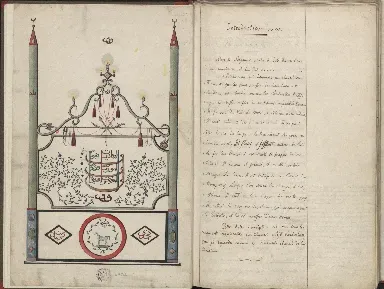
An excerpt from Count Rzewuski’s Sur les Chevaux Orientaux et Provenants des Races Orientales ("Concerning the Horses of the Orient and Those Originating from Oriental Breeds"). 1820 - 1830. Source: polona.pl.
Count Rzewuski is credited as one of the first to bring Arabian horses to Europe. A pioneer breeder, he brokered the sale of purebred Arabians to royal studs from France to imperial Russia. Renowned for their endurance, intelligence, strength and loyalty, these horses captivated Europe.
Today, their descendants remain among the world’s finest bloodlines, continuing to inspire admiration, poetry and praise from all those who encounter them.
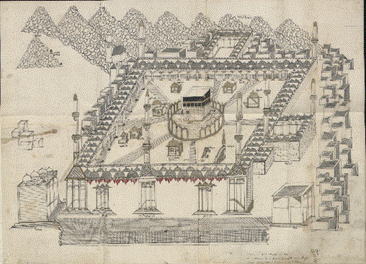
The Holy Kaaba, Makkah. An excerpt from Count Rzewuski’s Sur les Chevaux Orientaux et Provenants des Races Orientales ("Concerning the Horses of the Orient and Those Originating from Oriental Breeds"). 1820 - 1830. Source: polona.pl.
The man who found new roots and became a legend in his own right, left behind an extraordinary work, Sur les Chevaux Orientaux et Provenants des Races Orientales ("Concerning the Horses of the Orient and Those Originating from Oriental Breeds"), which contains more than 400 colorful illustrations and hundreds of pages of meticulously handwritten observations. It remains an invaluable compendium of knowledge about Arabian culture, heritage, horse breeding and equestrian traditions, documenting bloodlines, history, physical characteristics and breeding practices. The manuscript also preserves musical notation that allows scholars to recreate Bedouin music from two centuries ago, along with a census of several tribes and detailed descriptions of the methods of taming, training and breeding Arabian horses.
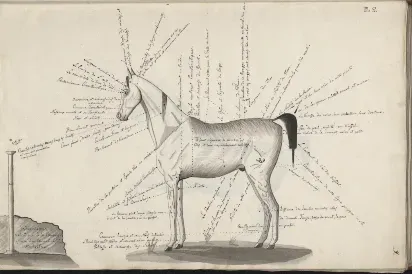
The wealth of knowledge and heritage of the Arabian horse. An excerpt from Count Rzewuski’s Sur les Chevaux Orientaux et Provenants des Races Orientales ("Concerning the Horses of the Orient and Those Originating from Oriental Breeds"). 1820 - 1830. Source: polona.pl.
The survival of Rzewuski’s manuscript for more than 200 years is a miracle in and of itself, having narrowly escaped destruction multiple times over the centuries. After his disappearance – and what some believe was his mysterious death in a battle – it passed through the hands of family members and among horse enthusiasts, was briefly lost, and was eventually acquired by the National Library in Warsaw in 1928. The manuscript survived World War II and is now on permanent display in Krasiński Palace, also known as Palace of the Commonwealth, in Warsaw.
These records, preserved to this day, are a testament to the gold-bearded Count Rzewuski’s profound respect for the roots and lineage of the people who welcomed him as one of their own.
He also lived up to the Polish saying: "A man without a horse is like a body without a soul."
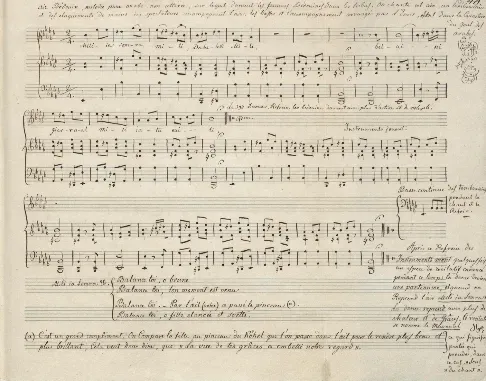
Notes (music notation) of Bedouin music over 200 years ago. An excerpt from Count Rzewuski’s Sur les Chevaux Orientaux et Provenants des Races Orientales ("Concerning the Horses of the Orient and Those Originating from Oriental Breeds"). 1820 - 1830. Source: polona.pl.
Rzewuski's story is a testament to the power of cultural exchange and the universal human quest for belonging. His life reminds us that roots are not always defined by geography or birth; they can also be chosen, nurtured, and earned through respect, understanding, and a willingness to become part of something greater than oneself.
In an age marked by borders and division, the tale of the Polish nobleman who became an honorary Arab sheikh endures as a luminous example of how one man's search for roots blossomed into a legacy that transcends nations and centuries.
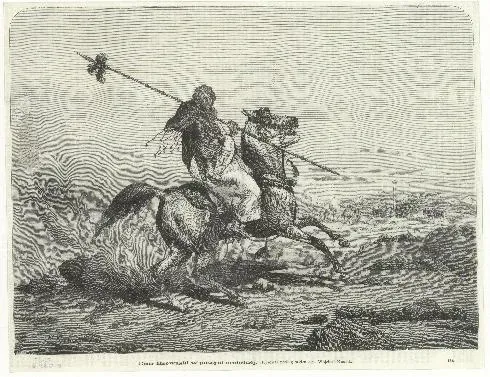
Count Rzewuski in the Arabian desert. 1874. Image credit: polona.pl
Enjoy exploring a selection of some of the remarkable pages of the manuscript that were hand-picked for you in this article, and find the full magnificent manuscript here at the National Library of Poland.
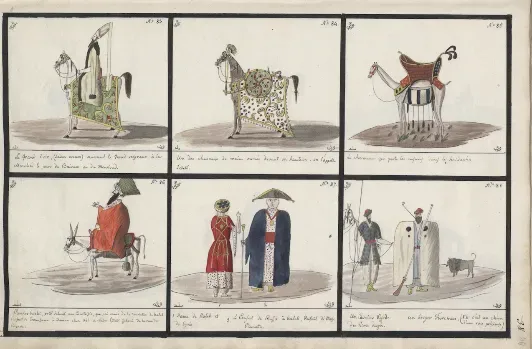
An excerpt from Count Rzewuski’s Sur les Chevaux Orientaux et Provenants des Races Orientales ("Concerning the Horses of the Orient and Those Originating from Oriental Breeds"). 1820 - 1830. Source: polona.pl.
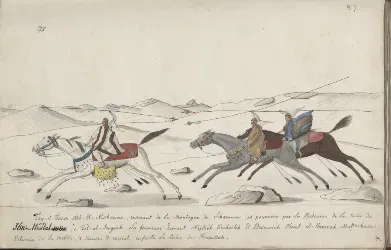
An excerpt from Count Rzewuski’s Sur les Chevaux Orientaux et Provenants des Races Orientales ("Concerning the Horses of the Orient and Those Originating from Oriental Breeds"). 1820 - 1830. Source: polona.pl.
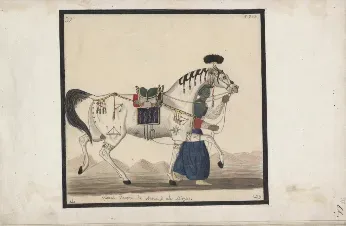
An excerpt from Count Rzewuski’s Sur les Chevaux Orientaux et Provenants des Races Orientales ("Concerning the Horses of the Orient and Those Originating from Oriental Breeds"). 1820 - 1830. Source: polona.pl.
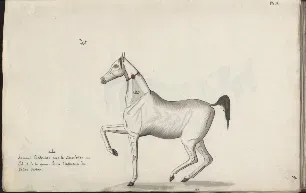
An excerpt from Count Rzewuski’s Sur les Chevaux Orientaux et Provenants des Races Orientales ("Concerning the Horses of the Orient and Those Originating from Oriental Breeds"). 1820 - 1830. Source: polona.pl.
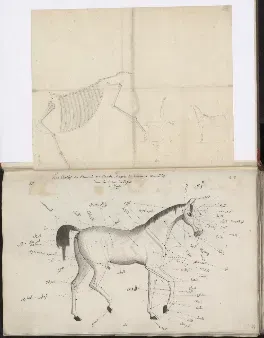
An excerpt from Count Rzewuski’s Sur les Chevaux Orientaux et Provenants des Races Orientales ("Concerning the Horses of the Orient and Those Originating from Oriental Breeds"). 1820 - 1830. Source: polona.pl.