Re-rooting, Regrowth
'Tree Roots.’ Vincent van Gogh. Auvers-sur-Oise. July 1890. Oil on canvas. 50.3 x 100.1 cm. Credits: Van Gogh Museum, Amsterdam (Vincent van Gogh Foundation).
"All that is gold does not glitter,
Not all those who wander are lost;
The old that is strong does not wither,
Deep roots are not reached by the frost…"
— J.R.R. Tolkien (1892 - 1973), academic and writer, The Fellowship of the Ring
In a world that often feels suspended in a frantic race toward the future and instant responses, we have chosen, for this edition, to pause, and turn our gaze downward towards the very thing we often take for granted. We have chosen to explore the realm of ‘Roots.’
It is a theme that hums with a quiet, ancient power. We are often too caught up by the louder and more visible elements of life—the bright bloom, the sweet fruit, the towering trunk of expectation and ambition; the list of tasks that keep growing. But the true story of resilience, of quiet strength, and of profound connection is often written in the dark, silent world beneath our feet, and in what we carry deep in our hearts. However one chooses to understand them and define them, roots are often our main anchor in a storm, a conduit to a shared narrative among one or many communities, a delicate network of life and its many players and settings.
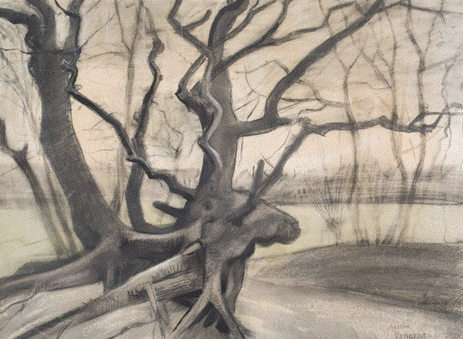
‘Tree Roots in a Sandy Ground (Les racines).’ Vincent van Gogh. April-May 1882. The Hague. Pencil, black chalk, brown and grey wash, opaque watercolour on watercolour paper. 51.5 × 70.7 cm. Credits: Kröller-Müller Museum. KM 117.091 RECTO.
This notion finds a powerful echo in the work of Vincent van Gogh (1853 - 1890), whose life and art we begin this edition’s journey with. In his final masterpiece, 'Tree Roots,' painted in July 1890 in the small French village of Auvers-sur-Oise, he poured his last frantic energy onto a canvas of exposed, gnarled roots clinging to a sandy bank. For over 130 years, the painting’s exact location remained a mystery; until 2020, when it was remarkably rediscovered, its sage-like twisted roots and clinging soil almost identical to Van Gogh’s rendering. We wonder what it was about this spot that left such an impression on the great master. What did Van Gogh see? Was it a reflection of his own soul, a "life's struggle" manifested in the fiercely determined grip of a tree against the ravages of time and storm?
For Van Gogh, the divine resided in both humanity and nature. In those twisted forms, he recognized a profound truth, and one he captured in an earlier drawing titled ‘Tree Roots in a Sandy Ground ("Les racines," April-May 1882) and described in a letter to his brother Theo: In these tree roots, ‘those gnarled black roots with their knots’, he recognizes something of ‘life’s struggle’, namely the ‘frantically and fervently rooting itself, as it were, in the earth, and yet being half torn up by the storm.’
It is a powerful metaphor for the human condition itself—our own beautiful, and sometimes painful effort to find our footing in the world, to hold on to our identity and our connections or form new ones as we uproot and are transplanted, often without warning, into unfamiliar soil: new cities, new cultures, new phases of life that feel foreign to our senses.
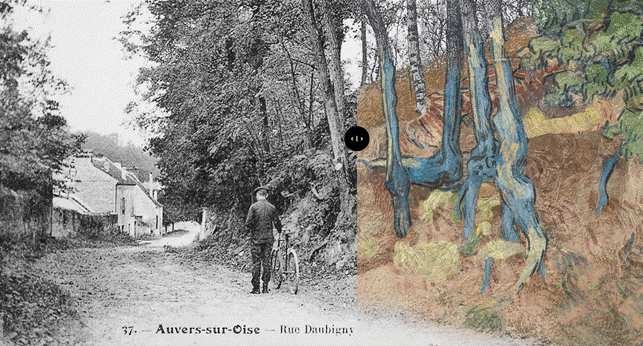
A postcard dating from 1900-1910 featuring a scene including tree trunks and roots growing on a hillside that look like those drawn by Vincent van Gogh. The location in Auvers-sur-Oise was discovered by Wouter van der Veen, the scientific director of the Institut Van Gogh, who found the postcard. Credits: Van Gogh Museum, Amsterdam.
In this edition of Ithraeyat, we wander through this concept in all its complexity. We explore the roots of our stories, of our crafts and art, and our search for a home wherever we go.
We invite you to reflect on what grounds you.
In the hustle of daily life, it is so easy to become a detached branch, or a confused leaf, blown about by the winds of opinion and expectation. We hope this edition serves as a gentle, necessary invitation to reconnect — to remember your own story, to honor the soil from which you came and the nourishing elements that sustain you. For it is only from a place of deep, secure rooting that true regrowth can begin.
Welcome to this journey of rediscovery, regrowth and roots.
With appreciation and respect

Rym Al-Ghazal
Editor-in-Chief