Roots, Unbound
‘Tree of My Life.’ Joseph Stella. 1919. Oil on canvas. 193 x 213.4 cm. Source: Obelisk.
When we speak of roots, we often summon a reassuring image: an origin fixed deep below, from which branches sprout and grow, while the root itself remains still and impervious to change, as though time passes only above the surface of the earth and never reaches it. In cultural and national discourse in particular, this image becomes even more rigid. Roots become synonymous with purity, authenticity and continuity, and the persistent return to them becomes an attempt to recapture a moment or a primal image, presumed to have been whole and harmonious.
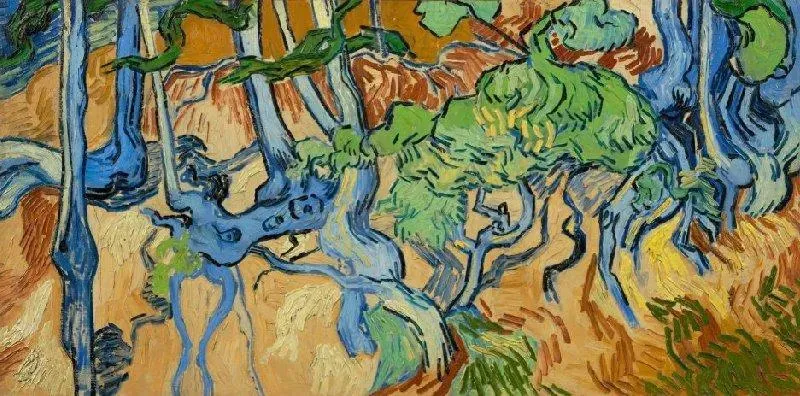
Yet a root is anything but still. It is a living organism that advances, branches out, and tests the soil. It responds to moisture and drought, avoids obstacles, and enters into relationships with microorganisms, fungi, and other roots. The root does more than sustain the life of the tree; it also lives a life of its own, one no less dynamic and complex than what unfolds among the branches.
The traditional view of the tree assumes a clear hierarchy that determines the place of the root and every other part of the tree. Within this order, the root is the origin, the trunk its extension, the branches its results and the fruit its purpose. By the same logic, the past becomes a foundation that exists in a final, settled form, while the present is a branch that derives its legitimacy from that foundation. Yet this image conceals a fundamental truth: The roots themselves grow in tandem with the branches, though in the opposite direction. As the tree expands and rises into space, it must reshape its presence in the soil. What happens above affects what happens below, and vice versa. The size and vitality of the leaves, the amount of light, the force and intensity of the wind, and the changing seasons all redirect the growth of the roots.
The relationship between root and branch, then, is one of continual exchange and interdependence, rather than a fixed cause producing a changing effect. They are two expressions of the same life. The branches reach toward light, while the roots reach toward water. The branches test the air; the roots read the soil. Each expands the boundaries of the living organism that is the tree and helps ensure its continuity.
Branches should not be given a higher status than roots simply because they are visible. Human cultures have long favored what can be seen over what remains hidden: light over darkness, sight over blindness. If the branches represent what culture produces — art, ideas, institutions, and new forms of life — then roots represent the deep reservoir of language, memory, customs, stories, and ways of sensing the world. Yet this reservoir is reinterpreted whenever the present changes. It never remains exactly as it was.
Culture, in this sense, is not a repository containing relics of the past; rather, it is a living system transformed through use. Language, which we consider one of our deepest roots, changes every day. New words enter it, meanings recede, and new metaphors emerge from words that have existed for centuries. The same is true of a social ritual, which no longer carries the same meaning when its setting, audience, or historical circumstances change, or of a folk tale, which does not remain the same as it passes from one storyteller to another.
Even what we call heritage does not reach us whole and complete from some bygone era. We select from it, arrange it, give it names, boundaries, and interpretations, and decide what is displayed in museums, what is taught in schools and what is left out. It is not enough, then, to say that we inherit our roots when we are continually participating in their making and reshaping.
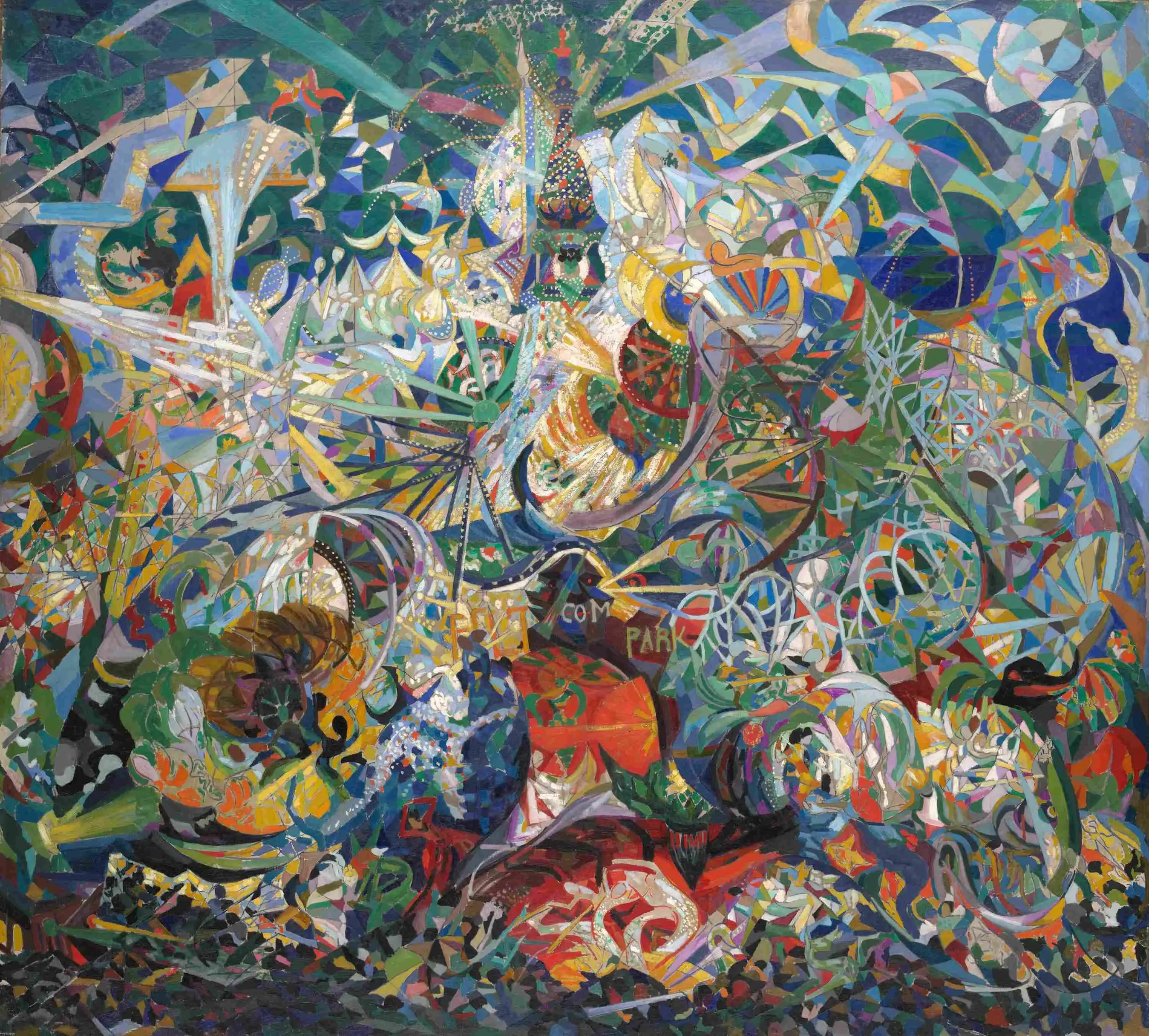
‘Battle of Lights, Coney Island, Mardi Gras.’ Joseph Stella. 1913–1914. Oil on canvas. 215.3 x 195.6 cm. Source: Obelisk.
At particular moments in history, the desire to search for roots intensifies, especially when nations seek to define themselves. This happens when states are founded, when they are liberated from colonial rule, when disparate groups and regions are united under a shared national identity, or when rapid transformations threaten familiar forms of life. At such pivotal moments, a nation needs a narrative that tells it who it is, where it came from, and what binds it together. It turns to artifacts, genealogies, narratives, language, dress customs and places, selecting from them markers capable of creating a sense of continuity.
Such a return to the past is understandable and necessary to building a sense of belonging, but it carries the risk of turning history into a static image. A nation may imagine for itself a single, fixed origin and a straight path, even though its formation was the result of countless encounters, migrations, conflicts, and exchanges. National culture may be presented as an ancient essence preserved from outside influence, even though cultures grow through contact, translation, borrowing and proximity. The question we ask of our roots, therefore, should not be: What pure form did we once possess? It may be more useful to ask: What paths formed us? What relationships did we enter into? And how did the elements of our culture change as they moved across time and place?
Here, the concept of the "rhizome," as formulated by philosophers Gilles Deleuze and Félix Guattari, takes on particular significance. In contrast to the model of the tree, built around a single origin and hierarchical branches, the rhizome offers the image of a network spreading horizontally, in which any point can connect to any other. The rhizome has no single center, no absolute beginning, and no predetermined path. It may be severed in one place and resume growing in another, while multiple lines intertwine within it without losing their distinctiveness. This way of thinking helps us understand culture as a network of relationships rather than as a lineage descending from a single origin.
The concept of the rhizome does not ask us to abandon roots or deny history. It frees the root from the image of a rigid column. Roots can spread sideways, meet, exchange nourishment and cross the boundaries humans draw on the surface of the earth. Cultural identity can therefore be understood as a form of life shaped by overlapping memories and continually renewed connections, rather than as a solitary tree enclosed within its own soil or a collection of branches severed from their past. A culture can be national and local while also carrying traces of trade, migration, religion, translation and contact with other cultures.
Placing roots and branches on equal footing frees both from the need to rank one above the other. Renewal does not require severing ties with the past, and fidelity to the past does not require repeating it as it was. A new branch expands the possibilities of the root; in the same way, a changing root allows unexpected branches to emerge. A living culture need not choose between authenticity and transformation.
Perhaps, then, what we need is less to dig into the earth in search of some first root than to listen to what the roots are doing now: how they spread, what they connect with, what they absorb and what they give to the soil around them.
The root is not a silent witness to a completed and closed past. It is a living thing that continues to write its history unseen, beneath the soil. If the branches give the tree its shape in the sky, the roots redraw and reshape it underground. Between what is hidden and what is visible, between memory and transformation, culture takes shape as continuous growth rather than a final return to an imagined point of origin.
Ali Almajnooni is a writer, translator and researcher.