The Queen’s Gambit and a Falconer’s Case
‘Portrait of William and Penelope Welby Playing Chess.’ Francis Cotes. 1769. United Kingdom.Oil on Canvas. 135 x 152 cm (unframed). Credits: Louvre Abu Dhabi © Department of Culture and Tourism - Abu Dhabi. Photo by APF. LAD 2013.007.
Roots, it turns out, are rarely confined to a single soil or place. They travel, graft, and intertwine across oceans, civilizations, and generations—nourishing identities that are as much forged in exchange as they are in tradition. In this edition of From the Vault, we descend into the majestic collections of Louvre Abu Dhabi to uncover five remarkable objects that did not simply reflect their cultures of origin, they built bridges and networks of exchange that nourish identities far beyond their point of origin.
Produced in northern Italy during the 16th century, this finely crafted feed case reflects the prestige of falconry, a practice long associated with courts and the nobility. Decorated with heraldic motifs reminiscent of the Medici coat of arms, it embodies the close relationship between hunting traditions, social status, and artistic craftsmanship.
Although European in origin, the object resonates strongly in the Arabian Peninsula, where falconry remains a living cultural tradition.
Materially robust yet intricately detailed, the object embodies the technical and artistic excellence that characterised luxury production linked to courtly pursuits.
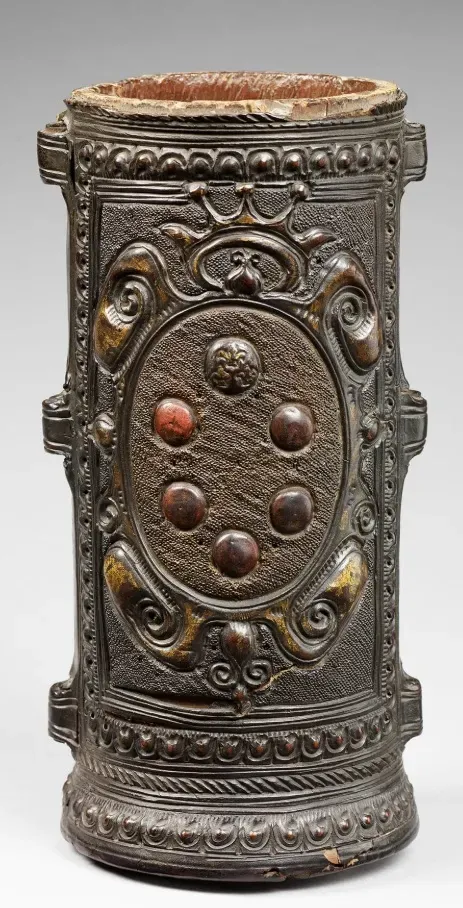
‘Falconer’s Feed Case, Decorated with a Coat of Arms.’ 16th century. Northern Italy. Wood and leather. 22.4 x 11 x 11 cm. Credits: Louvre Abu Dhabi © Department of Culture and Tourism - Abu Dhabi. Photo by Thierry Ollivier. LAD 2012.008.
This monumental 14th-century Mamluk mosque lamp represents the height of Islamic glassmaking. Decorated with botanical ornamentation, Qur’anic calligraphy—including the celebrated Verse of Light (Quran 24:35)—and the blazon of the Mamluk Amir Sayf al-Din Sarghitmish, it reflects the artistic refinement of the Mamluk period.
This mosque lamp is a great representative of Mamluk examples in both its shape and technique. The surface of the lamp is organized in numerous registers, with two calligraphic inscriptions, and registers intersected by two medallions holding the patron's emblem, and decorated with botanical ornamentation. The calligraphy is that of a dedicatory inscription mentioning the commissioner and the sultan with whom he is affiliated.
A usual format mentioning the commissioner, referred to here as Amir Sayf al-Din Sarghitmish, and that of the name of whom he is in service of, the Sultan al-Nasir.
Medallions holding the blazon of the red napkin or buqja of the master of the robes or the jamdār, also refer to the commissioner, who was Mamluk Amir Sayf al-Din Sarghitmish al-Nasiri, Ras Nowhat-el-Nowab (d. 1358). According to Al-Maqrizi, he was an emir and later, the atabeg of the army.
Such lamps were often produced in large numbers to adorn the ceilings of architectural religious monuments commissioned by important Mamluk patrons, in an act of religious piety. A production often done in a mass, mentioning their name as patrons and their emblems.
This lamp would have most likely been commissioned for the complex of Sarghitmish still standing today within Cairo's medieval quarter of Sayyida Zaynab. The complex, which appears on the 5 Egyptian pounds note, was inaugurated in 1356 in an opulent event in presence of emirs and ulemas according to Al-Maqrizi.
This work also embodies the broader context of artistic patronage during the Mamluk period, a time of considerable prosperity for the dynasty. The flourishing of the arts during this era was closely tied to this economic and political strength, enabling the production of objects of exceptional quality.
Inscription appearing on the first register:
"اللَّهُ نُورُ السَّمَاوَاتِ وَالْأَرْضِ مَثَلُ نُورِهِ كَمِشْكَاةٍ فِيهَا مِصْبَاحٌ "
"Allah is the Light of the heavens and the earth. His light is like a niche in which there is a lamp"
Quran (Surat Al-Nur, verse 35)
Often the inscription that prevailed on such lamps, referring to the light that will eminently pass and enlighten the religious space and the path of the believers.
Inscription appearing on the third register:
"المقر الكريم العالي المولوي المالكي المخدومي السيفي صرغتمش رأس نوبة الملك الناصر"
"His Honorable and High Excellency our Lord, the Royal, the Well-Served, Saif ad-Din Sarghitmish, Chief of Corps of Mamluks of al-Malik an-Nasr."
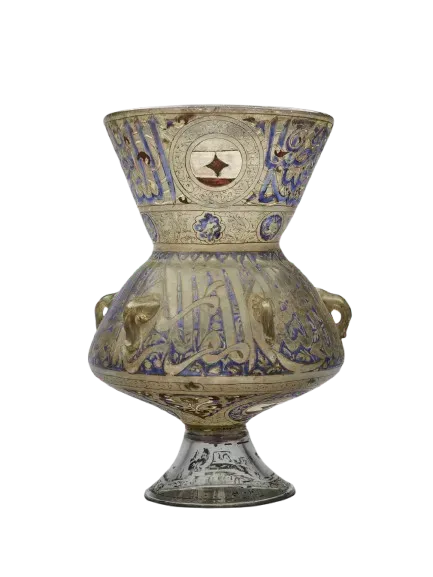
Mosque Lamp. Commissioned by: Amir Sayf al-Din Sarghitmish al-Nasiri, Ras Nowhat-el-Nowab (d. 1358). Egypt or Syria. 1351 - 1358, Mamluk Sultanate (1250-1517). Enamelled glass. 38.7 x 27.5 x 27.5 cm. Louvre Abu Dhabi © Department of Culture and Tourism – Abu Dhabi. Photo by Noora Alzaabi. LAD 2024.021
Produced in southern France around the turn of the 14th century, estimated between 1291 and 1310, this astrolabe quadrant reflects centuries of scientific exchange across the Islamic world, the Mediterranean, and Europe. Used for navigation, timekeeping, and determining prayer times, it exemplifies the union of scientific knowledge and master craftsmanship.
Across the Arabian Peninsula, instruments such as these supported the maritime networks that linked the region with East Africa, India, and beyond, underscoring the global nature of scientific progress.
This quadrant astrolabe, quadrans novus, is used to for latitudes, longitudes and calendrical and time calculations. It is engraved on both sides filled with red and black wax infills and like the majority of European and Islamic astrolabe quadrants it is made of brass. The astrolabe quadrant was invented by Jacob ben Machir ibn Tibbon (ca. 1236-1305). This quadrant is very rare, the earliest of only eight known specimens of its kind, this one is the earliest. Such instruments are usually only valid for one, single latitude, while Ibn Tibbon’s quadrans novus (new quadrant), is a universal tool to resolve many issues in spherical astronomical and astrological calculations.
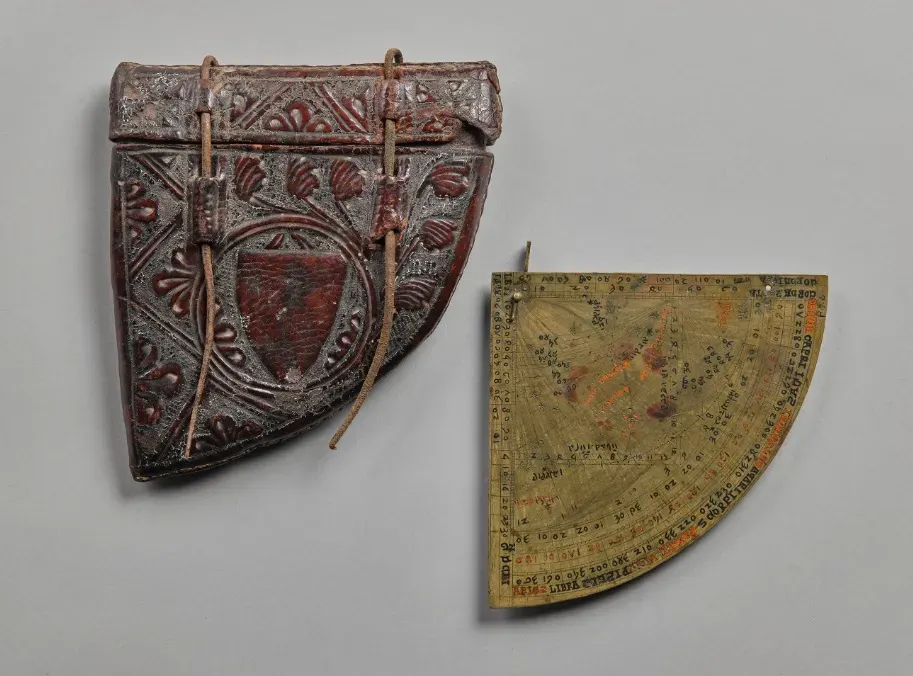
Quadrant and Case. Southern France (?). ca. 1291 to ca. 1310. Brass, leather case. 15 x 14 cm. Louvre Abu Dhabi © Department of Culture and Tourism – Abu Dhabi. Photo by Ismail Noor. LAD 2019.036
Long before they became forms of entertainment, board games fostered strategy, learning, and human connection.
Francis Cotes’s double portrait depicts the Welby couple engaged in a game of chess, with the board occupying the compositional centre. Quite symbolic, only the two kings remain on the board: the game ends in a draw, where neither the husband nor the wife can win.
The painting is among the earliest representations of chess in the history of English portraiture. By choosing this subject, the Welbys signal their stylishness — chess was enjoying considerable popularity among European elites at this period — whilst the contrast between William’s animated posture and Penelope’s composure suggests a relationship characterised by intellectual equality.‘Portrait of William and Penelope Welby Playing Chess.’ Francis Cotes. 1769. United Kingdom. Oil on Canvas. 135 x 152 cm (unframed). Credits: Louvre Abu Dhabi © Department of Culture and Tourism - Abu Dhabi. Photo by APF. LAD 2013.007
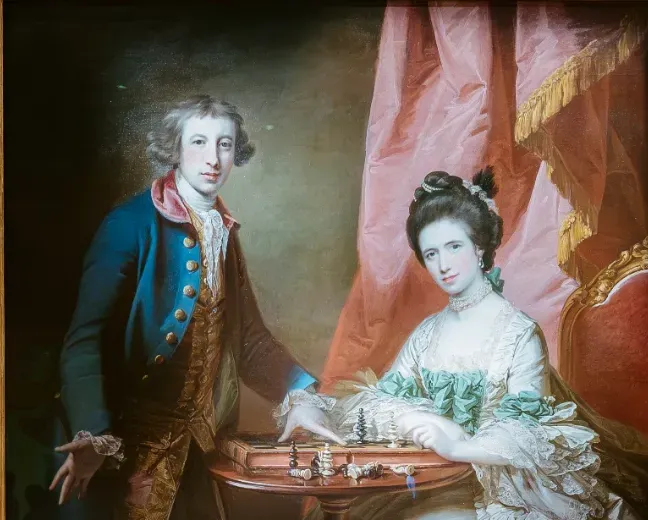
‘Portrait of William and Penelope Welby Playing Chess.’ Francis Cotes. 1769. United Kingdom. Oil on Canvas. 135 x 152 cm (unframed). Credits: Louvre Abu Dhabi © Department of Culture and Tourism - Abu Dhabi. Photo by APF. LAD 2013.007
Nearby, a katra board from Madagascar represents one of the many regional expressions of mancala, a game whose enduring appeal lies in strategy, calculation, and foresight. Though its rules and names vary across regions, its objective remains constant: to move seeds from pit to pit, gathering as many as possible.
Together, these works, featured in Louvre Abu Dhabi’s exhibition A Board Game Adventure, demonstrate how games have crossed cultures for centuries, carrying with them shared traditions of competition, learning, and exchange.
Discover more treasures from Louvre Abu Dhabi’s collection by visiting the museum’s website.
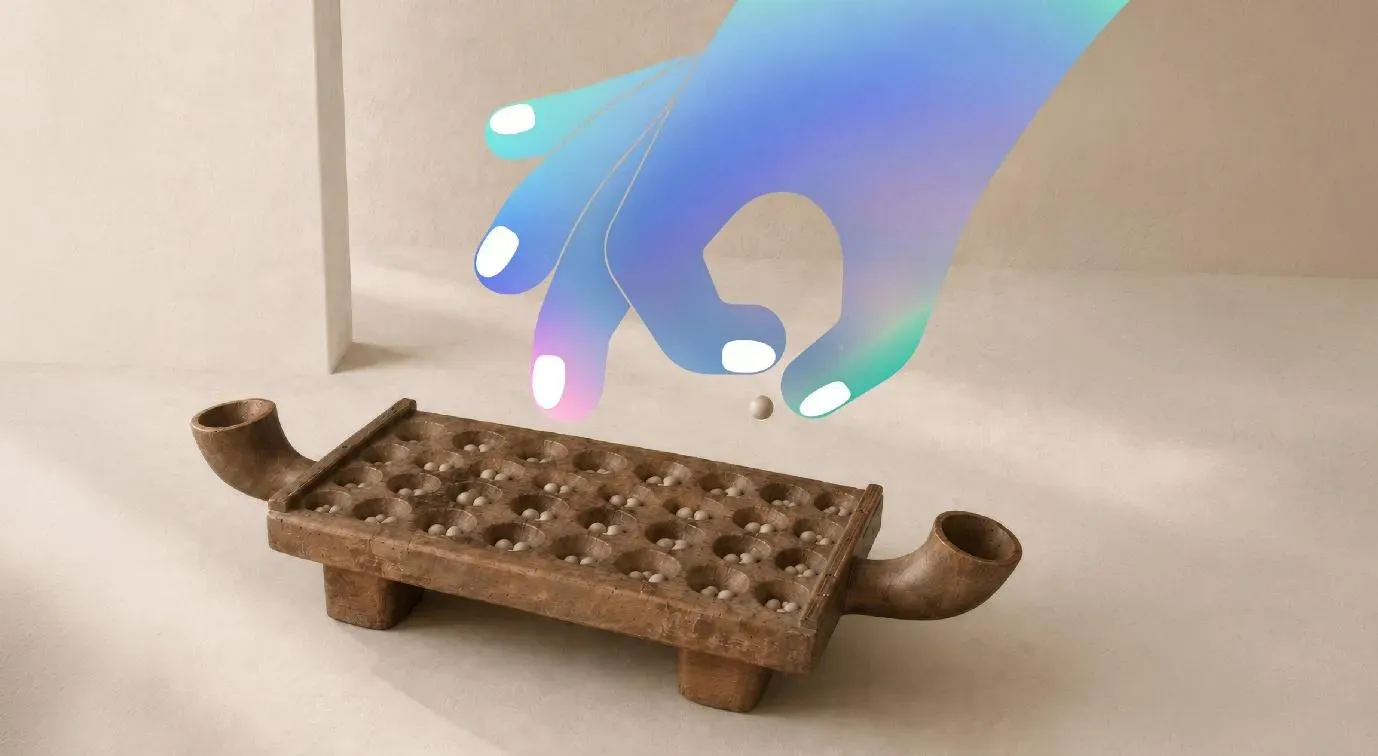
‘Katra Game.’ Madagascar. At least 100 years ago. Credits: Children Museum, Louvre Abu Dhabi © Department of Culture and Tourism – Abu Dhabi. Photo by Nino Consorte.