The Quest for Blue
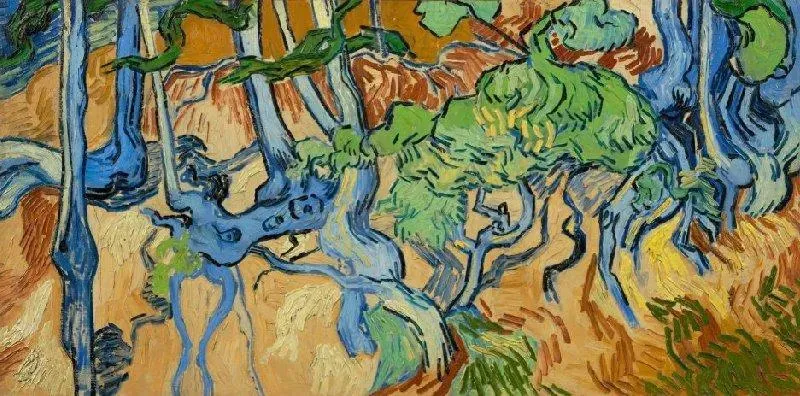
‘Untitled.' Hussain Al-Mohasen. 2014. Mixed media on paper. The vibrant colors of this work are its most important elements. For Al-Mohasen, they encapsulate the messages and emotions he wishes to convey. The letters stenciled form words that have no precise meaning. The meaning is individual to you, the viewer. Part of Ithra Museum’s art collection.
Rare in nature and difficult to extract from minerals, blue eluded artisans for centuries until Egyptians invented the world’s first synthetic pigment. Formulas for blues from cobalt and indigo followed, and the results have delighted our eyes and evoked the sacred, the royal, the opulent and the mysterious ever since. And the quest is not over.
It’s easy to think of blue as a naturally pervasive color. It’s all around us in clear skies and bodies of water. Yet elsewhere blue appears infrequently, coloring only a handful of minerals and less than 10 percent of flowering plants. Even the feathers of birds, from blue jays to bluebirds, are not truly blue but the result of a biologically sophisticated trick of the eye. The scarcity of blue in the natural world has, for much of history, made it hard to reproduce.
"Other colors were made from natural materials that you perhaps processed, but blue as a pigment didn’t already exist and had to be created," says Mark Pollard, professor of archeological science at University of Oxford .
The earliest humans could pick up chunks of red or yellow ochre or white chalk and use them almost like crayons, and black could be found at the end of every burnt stick. But the transformation of natural materials into the color blue, Pollard explains, required considerable effort and ingenuity.
The quest to unlock the secret of that transformation dates back millennia and spans cultures and civilizations, from Bronze Age Central Asia to early imperial China, from medieval Venice to the modern Maghrib (Islamic North Africa).
The breakthrough came more than 5,000 years ago along the banks of the Nile when early Egyptian chemists first brought the color of the sky down to earth.
Of all the colors on a painter’s palette, the most elusive have been blues.
"The fields are caused to grow, the fields are made blue, everything alongside the earth is caused to come into being," reads a hieroglyphic inscription from the third-century-BCE temple of Horus at Edfu, referring to how the annual floodwaters of the Nile nourished the fields. A source of inspiration and worship, blue was also the color of the cosmos, fertility, sustenance and rebirth, according to Lorelei Corcoran, professor of Egyptian art and archeology at the University of Memphis and a translator of the Edfu text. Additionally, the shimmering interplay of sun and sky embodied the spark of life itself, Corcoran explains.
"Blue isn’t immediately a color one would associate with the sun. We usually think of yellow or red," she says. "But if you look at the headdress that the ancient Egyptian kings wore, at the mask of Tutankhamun for example, you see it’s made out of blue and gold stripes, and it’s been suggested that it represents the rays of the sun breaking through the heavens."
This is an excerpt from a special dispatch from AramcoWorld, to read the full article, please check here.
Tom Verde, a senior contributor to AramcoWorld.
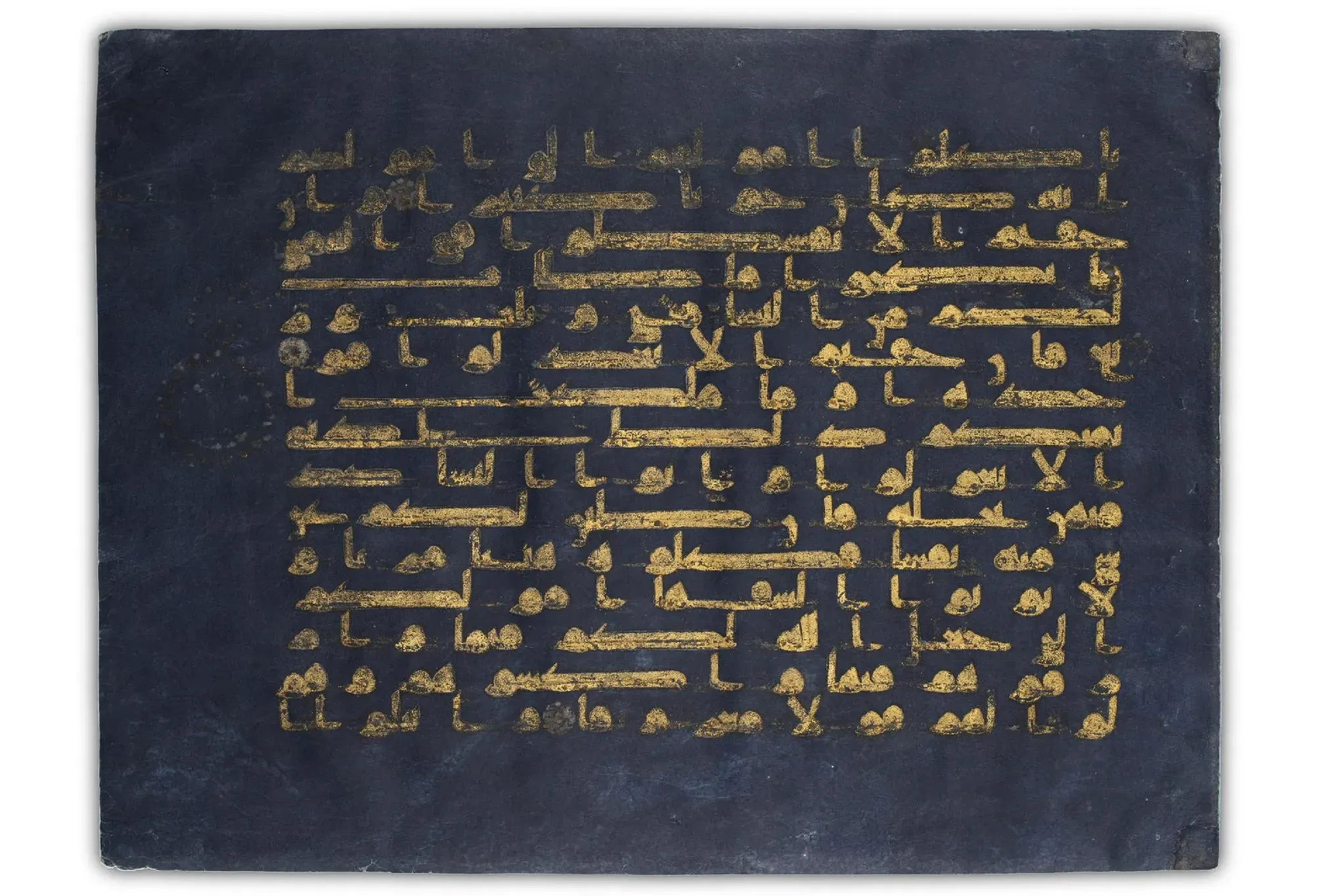
Page from a Manuscript of the Holy Qur’an: Surat an-Nisa (4): 2–8. Tunisia, probably Qayrawan, late ninth – early 10th century. Gold leaf, silver, and ink on parchment colored with indigo. Height: 28cm, width: 36cm. According to the waqfiyya (endowment deed) of the Qayrawan Mosque in Tunisia, the volume from which this page comes – the Blue Qur’an – was donated to the mosque sometime in the 13th century. Part of Ithra Museum’s art collection.