The Trace of the Unseen
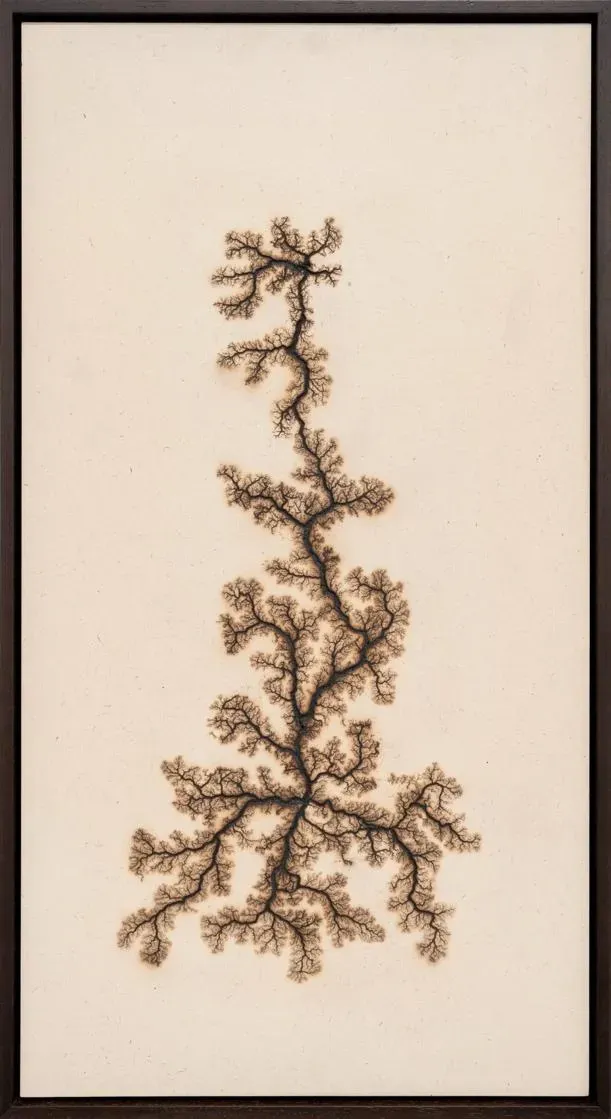
‘Lichtenberg Drawing 14.’ Douglas White. 2026. 10,000 Volts on Board. 34 x 28 cm. Courtesy of Leila Heller Gallery and Doulgas White.
Things don’t begin where we first see them. What appears on the surface is often shaped by something hidden, a memory, a passing place, accumulated experiences, or a cultural inheritance that changes each time we return to it.
In artistic practice, these sources remain the spark behind creation. They appear in countless forms, inviting new readings and interpretations, and giving rise to dozens of questions. Here, we journey into the worlds of three artists, each with their own way of reading the world, their sources of inspiration, and the traces that point back to their roots.
Douglas White is a British sculptor known for transforming discarded and overlooked materials into evocative, often monumental works. His practice explores transformation, revealing unexpected forms and structures within the remnants of the everyday.
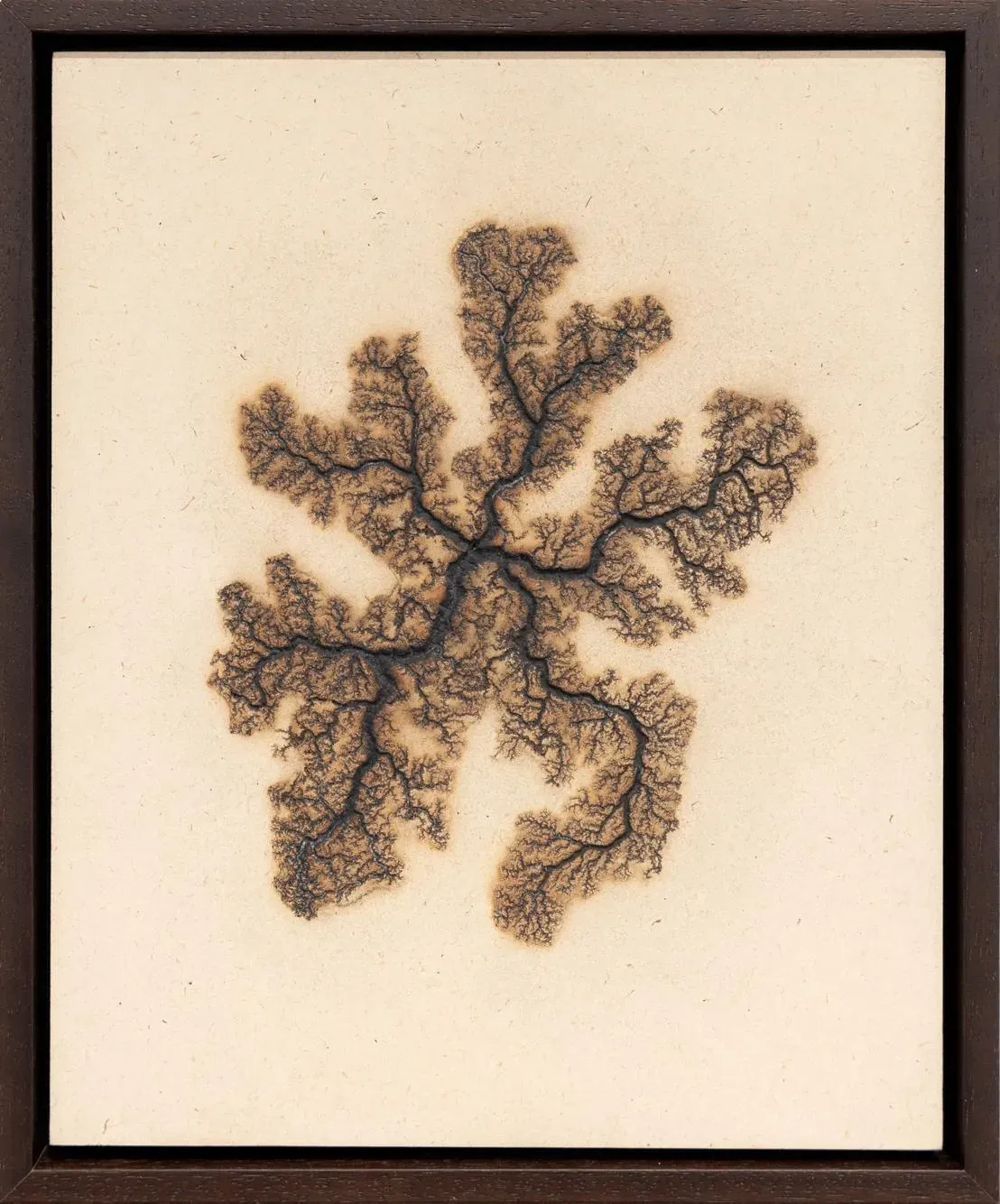
‘Lichtenberg Drawing 14.’ Douglas White. 2026. 10,000 Volts on Board. 34 x 28 cm. Courtesy of Leila Heller Gallery and Doulgas White.
Art is how I navigate the world. My sculptures have never followed a predetermined plan but have evolved through a chain of discoveries, with one investigation leading naturally to the next. A sculptural intervention exposing tree roots led me to think about arborescence and branching systems, which in turn led to lightning strikes and electrical discharge, eventually becoming the Lichtenberg Drawings. Each work opens the door to another.
The world, and our place within it, is impossibly complex and endlessly fascinating. Faced with that complexity, the question for me is always where to direct my attention. Every material carries the history of its formation, the forces that have acted upon it and, eventually, its destruction, just as we do.
I'm interested in those moments when the material world seems to speak directly to our inner lives.
Certain forms, materials and processes—the branching roots of a tree, the dried husk of a cactus, the torn steel filaments of a blown-out tyre—carry a strange psychological resonance. They seem to carry a familiarity that precedes explanation. I'm less interested in explaining those correspondences than in creating the conditions in which they can be encountered. Sculpture, for me, is a way of inviting us to attend differently to the material world.
I'm drawn to moments of transformation, when a material becomes something other than what it was before. Many of the works begin with an unexpected correspondence, usually prompted by a material that has undergone some kind of violent change. I've always been fascinated by the way destructive forces can reveal an unexpected delicacy.
I'm interested in that uncanny moment when a material is both recognizably itself and something entirely new. Blown-out truck tyres are a good example. During the blowout, the rubber tears apart and the fine steel filaments are exposed, transforming what was once a heavy, inert object into something that appears almost organic and alive. Those unexpected correspondences create a kind of psychological recognition that is difficult to explain but immediately felt.
Ultimately, my work is about the movement of energy. One form becomes another. Violence becomes delicacy. Destruction becomes creation. Matter is not erased or replaced, but continually transformed.
The Great Wave (after Hokusai) holds a special place for me. It marked a new way of working with a material that has occupied me for many years, allowing me to explore movement, accumulated force, suspension and transformation. The wave is caught at the instant before it breaks, holding an enormous amount of energy in a temporary state of balance. Hokusai's wave felt like the perfect image through which to explore a sense of turbulence in the world, of something impending, hanging over us.
Earlier this year, having collected the raw materials from around the world, I shipped them to Dubai to construct the work in situ. At exactly that point, conflict broke out across the region and we continued building and installing the work throughout that period of uncertainty. It felt as though the work, the conditions under which it was being made and the wider world had briefly converged.
While it was an incredibly difficult time, looking back I feel those circumstances became inseparable from the work. They gave it an intensity that it still carries.
‘Lichtenberg Drawing 11.’ Douglas White. 2026. 10,000 Volts on Board. 27 x 49 cm. Courtesy of Leila Heller Gallery and Doulgas White.
The French chemist Antoine Lavoisier wrote: "Nothing is lost, nothing is created, everything is transformed."
This quotation has long been a touchstone for my practice. I'm fascinated by the way energy moves through the world, acting upon materials, pulling them apart and giving rise to new forms. What interests me is transformation as a physical reality rather than simply a metaphor.
I think every material bears the evidence of its own formation, its use and the forces that have acted upon it. My role is not to erase those histories or impose something entirely new, but to work with them, allowing unexpected possibilities to emerge from within the material itself.
Roots belong to what is buried. They are the systems, histories and forces that sustain us without necessarily being visible to us. My first thought is of Enraciné, a site-specific intervention I created in a forest in northern France. Using specialised excavating machinery, I removed a carpet-like section of topsoil while leaving the network of tree roots intact. What was normally concealed beneath the forest floor was suddenly exposed, revealing an extraordinarily intricate structure spreading between the trees.
I was interested in the strangeness of revealing something so fundamental to the landscape. The roots had always been present, supporting and connecting the visible life of the forest, but they existed beyond ordinary perception. Once uncovered, they appeared both anatomical and otherworldly, as though the forest had been turned inside out and its hidden nervous system exposed.
There are always several projects in development, often because of the scale and complexity of bringing them to fruition. The next major milestone is showing a large Black Palm at Frieze Sculpture in London. It feels particularly significant because London is my home, and it will be the first time I have presented work at this scale in the UK for many years.
Alongside that, I am working on my first major museum commission for a new museum in Saudi Arabia, the details of which remain under wraps for now.
More than anything, I hope these projects allow the work to reach new audiences and find new contexts. I'm interested in how sculptures change as they move between landscapes, architectures and cultures. Ultimately, I hope each project creates the conditions for the next one.
Ran Hwang is a Korean-born, New York-based artist known for creating intricate installations from everyday materials. Her work explores the cyclical nature of life, impermanence and the beauty of fleeting moments.
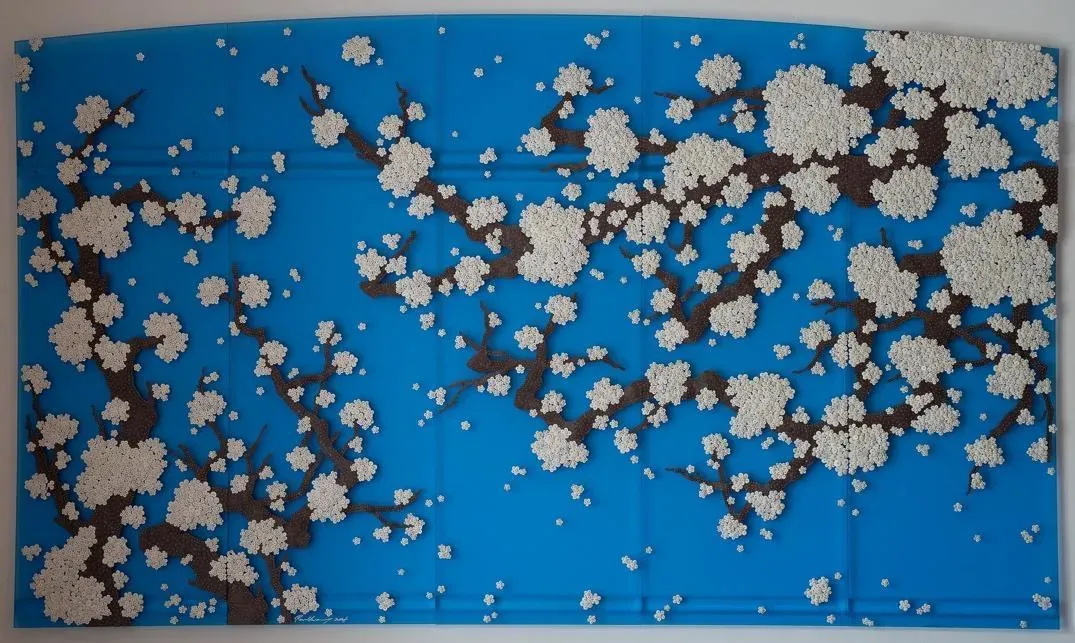
‘Becoming Again_BSA’. Ran Hwang. 2025. Mulberry paper buttons, beads, pins on Plexiglas.177 x 300 cm. Courtesy of Leila Heller Gallery and Ran Hwang.
For me, the repetitive labor of hammering tens of thousands of pins is a form of spiritual practice that goes beyond mere physical work. In the process of inserting each pin, one by one, I empty myself of human greed and distracting thoughts. Paradoxically, my mind becomes most serene when physical pain reaches its peak. I believe this discipline and tranquility infuse my work with spiritual energy.
This body of work is inspired by the coexistence of humanity and nature, as well as the philosophical balance between reality and illusion. For instance, Healing Oblivious Aqua_OS visualizes coral bleaching caused by environmental pollution in the form of plum blossoms, using recycled hanji (traditional Korean paper) to reflect on the cycle of life. Return to Nature uses a transparent medium to reveal the coexistence of the glamorous surface (reality) and the hidden shadow (illusion) behind it.
When people experience these works, I hope they look beyond their immediate visual beauty and reflect on our deep connection with nature, ultimately feeling a sense of profound healing and inner tranquility.
I am particularly attached to one of my recent works, Renascence (2025), which incorporates a discarded Jagaejang, a traditional Korean mother-of-pearl lacquerware chest. Korean Goryeo-era najeonchilgi, or mother-of-pearl lacquerware, is recognized worldwide for its outstanding artistry and technique, with examples now housed in museums around the world.
Carrying on this profound legacy, these chests became beloved symbols of wealth and essential household furnishings in Korea during the 1970s and ’80s. However, as homes became increasingly westernized with the rise of modern apartments and built-in closets, the chests were left behind by changing times and are now frequently abandoned on the streets.
This piece is very special to me because it fully embodies the value of "regeneration," by breathing new life through art into a jagaejang that was once an object of both cultural and personal value but has since been discarded.
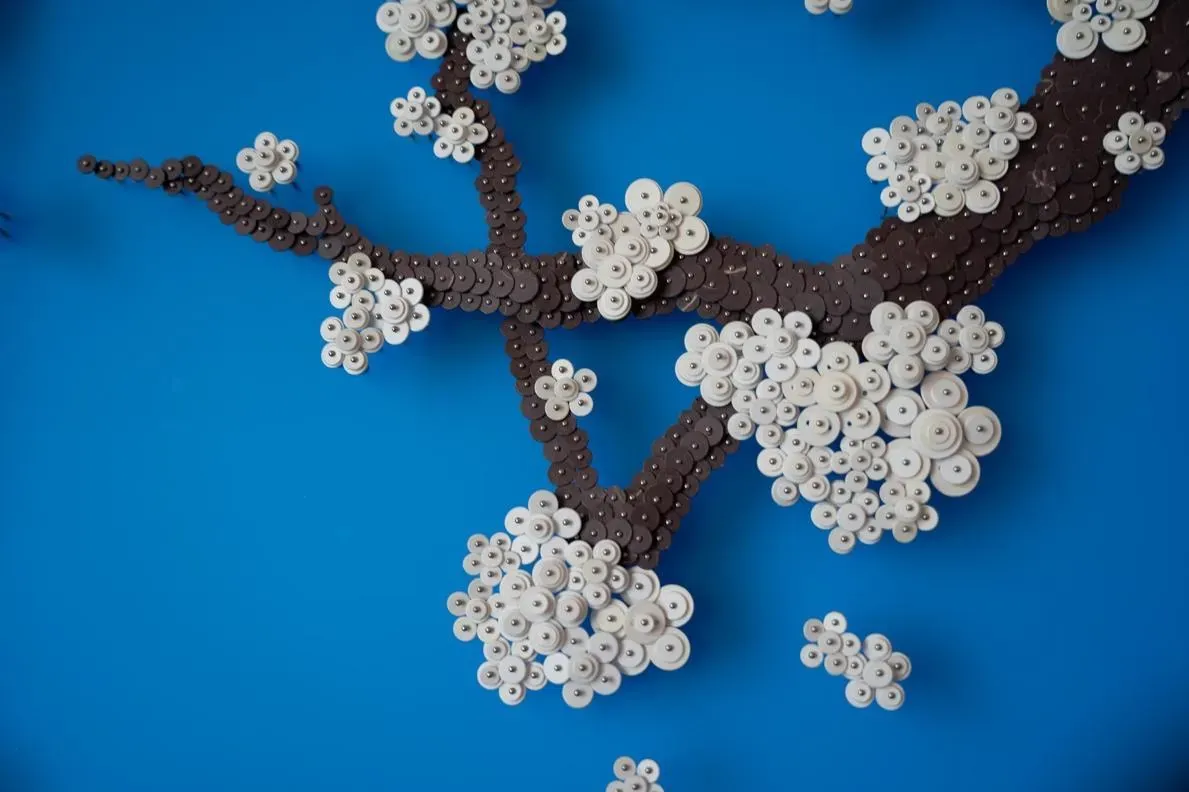
‘Becoming Again_BSA’. Ran Hwang. 2025. Mulberry paper buttons, beads, pins on Plexiglas.177 x 300 cm. Courtesy of Leila Heller Gallery and Ran Hwang.
The philosophy that guides my life and art is "Emptying and Filling." My motto is embodied in the very process of my work: hammering countless pins to empty myself of the pain and emptiness of life, then filling those vacant spaces with meditative energy, tranquility and solace.
To me, roots are the source of a life force that continuously gives rise to new growth. During my childhood, the image of my father— a master calligrapher —holding his brush, and the scent of ink that permeated our home, became deeply rooted in my emotional landscape. Just as a tree grows taller when its roots grow deeper, my respect for tradition and my own roots firmly support all my new artistic experiments.
I am currently preparing a comprehensive monograph commemorating my 30-year artistic career. I am also continuing to work on projects that combine digital technology with various materials, allowing the audience and the artwork to become one seamlessly integrated whole. I plan to continue creating large-scale installations in which the entire space breathes as a single story.
Ultimately, I sincerely hope my work connects deeply with the lives of those who encounter it, offering a fleeting moment in which forgotten memories resurface and they experience sublime emotions that cannot be expressed in words.
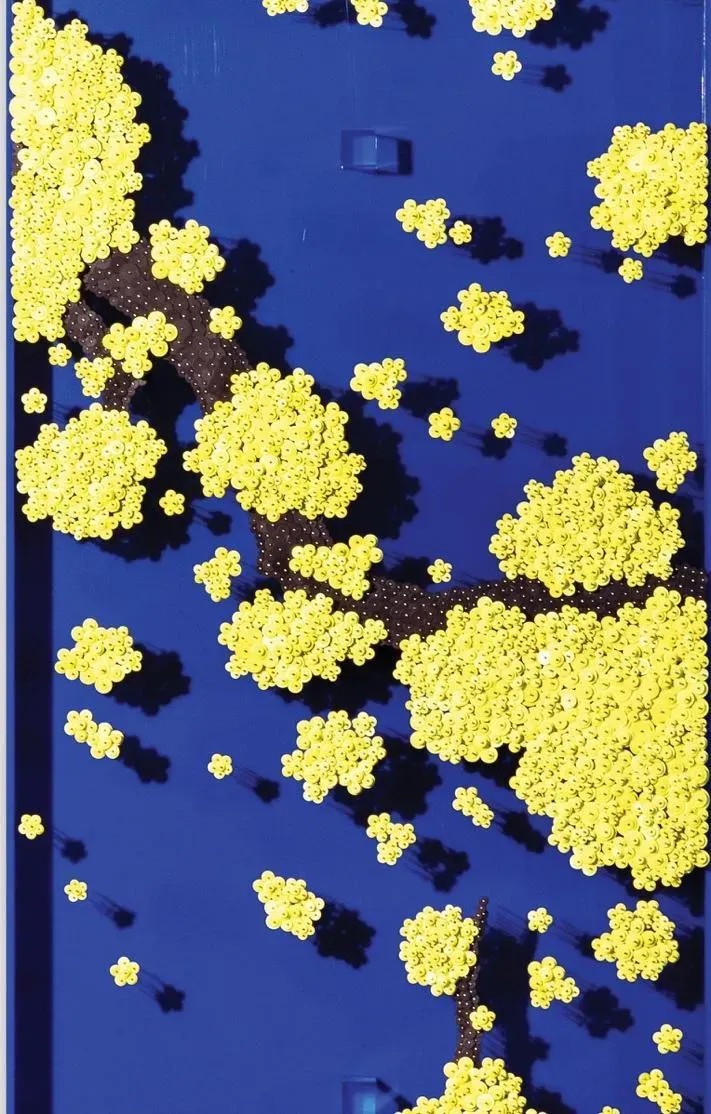
‘Becoming Again_BY3.’ Ran Hwang. 2021.Paper buttons, beads, crystals, pins on Plexiglas and Plexiglas frame. 242 x 63 x 12 cm. Courtesy of Leila Heller Gallery and Ran Hwang.
Azza Alqubaisi is an Emirati multidisciplinary artist and designer known for exploring identity, heritage and place through materials ranging from metals to palm fronds. Her practice spans jewelry, sculpture and public art, drawing deeply on the landscapes and traditions of the UAE.
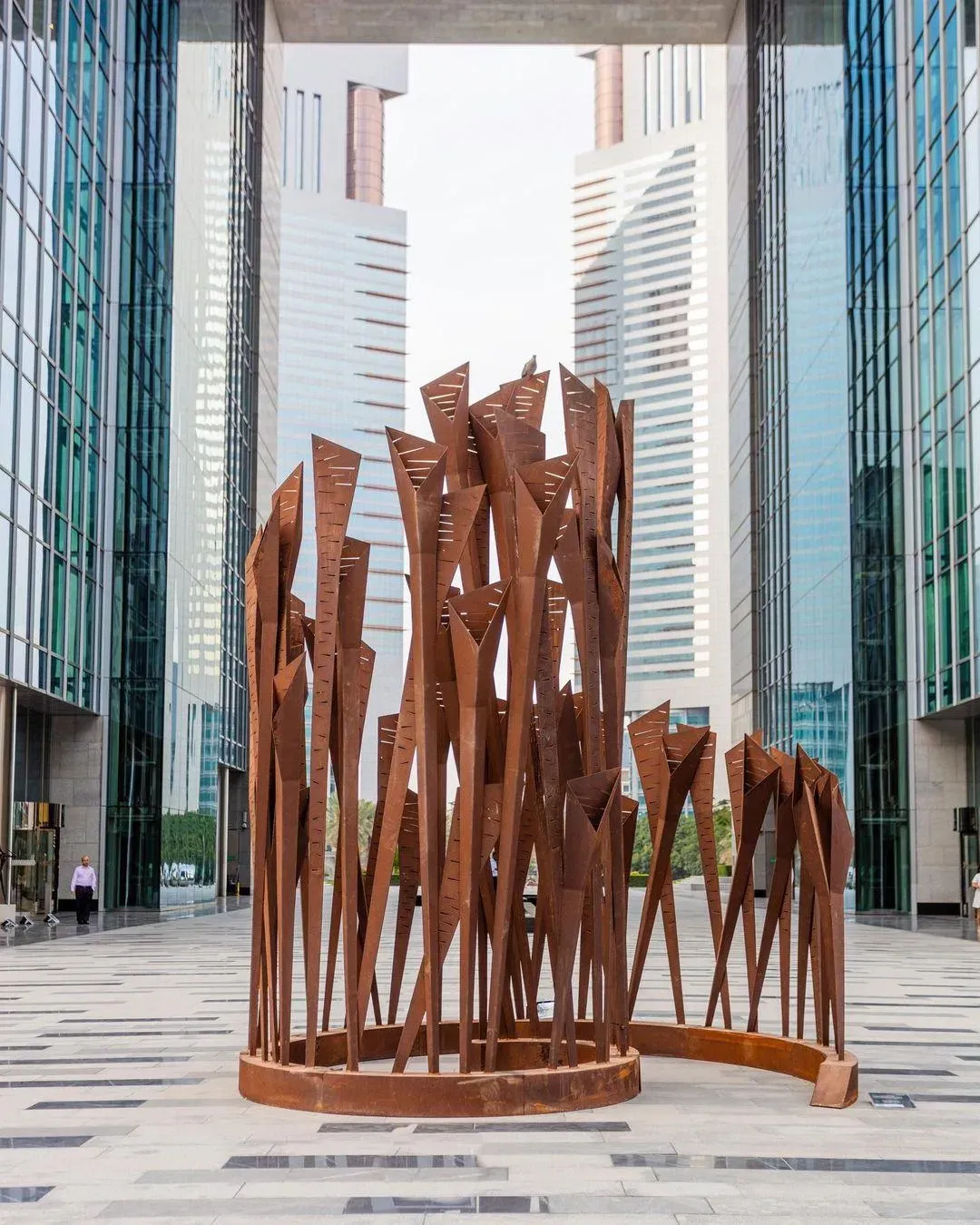
‘AlphabetofLife.’ Azza Alqubaisi. 2018. Mild steel. 300 x 300 x 600 cm. Courtesy of Leila Heller Gallery and Azza Alqubaisi.
Art is how I understand and respond to the world around me. It allows me to transform memory, nature, and lived experience into material form, creating works that connect people to place, identity and time. For me, every artwork is an opportunity to begin a conversation rather than provide an answer.
This body of work is inspired by the natural environment of the UAE and the systems that quietly sustain it. I am fascinated by the patterns, structures and rhythms found in nature and by how they hold stories of resilience, continuity and belonging. Rather than directing the viewer toward a single interpretation, I hope the work invites curiosity and reflection, allowing each person to discover their own connection with it over time.
It is difficult to choose one piece because each represents a different stage of my journey. If I had to choose, it would be Roots, one of my latest public sculptures in Dubai. It brings together ideas I have been exploring for years—our relationship with nature, cultural memory, movement and the dialogue between people and place. Seeing the work become part of everyday public life has made it especially meaningful to me.
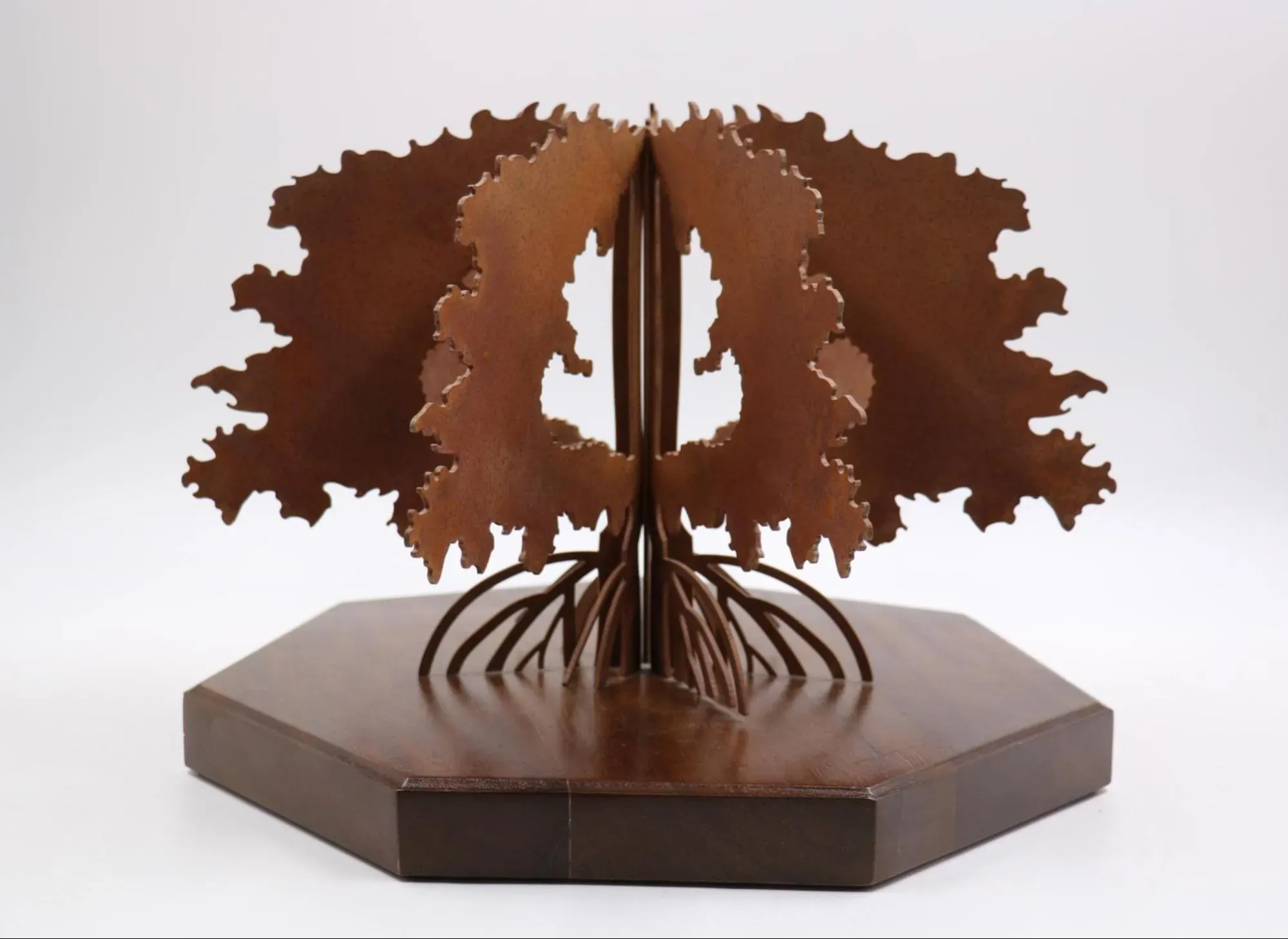
‘Ghaff and Mangrove.’ Azza Alqubaisi. Mild steel and wood. Courtesy of Leila Heller Gallery and Azza Alqubaisi.
The words of the late Sheikh Zayed have always stayed with me: "He who has no past has no present or future." It is a principle that guides both my life and my practice, reminding me that meaningful innovation begins with understanding where we come from and carrying those values forward with honesty and purpose.
The word "roots" immediately brings to mind belonging, continuity and the unseen connections that shape our identity. It is a title I have returned to more than once because it reflects an ongoing thread in my practice.
My public sculpture Roots in Dubai explores the visual language of the date palm and our relationship with place, while another body of work under the same title draws inspiration from the mangrove ecosystem and its remarkable resilience. Although they are different works, they share the same belief: Our strongest foundations are often the ones we cannot immediately see—our connection to nature, culture, memory and one another.
I am continuing to expand my public art practice, exploring larger sculptural works that encourage interaction and invite people to experience art as part of their everyday environment. My current research continues to focus on nature, material innovation, and environmental awareness, while exploring how sculpture can strengthen our connection to place and create meaningful shared experiences.
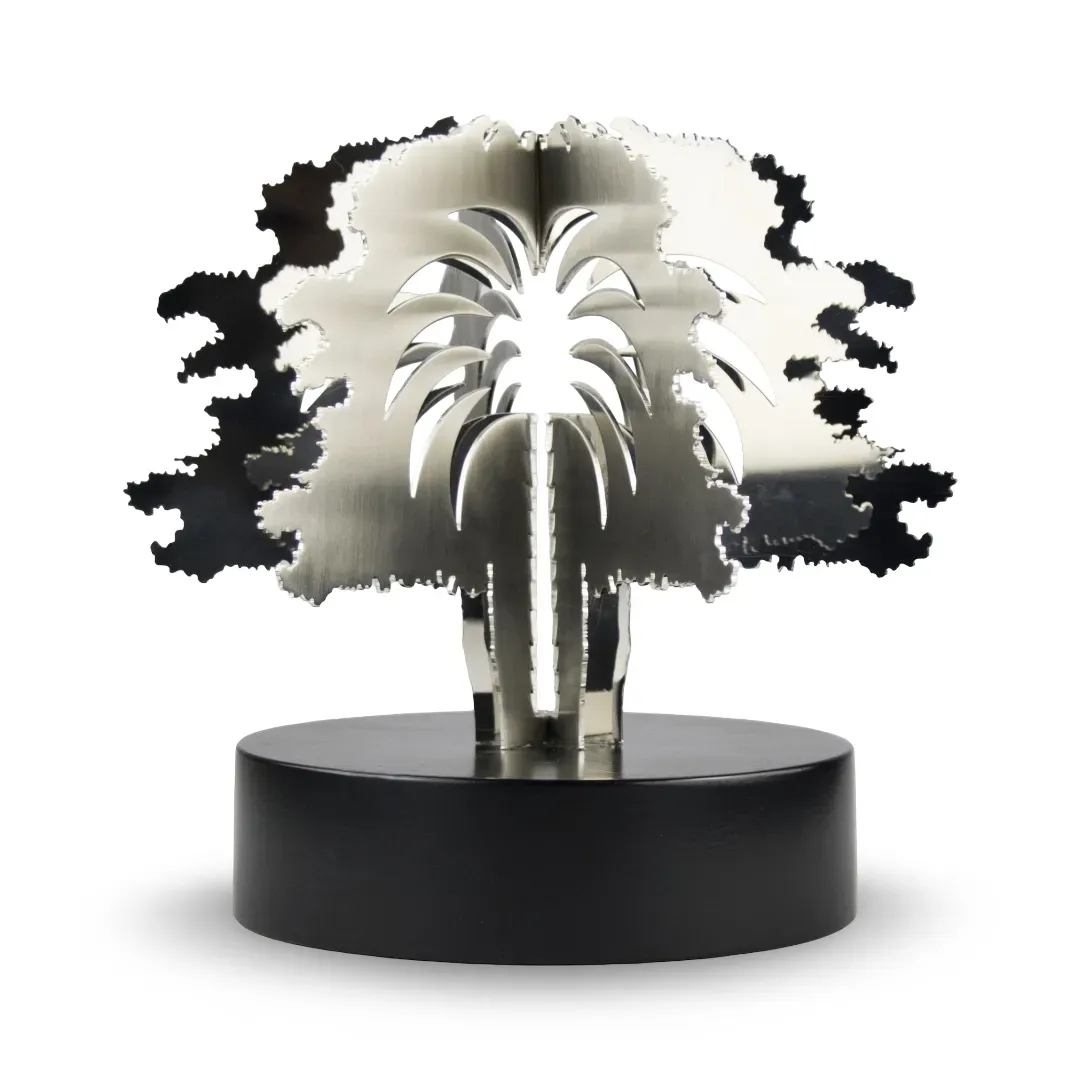
‘Seeking identity.’ Azza Alqubaisi. 2023. 22 x 22 x23 cm. Courtesy of Leila Heller Gallery and Azza Alqubaisi.
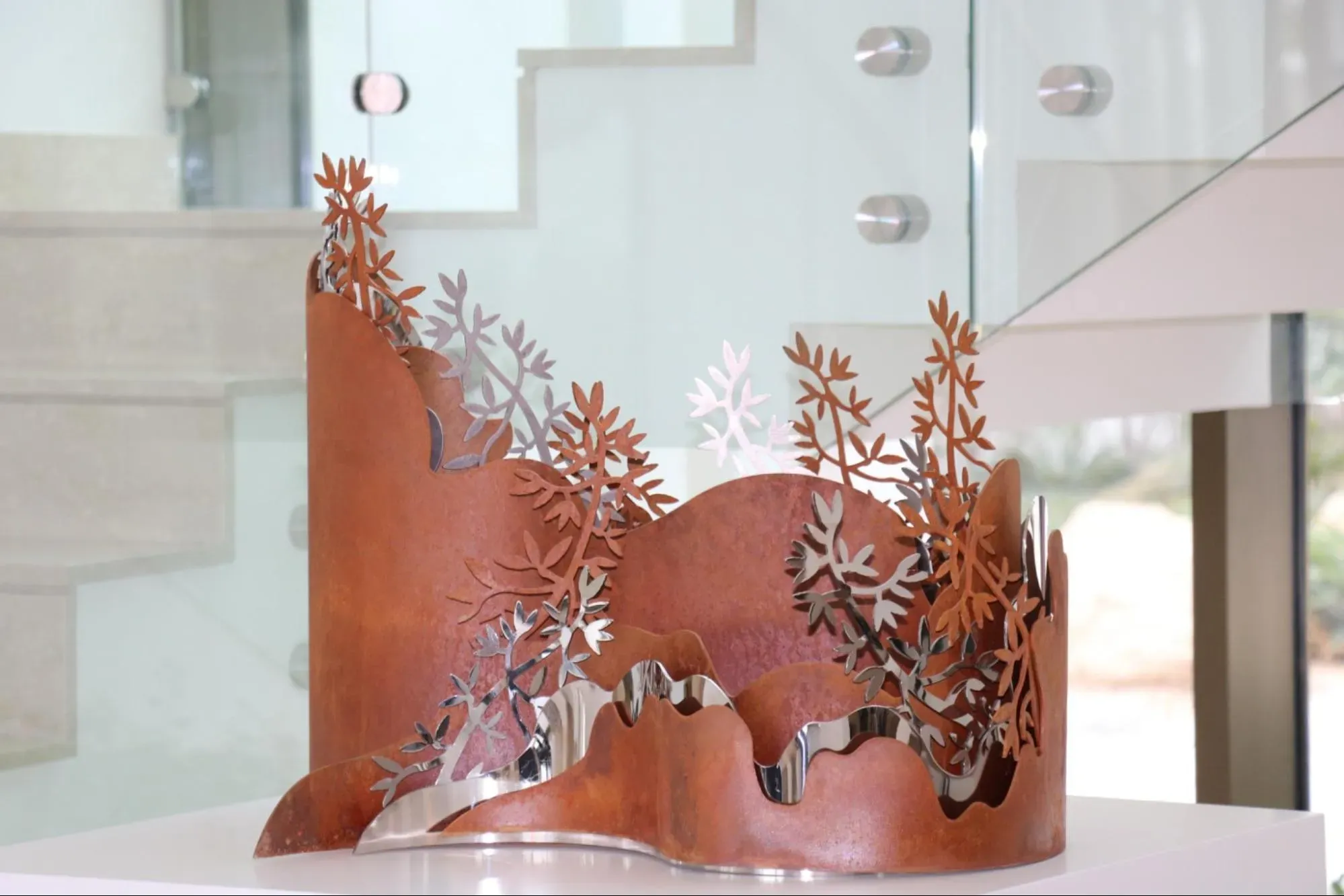
‘Root 04.’ Azza Alqubaisi. 2023. Stainless steel and mild steel. 70 x 70 x 50 cm. Courtesy of Leila Heller Gallery and Azza Alqubaisi.
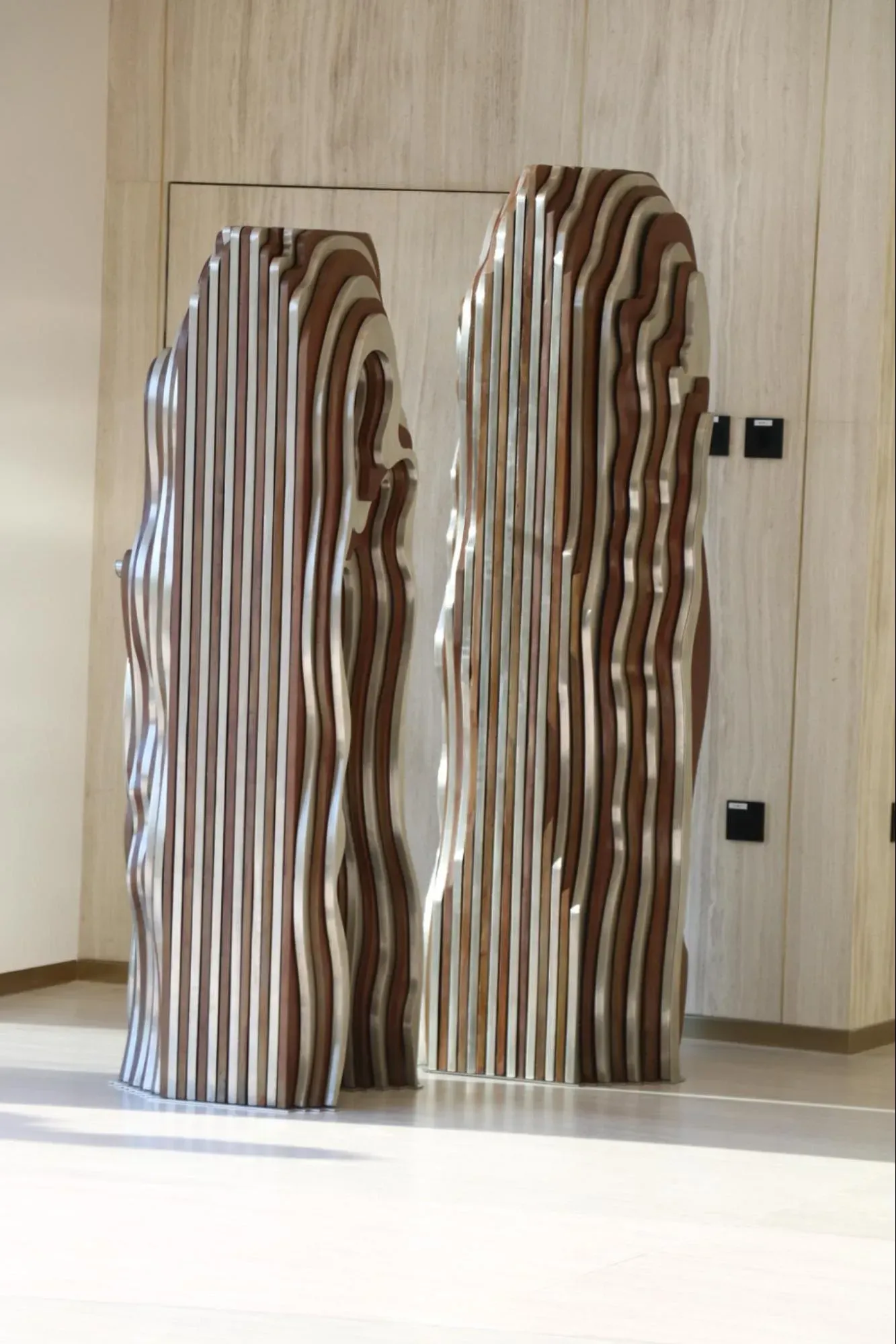
‘Metaphor.’ Azza Alqubaisi. 2024. Stainless steel and mild steel. 50 x 50 x 185 cm and 50 x 50 x 170 cm. Courtesy of Leila Heller Gallery and Azza Alqubaisi.
What connects these artists is a sensitivity to what endures: the history held by a material, a childhood memory that continues to inspire, a landscape whose patterns become a visual language. Their roots appear differently, yet each artist allows them to grow into something distinctly their own. And somewhere between what is inherited and what is made, another source begins.
To view more wonderful artworks, you can visit: Leila Heller Gallery.