What Roots Preserve: Oral Heritage as a Living Memory
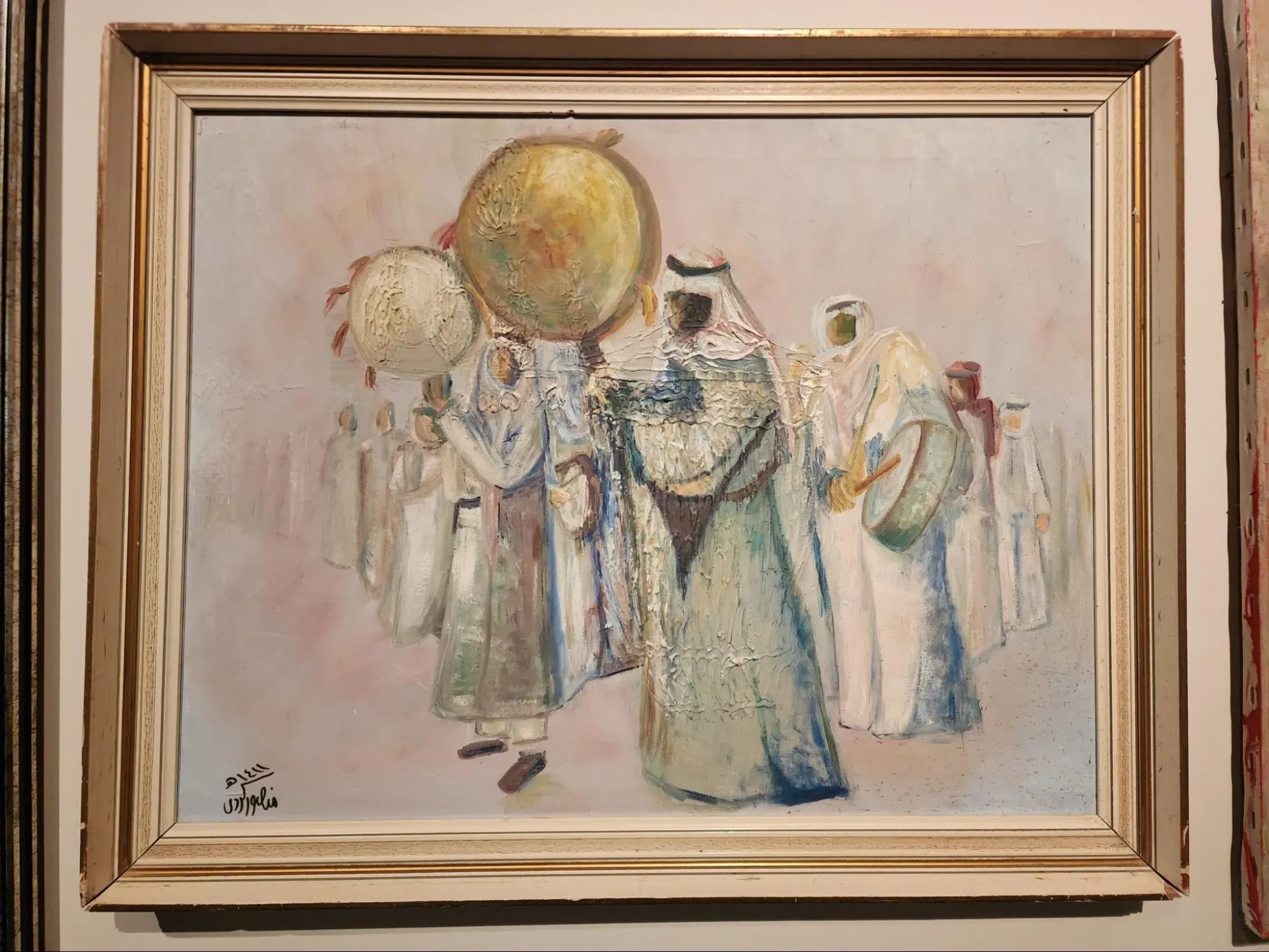
‘The Traditional Folk Dance Al-Khubayti.’ Fouad Mougharbel. 1987. Oil on canvas. 90 x 70 cm. Courtesy of Mohammad Abdullah Alalyani private collection. Photo by: Ahmad Al Thani. From the exhibition Bedayat: Beginnings of Saudi Art Movement.
This interview began with a simple question from a musician friend: Why does folk music disappear when the environments and cultures that gave rise to it disappear? But the question led me somewhere broader. If folk music is part of oral heritage, what happens to the memory of society when the environments that gave this heritage its language, rhythm and meaning begin to change? And how do we preserve this heritage, as one of the roots of our cultural identity, without turning it into a static relic or reducing it to nostalgia for the past?
In this interview, I speak with Dr. Samir Al-Dhamer, one of the foremost researchers of Saudi culture and oral heritage, about the place of oral heritage in the Arabian Peninsula, its relationship with folk music, its role in preserving memory and identity, and why safeguarding it remains a cultural necessity today rather than simply an exercise in recovering the past.
Q1: Oral heritage is classified as "intangible cultural heritage." But is it truly intangible? Or is it embodied in place, body, relationships, and daily practice?
The classification of oral heritage as "intangible cultural heritage" is an academic and organizational one, intended to distinguish it from buildings, artifacts and other physical objects. But my many years of documenting cultural heritage and folk arts has led me to see oral heritage as something that is not entirely intangible. It is a living heritage, embodied in people, places and practices.
Through my interviews with storytellers and elders, I came to understand that oral heritage cannot be separated from place or the body. Place is no silent backdrop to a story; it is part of its memory. The body, too, is its first archive, preserving the manner of performance, the tone of a call, the movements of craftspeople and the rhythm of work. A storyteller may forget some of the words, but the body remembers the movements. A craftsman may struggle to explain a skill, while their hands perform it with remarkable precision.
So, when we describe oral heritage as "intangible," this does not mean that it is detached from the physical world. Rather, its essential value lies in knowledge, skill and meanings. This heritage cannot survive without a body to carry it, a place to hold it, a community to practice it, and human relationships through which it can be passed on.
It may be classified as intangible heritage, but it is deeply embodied in life. Perhaps a more precise way of putting it is this: Oral heritage is an intangible memory that cannot survive without tangible vessels.
Q2: Why does oral heritage hold such particular importance in the culture of the Arabian Peninsula, not only as a subject of study, but as a system of knowledge and a way of understanding the world? What factors, in your view, helped establish this significance?
Oral heritage holds special importance in the culture of the Arabian Peninsula because it was never simply a means of preserving the past. It was a complete system for producing, transmitting and interpreting knowledge. Through stories, proverbs, poetry, and counsel, people passed on knowledge of nature, routes, seasons, ways of life, and social values and norms from one generation to the next. These forms were not merely entertainment or displays of eloquence; they preserved knowledge, shaped behavior, and carried the accumulated experience of generations. When we study oral heritage, we do not ask only, "What happened?" We also ask, "How did people understand what happened? And how did they reshape it through their stories, proverbs and poetry?".
Historical, social and environmental factors all helped establish the status of oral heritage in the Arabian Peninsula. Before the spread of writing and printing, oral transmission was the primary means of preserving and sharing knowledge. It was supported by a culture that valued memorization and storytelling, as well as by social institutions such as gatherings (the majalis), which provided spaces for learning and exchanging experience. Life in the Arabian Peninsula also demanded precise knowledge of place, seasons and resources, making the oral transmission of such knowledge across generations essential. In this way, oral heritage became an integral part of society’s knowledge system rather than simply a means of preserving the past.
Oral heritage in the Arabian Peninsula, then, is not something we return to out of nostalgia. It is a complete system of knowledge, and the traditional storyteller was one of its most important custodians. When a storyteller passes away without their knowledge being documented, part of the community’s memory disappears with them.
Q3: Some believe that folk tales and songs are no longer relevant to contemporary life because they emerged from very different circumstances. How do you respond to that view?
I think this view comes from seeing folk tales and songs as products of a bygone era rather than expressions of enduring human questions. It is true that the circumstances in which many of these tales and songs emerged have changed, and that some of the professions, occasions, and environments that once sustained them no longer exist in the same form. But the emotions and experiences they expressed remain very much a part of our lives: love, fear, loss, longing, injustice, hope, courage, and the search for security and belonging.
A folk tale does not lose its value simply because circumstances change. Its purpose is not to describe the tools of the past, but to reveal people confronting life. Its forms may change, but the questions it explores remain.
The same is true of folk songs. I know many young people who feel a deep connection to folk music despite never having experienced the environments or circumstances from which it emerged. This shows that engaging with heritage does not require us to have lived in the era that produced it. It is enough to find something within it that speaks to us or reconnects us with roots we feel are our own. Young people do not reject heritage itself; they turn away from the rigid ways in which it is sometimes presented to them.
When heritage is presented merely as something to be memorized, young people distance themselves from it. When they encounter it through film, games, or digital content, they discover that it can speak to their questions, too.
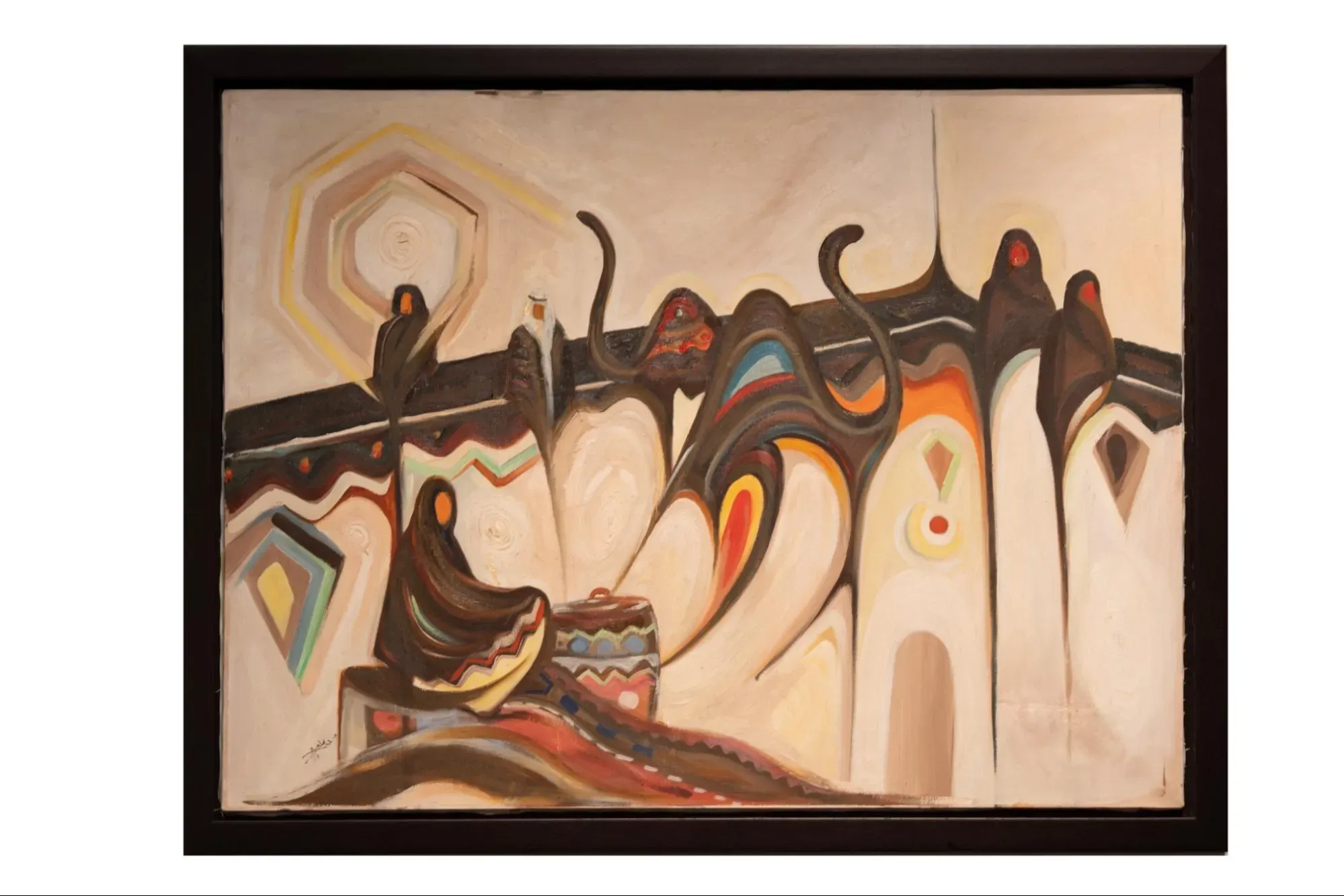
‘From the Desert.’ Abdullah Nawawi. 1987. Oil on canvas. 90 x 123 cm. Credit: Collection of the Museums Commission, Ministry of Culture. Photo by: Ahmad Al Thani. Exhibit Bedayat: Beginnings of Saudi Art Movement.
Song | Glory be to Him Who Brings Forth Water and Causes the Greenery to Grow (سبحان من أنبع الماء وأنبت الأخضر) | Artist: Taher Al-Ahsa’i | Session Recording.
To discover some of the folk musicians who remain popular among younger generations, listen to a recording of “Glory Be to Him Who Brings Forth Water and Causes the Greenery to Grow” by Taher Al-Ahsa’i, from Dr. Samir Al-Dhamer’s archive on YouTube.
Q4: How do you see the relationship between folk music and oral heritage? Can folk songs be considered one of the most prominent vessels of cultural memory, alongside tales, proverbs and poetry?
I see the relationship between folk music and oral heritage as organic and inseparable. Folk music is more than melody accompanying words; it is one of the ways a community preserves its memory and expresses its experience. If a tale preserves events and characters, a proverb distills experience and poetry gives form to emotion, the folk song brings together words, voice, rhythm, and performance in a single vessel. Through it, we can hear how the heart of a community once beat.
This is especially evident in songs associated with the sea, agriculture and weddings. They preserve more than words; they carry the rhythm of work, social relationships and collective feeling. We see this particularly clearly in maritime folk arts, which I will return to as an example.
A folk song, therefore, cannot be fully preserved through its lyrics alone. Its sound, performance, and context must also be documented, alongside the accounts of the performers and audiences who experienced it. Only then can we preserve its ability to be transmitted, renewed and reinterpreted by new generations.
‘Untitled.’ Abdullah Hammas. 1953. Oil on canvas. 56 x 76 cm. Courtesy of the artist. Photo by: Ahmad Al Thani. Exhibit Bedayat: Beginnings of Saudi Art Movement.
Q5: Could you share an example of a folk song that embodies the ideas we have discussed in this interview? What makes it particularly significant?
We can look at the maritime folk arts of Al-Uqair coast and the Arabian Gulf, particularly the Hasawi tradition. It is a significant example because it is a composite art form in which many elements come together: poetry, melody, rhythm and bodily performance, as well as traditional objects used as instruments, such as the Jahla (traditional water jar) and the Hawen (mortar).
Sailors also produced rhythm with their bodies through collective singing, clapping, and rhythmically striking their hands on the deck of the vessel, swaying, spinning, "zafin" dancing, and "nash". In nash, the performer rises into the air and comes back down in time with the final "dum" beat of the rhythm. The body itself becomes a rhythmic instrument, and the performance becomes an expression of the group's cohesion and harmony. When we listen to these traditions, we hear more than a sea song; we encounter the entire world of the sailors.
This tradition also offers an important example of the intermingling of cultural environments across the Arabian Gulf. Melodies, rhythms and poems traveled with sailors between ports and coastlines, yet in al-Hasa they acquired a distinctly local mode of performance and their own cultural memory. This shows us that heritage is neither fixed or closed. It is alive: it travels, interacts, and is continually reshaped within each environment.
The folk song thus becomes a vessel of cultural memory; it preserves the lyrics, the rhythm of work, the movement of the body and the relationship between people and place.
Q6: Is there any idea, experience, project or message you would like to share with the readers that we have not touched on in this interview?
The message I would like to leave readers with is that documenting oral heritage should not stop at collecting texts, transcribing them and publishing them in books. We need a more complete form of documentation, one that preserves people performing their heritage within its natural setting: their voices, movements, tools, expressions and relationship with place and the community around them.
Caring for oral heritage is not the responsibility of researchers and institutions alone. It is a responsibility shared by families and communities. In every home there is a storyteller; in every family, a story; in every village or neighborhood, a song or memory worth preserving. Every day we postpone speaking with elders and documenting their experiences, we lose pages for which no other copy exists.
Preserving heritage does not always begin with a major project. It can begin with a sincere question asked of a mother or grandmother, with recording a song remembered by an elderly sailor, or with documenting a movement performed by a folk artist. From these small acts, we can build a living national memory, one that preserves the past while giving new generations roots to draw on as they help build the future.
I began this conversation wondering what happens to folk music when the world that gave it meaning begins to disappear. I leave it thinking that perhaps disappearance is not inevitable. Memory can survive change when we continue to ask, listen and record — not to keep heritage untouched, but to keep it in conversation with the lives that come after it. Perhaps preserving our roots begins as simply as that: listening before a voice falls silent.
Tara Al Dughaither is an artist, researcher, and art curator.