Astrolabes - Precious Tools of Time & Travel
Planispheric Astrolabe Spain (Historic Al-Andalus), probably Toledo, 1300s. Bronze, engraved and inlaid with silver. Diameter 13.5 cm AKM611. Courtesy of the Aga Khan Museum.
Long before mechanical clocks and watches defined our days and lives, masterful engineers and astronomers in the Muslim world built sophisticated astrolabes that brought time and space together into a single intricate gadget.
Astrolabes, like this sophisticated example which is attributed to 14th-century Toledo in Southern Spain and once owned by one Mas’oud, would once have been indispensable travel companions as well as crucial everyday calculating devices. On the road, travelers could use it to determine the time and length of day, when to pray, the direction (qibla) towards Makkah, and the distance remaining to their destination. All in all, astrolabes were among the most important and versatile instruments used by Muslim scientists.
First invented by the Greeks around the 3rd century BCE, they were perfected in the medieval Islamic world and were said to have over a thousand different uses, including measuring the position of celestial bodies in the sky, casting horoscopes, and surveying the land. Astrolabes could also calculate the moon’s angle above the horizon and the lunar mansions (i.e. the position of the moon within a sign of the zodiac on a particular night).
The word “astrolabe” (and the Arabic word asturlab) are derived from the Greek term astrolabon for “star taker.” The instrument has been called many names, some of them quite poetic; the polymath medieval scholar Al-Biruni called it “mirror of the stars” and “taker of the stars.”
An astrolabe is made up of four main pieces: the base plate (mater); the web-like plate (rete), which shows the fixed stars, the zodiac constellations, part of the sky across which the sun travels, and certain naked-eye stars; plates made for different latitudes; and the rule (alidade) at the back, used for making observations and reading off of scales.
This medieval Spanish astrolabe is particularly fascinating for another, unique reason: it has inscriptions in Latin, Hebrew and Arabic and comes from a time when Christian, Jews and Muslims in Al-Andalus all lived and worked peacefully alongside each other.
It is a symbolic treasure, one embodying the essence of acceptance and multiculturalism.
Also, if you're curious you should click the link and meet the master craftswoman, 10th century astrolabe maker Maryam Al-Ijliya, also known as Al-Astrulabiya.
Maryam had learned under her father, who in turn learned from famous makers of astrolabes. She made astrolabes in Aleppo, northern Syria and was employed by Sayf al-Dawla, the ruler in charge of the city from 944-967.
An often overlooked pioneer, it is worth recognizing her story and her historic contribution to how we measure and understand the world around us.
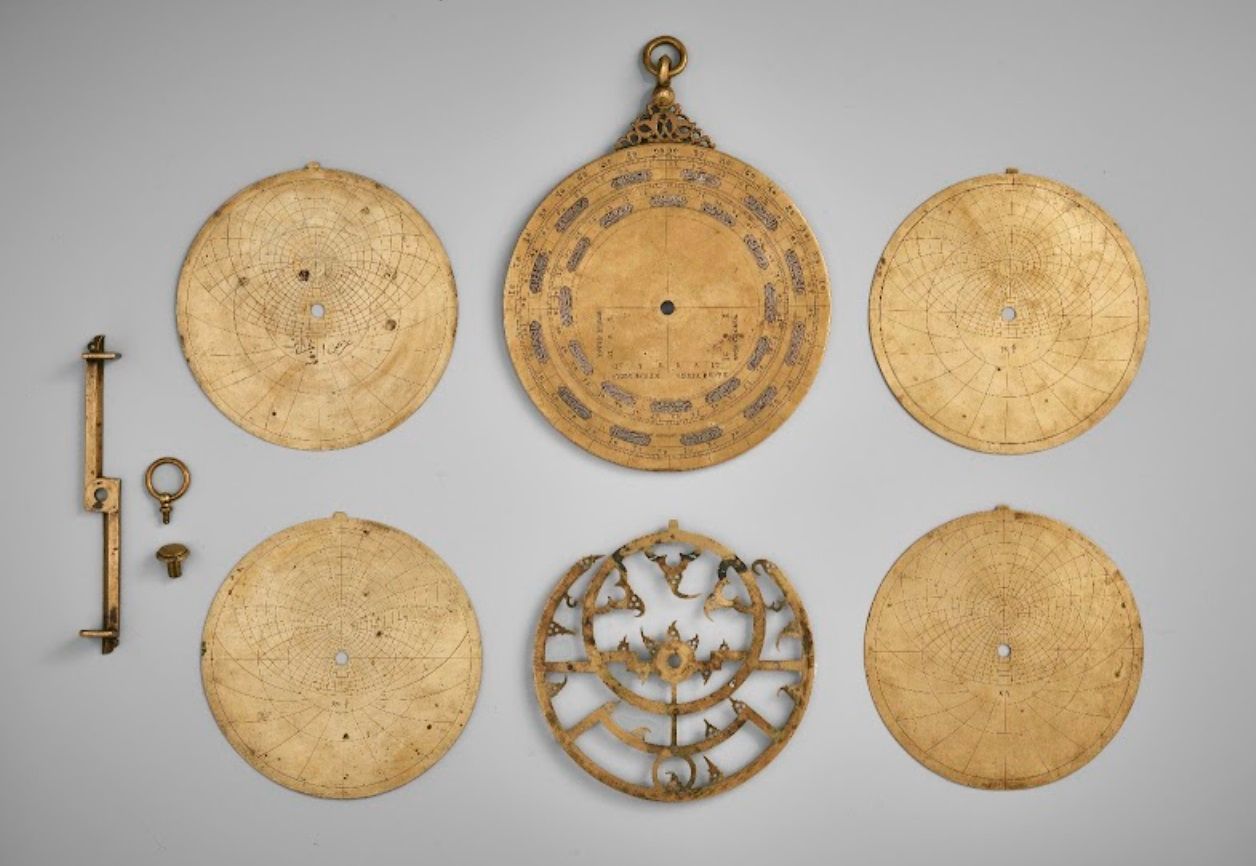
Planispheric Astrolabe Spain (Historic Al-Andalus), probably Toledo, 1300s. Bronze, engraved and inlaid with silver. Diameter 13.5 cm AKM611. Courtesy of the Aga Khan Museum.
*Written by Special Guest Contributor Dr. Ulrike Al-Khamis, PhD, the Director of the Aga Khan Museum. Parts of the piece were published in an earlier “Travels” edition.