Painting Between the Folds of Time
‘Ve Cn Dot!.’ 2025. Oil on Folded Canvas. 54 x 41 in. / 137.16 x 104.14 cm. Known to many as “Rosie the Riveter,” this painting by Saudi Prince and artist Sultan Bin Fahad depicts Naomi Parker Fraley, a crucial figure in driving women to join the workforce during World War II. This painting showcases the revolutionary work of Parker Fraley, challenging the trajectory of gender roles and serving as a motivational figure for women of the time and beyond. By depicting Parker Fraley in her later years, Bin Fahad extends her impact beyond her war-era work.
What if we could go back in time and change a critical moment in our history? What if an important figure who became symbolic is seen differently and has grown old and doesn’t fit into our image of that person? What if a particular moment never happened, such as the fall of the Berlin Wall on November 9, 1989? What kind of Germany would we have today?
Time is a thorny concept with many ‘what ifs,’ differing ideas on what happened and didn’t happen, and history told from different perspectives and lenses, all of which makes it so the final story of our time - and all the chapters in our history - can never be set in stone.
In his latest series titled ‘Cncve,’ Saudi Prince and multidisciplinary artist Sultan Bin Fahad explores these many possibilities and addresses questions of our material instability with those around the cyclical path of history. His portraits ‘contemporize’ history, presenting possible futures interwoven with the outcomes of actual events, and leaving room to wonder upon the impermanence of the past, present and future.
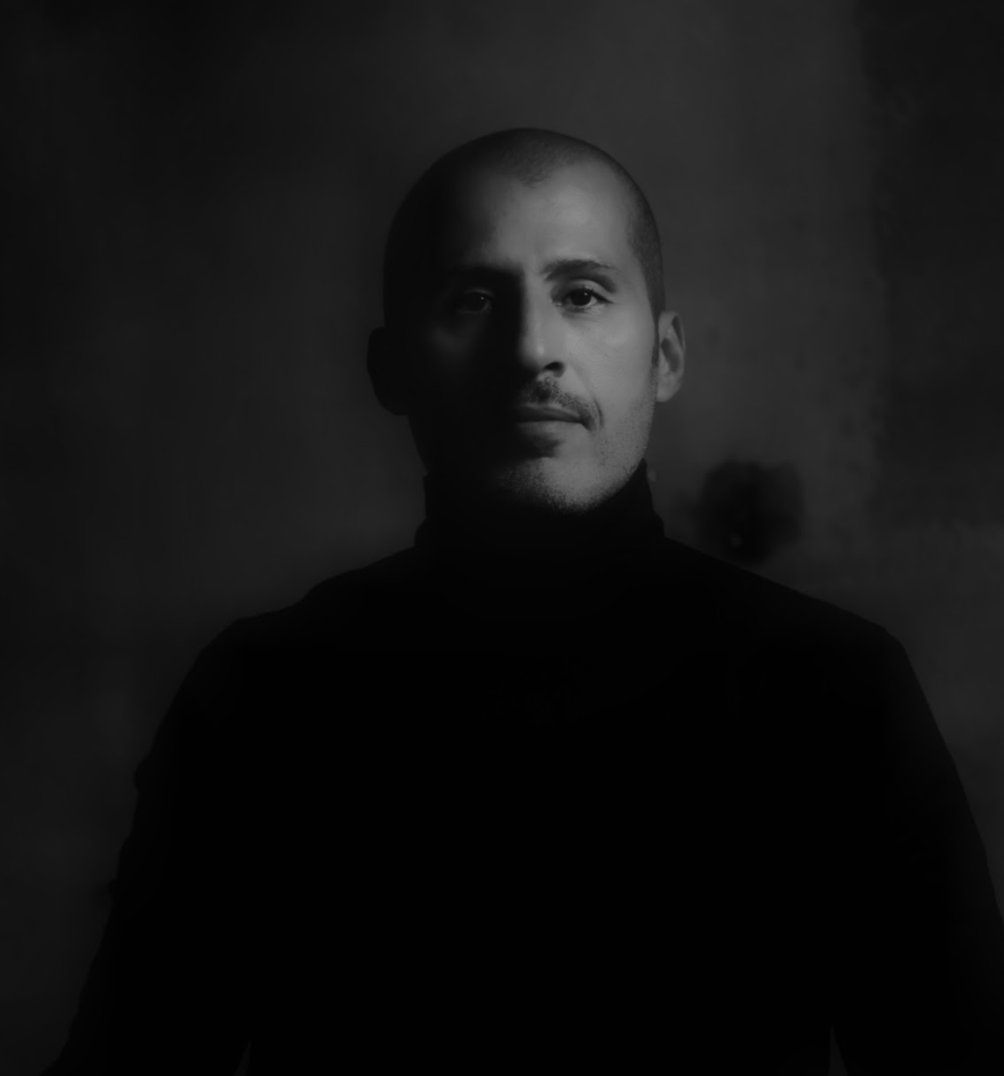
"Now is a period of upheaval across the Middle East and beyond. Sultan’s exhibition is so timely and addresses many critical moments in history. This is a very important and well-executed series of paintings. The show has everything to do with time, history and memory,” said Leila Heller, of ‘Leila Heller Gallery,’ where Bin Fahad’s solo exhibition was on display from September 4 until October 8th, 2025 in New York.
Since its establishment in New York City in 1982, Leila Heller Gallery has gained international recognition in fostering creative dialogue between Western and Middle Eastern, Central Asian, and Southeast Asian artists, and specializing in modern and contemporary masters.
With artworks acquired by Toledo Museum of Art, Royal commission of AlUla, Guggenheim Abu, Palestine Museum and Ithra, Bin Fahad’s diverse artworks span abstract paintings, sculptures and installations. At the core of his work lies an exploration of spirituality and the material culture of his home country of Saudi Arabia. Themes central to his practice revolve around repetition, sound and movement using symbols that derive from Islam. Connecting past to present, his stories evoke multi-layered journeys between the latent relationship of what is remembered and what remains silently contained within the corporeal.
Reinterpreting histories, stories, and narratives through objects and images, in this collection Bin Fahad focuses on a few pivotal figures and recontextualizes moments from history in his art, with each creation exploring the relationship between what happened and what could have happened. He proposes questions of “What would change if another person reached a position of power? Or if a particular assassination failed?”
In an interview with Ithraeyat, Bin Fahad explained his vision further and who he would meet from the past if he could time travel.
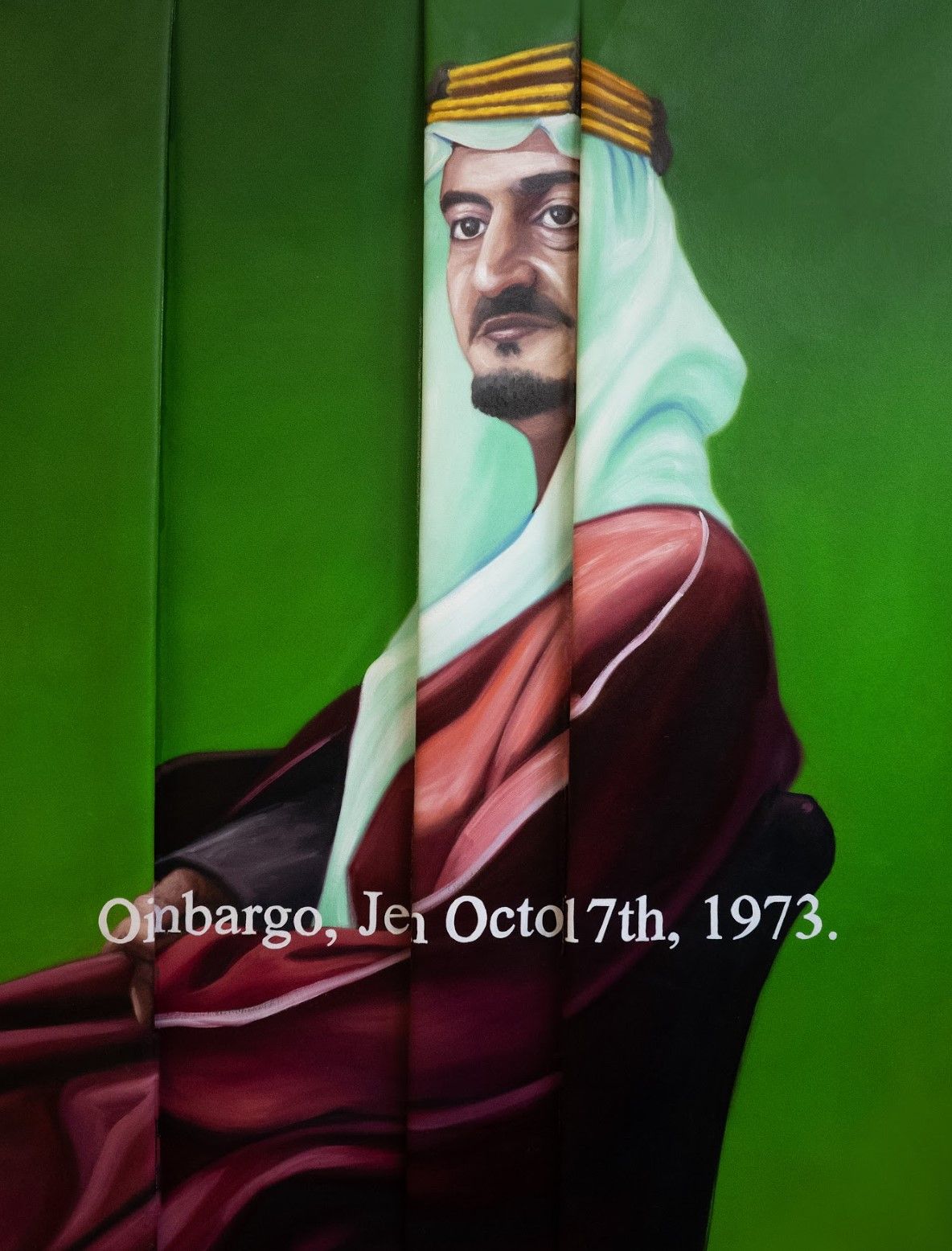
Oinbargo, 2025. Oil on Folded Canvas 54 x 41 in. / 137.16 x 104.14 cm. This painting by Saudi Prince and artist Sultan Bin Fahad depicts His Royal Highness the late King Faisal of Saudi Arabia seated in profile as part of his ‘Cncve’ series. The work primarily focuses on his order to raise oil prices to the United States, widely known as the Oil Embargo of 1973, in protest of military support of Israel. By bringing this historic act back into view, the work invites reflection on the dynamics between the Middle East and the West and their continued relevance today.
Art is life, and it's time. The world around us, our past experiences and our hopes for the future.
The motive behind Cncve is interrogating history, and showing off its impermanence in the process. I think people take for granted that the past is set in stone, so I wanted to take that and challenge it; what if something happened didn't? What if the story were different? Taking different choices to open subjects and seeing how history could be like, what the world would be. And that turned out in the folds of these paintings, peeling it back to famous faces and unknown ones as well. I hope audiences are inspired by this exhibition to put faces to those stories.
Time is essential to my practice, because time is art. Time is how we experience the world, and so it's also for me how we can express ourselves—nostalgia can be as much a medium as painting or installations are. It's all in the way you view it.
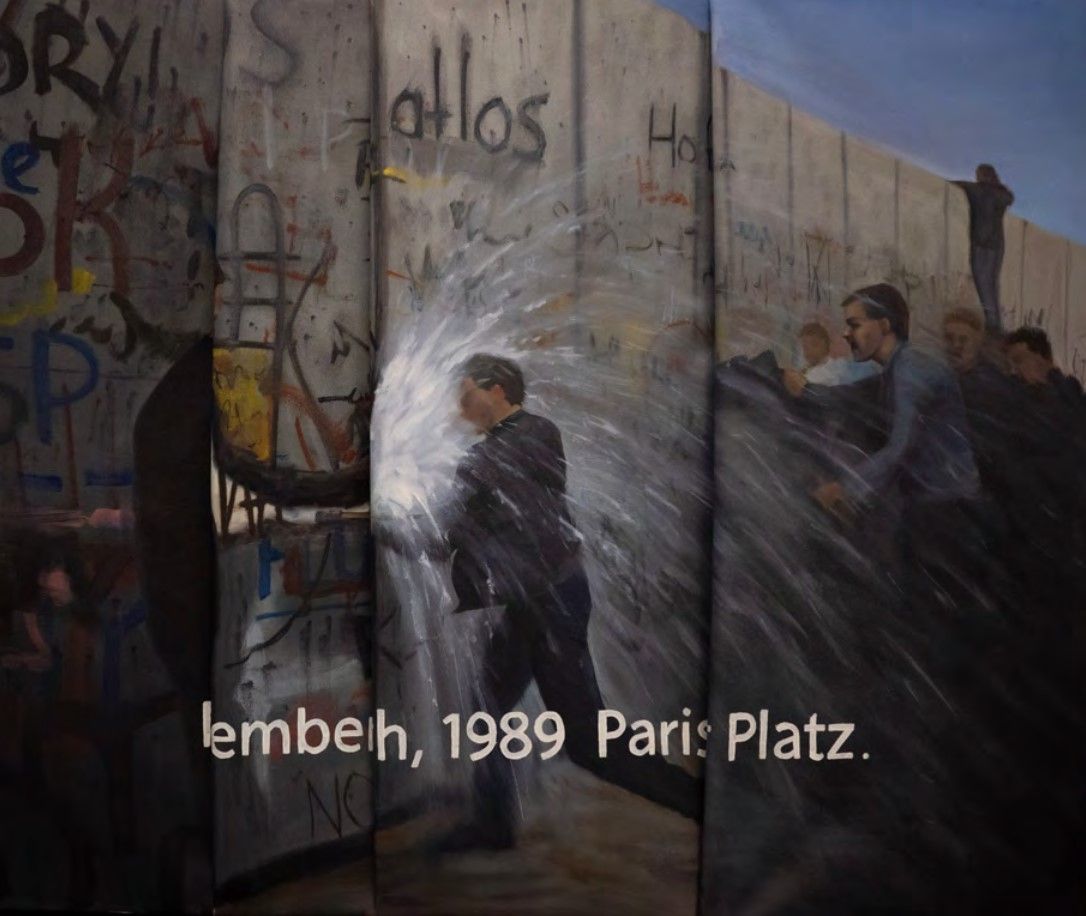
lembeh, 2025. Oil on Folded Canvas 30 x 36 in. / 76.2 x 91.44 cm. Illustrating the era of unity marked by the fall of the Berlin Wall in 1989, the barrier that for 28 years divided East and West Berlin, Bin Fahad employs his recurring folding motif to examine the split between theoretical and actual histories. The folds act as visual ruptures, dividing the moment into parallel narratives and suggesting the possibility of alternate outcomes.
Jackson Pollock, Cy Twombly, Louise Bourgeois, and Francis Bacon, among others.
Never complain and never explain. Express yourself as you are and don't underline your identity by how someone else defines you.
If I could meet anyone? Leonardo da Vinci is one; he was self-taught, and so mixed in his mediums in creating those classic narrative paintings from the Bible. He was so ahead of his time in his work. Michelangelo too; as a storyteller I relate to the way he spins stories, in his paintings in the Sistine Chapel, and in others with such detail, drawn with awe in ways I aspire to capture.
I think I'll keep that a surprise for the future, at least for now. I can hint that what I'm working on is something spectacular, and musical too.
With a lot to reflect on, we hope our readers enjoy discovering the wealth of artworks by Sultan Bin Fahad and what questions and possibilities they present.
More Artworks by Sultan Bin Fahad:
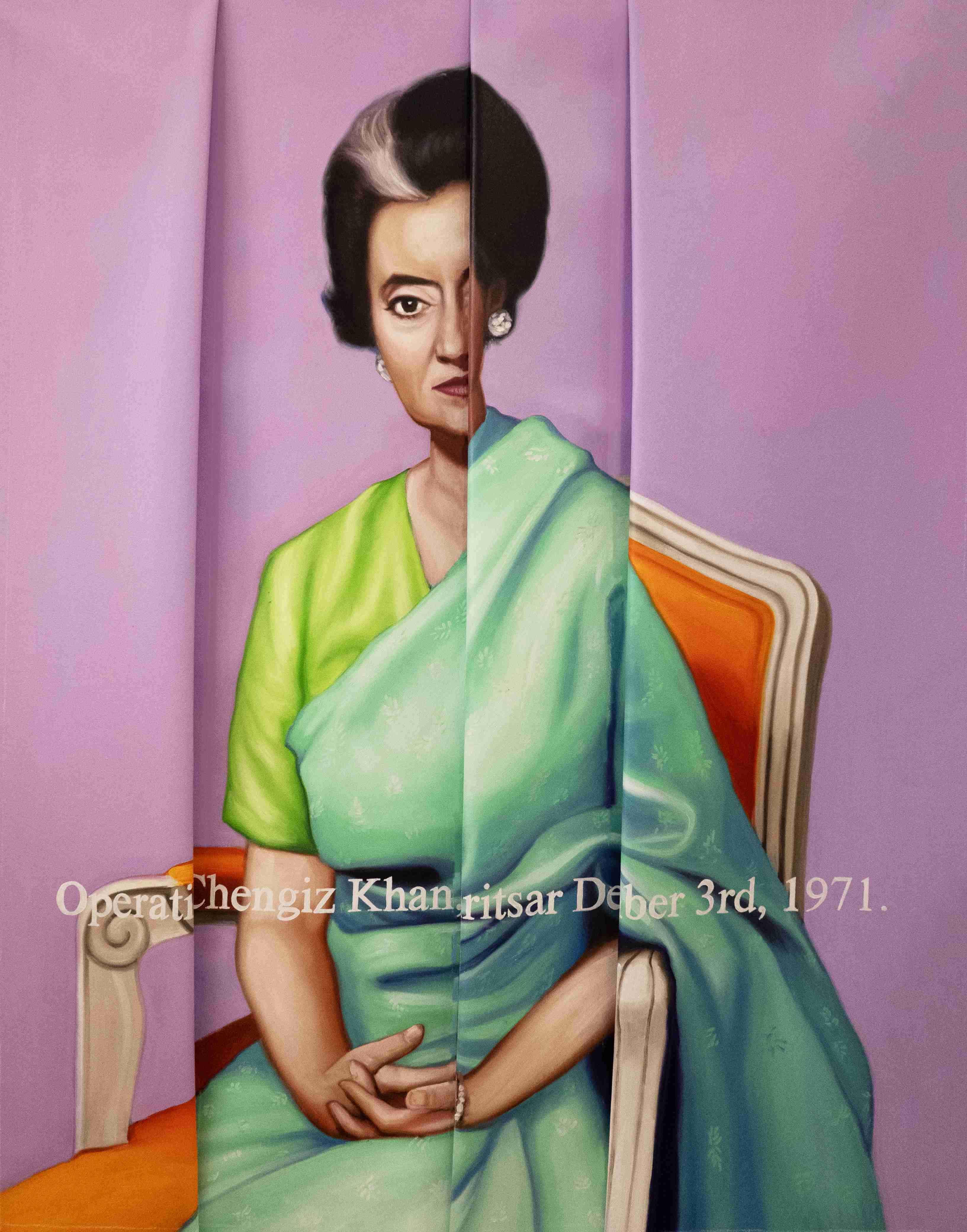
Operatihengiz, 2025. Oil on Folded Canvas 54 x 41 in. / 137.16 x 104.14 cm. Featured in this painting is Indira Gandhi, the first and only female prime minister ofIndia. She is depicted in the context of the Chengiz Khan operation as an effort against preemptive strikes against Indian Air bases. This was considered as the formal initiation of the Indo-Pakistani War of 1971, resulting in victory, with her decisions creating lasting impacts that forever changed India. The work cuts lines into the strands of military decisions and the fallout from them.
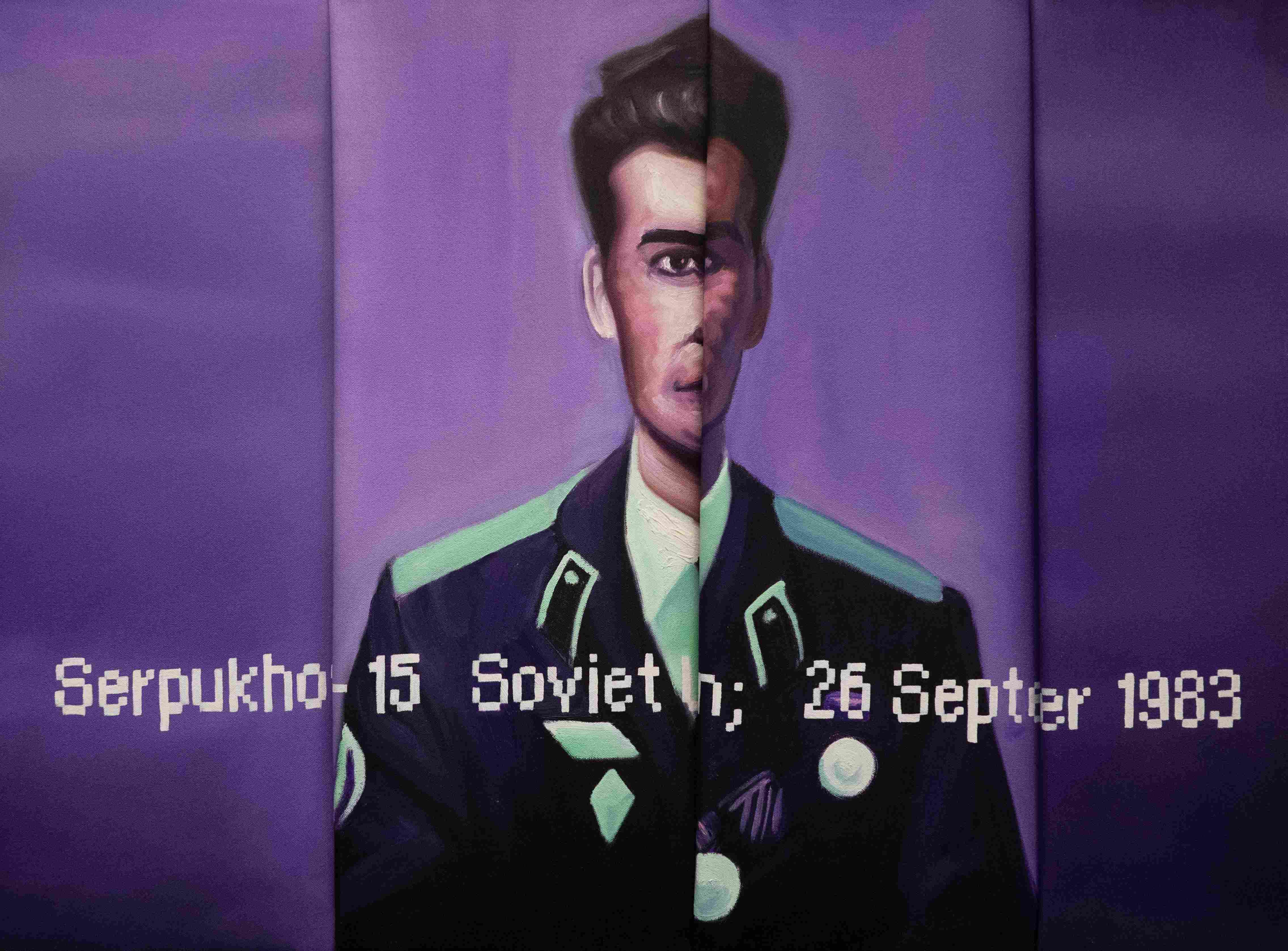
Serpukho, 2025. Oil on Folded Canvas 26 x 34 in. / 66.04 x 86.36 cm. Depicted in this painting is Stanislav Petrov, an engineer of the Soviet Air Defense Forces. Petrov served a crucial role in preventing a nuclear conflict between the United States and Russia in 1983. His valiant efforts saved the world from mass destruction. However, the folds of the canvas cleave Petrov’s portrait, prompting a reality where his efforts were not successful and catastrophe ensued.
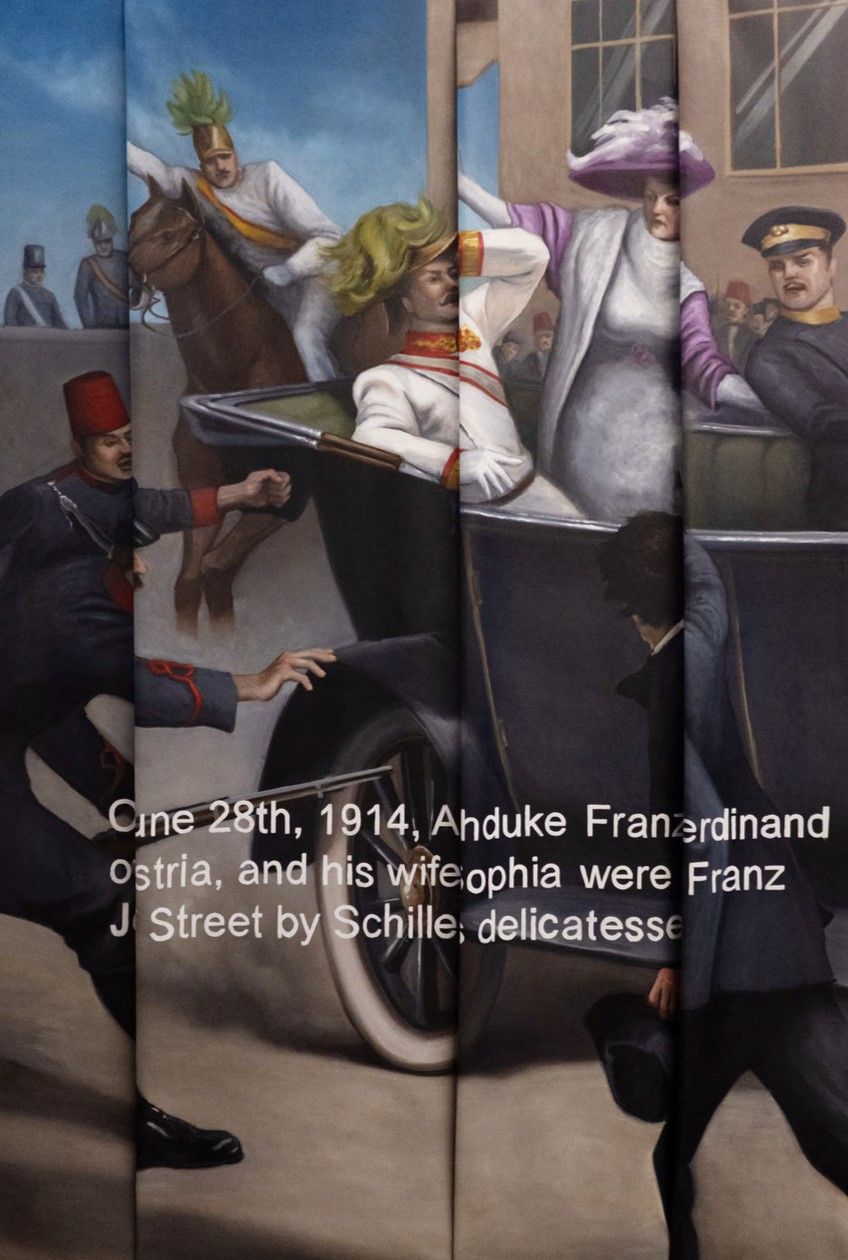
One 28th, 2025. Oil on Folded Canvas 72 x 50 in. / 182.88 x 127 cm. This work reconstructs Achille Beltrame’s illustration of the assassination of Archduke Franz Ferdinand. This event directly triggered World War I, redrawing national borders and sparking political, social, and economic shifts that pro-foundly shaped much of the 20th century. The painting reflects on how one moment can ripple through years to shape the future, suggesting that the present will one day become the history others look back on.
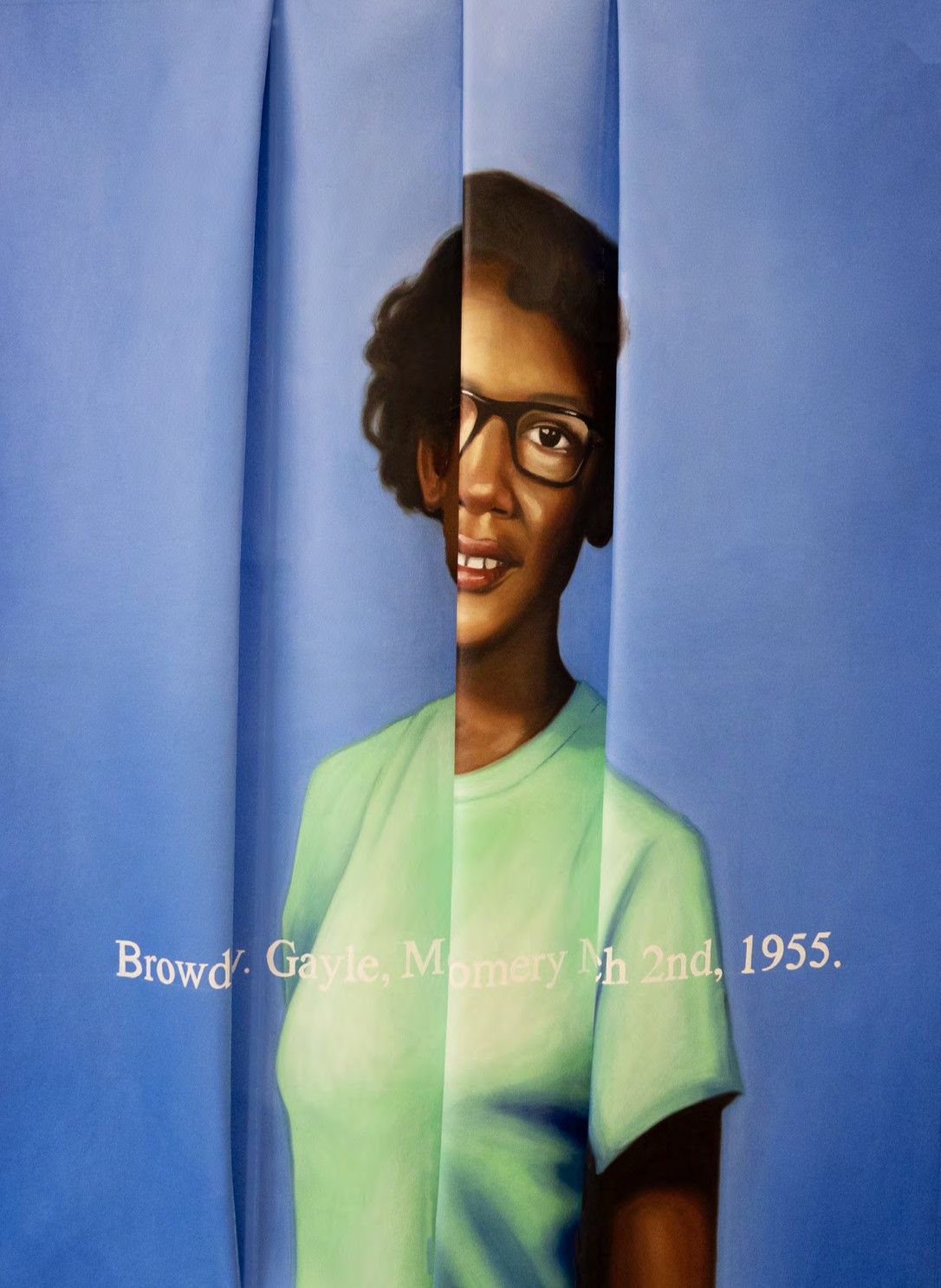
Browd Gayle, 2025. Oil on Folded Canvas 54 x 41 in. / 137.16 x 104.14 cm. Claudette Colvin, a pioneering figure in the Civil Rights Movement, gained recognition for refusing to give up her bus seat to a white passenger — an act of defiance that occurred nine months before Rosa Parks’ historic stand. In this work, Bin Fahad employs the fold to obscure much of her body, allowing only her face to emerge. This gesture reflects how her contribution, though partially hidden in the broader historical narrative, continues to be seen and remembered.
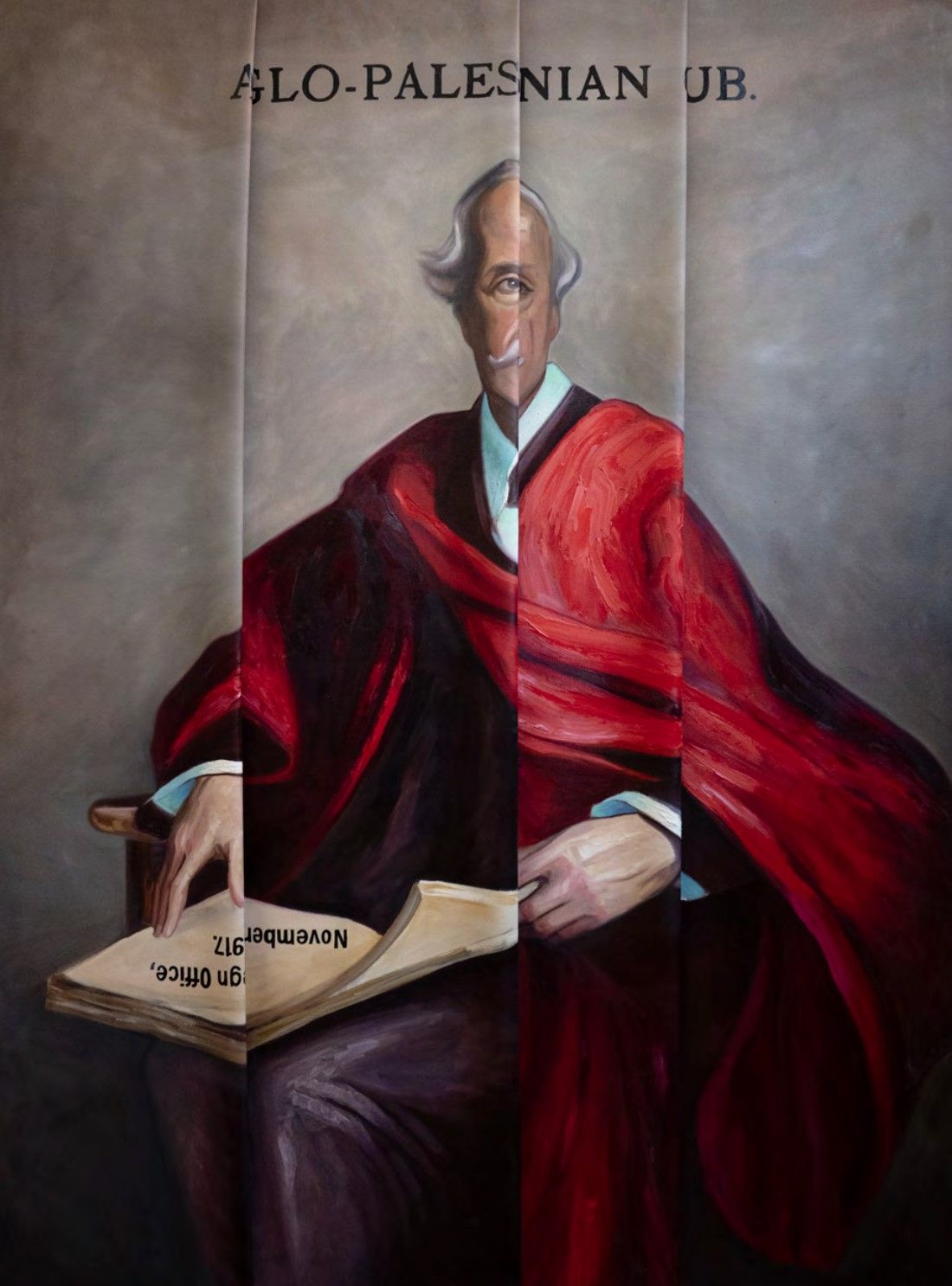
Alo-Palesnian, 2025. Oil on Folded Canvas 72 x 54 in. / 182.88 x 137.16 cm. This work documents the creation and signing of the Balfour Declaration by Arthur Balfour in 1917, which was approved by the British Parliament. The declaration would divide historic Palestine to pave the way for the construction of Israel. The work reinterprets the push of history and its consequences in the layers within.
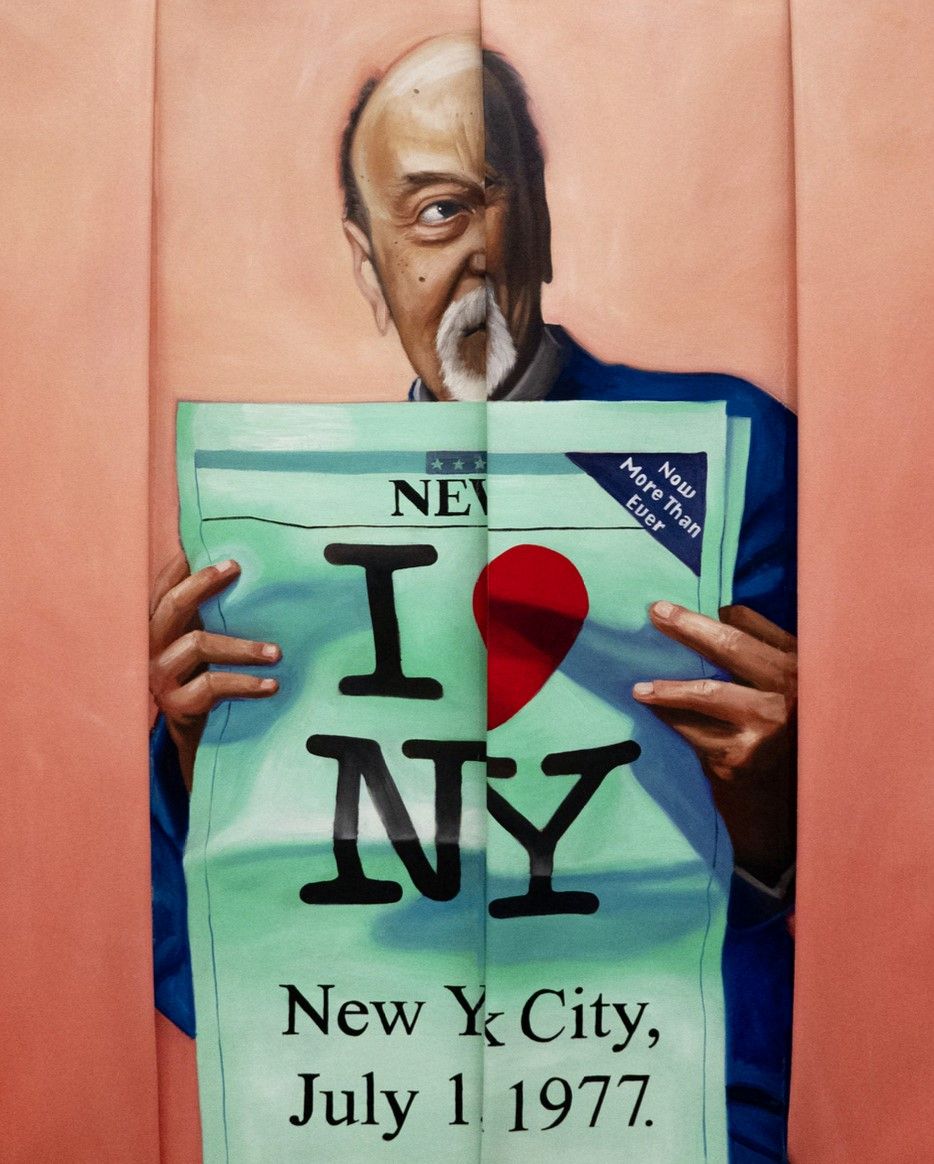
New X City, 2025. Oil on Folded Canvas 54 x 41 in. / 137.16 x 104.14 cm. The NY slogan serves as a pinnacle of New York tourism and culture. This painting depicts Milton Glaser, the artist, with the slogan he developed for Wells Rich Greene. It acts as a symbol of graphic history deconstructed and re-established into its base parts.
To find out more about Leila Heller Gallery, explore their website here.