The Prague Clock: Redefining Time
The astronomical dial of the Prague clock. Image source: Freepik.
In the center of Prague’s historic Old Town Square, the southern façade of the Old Town Hall Tower is home to a medieval icon first recorded in 1410, the Prague Astronomical Clock (Pražský Orloj).
Widely recognized as the world’s third-oldest astronomical clock, and the only one still operating with impressive accuracy, it remains a major attraction for visitors and researchers alike.
More than a tool for telling time, the clock is a remarkable blend of science, art and faith, its intricate mechanisms continuing their uninterrupted movement through the centuries.
As history traces back to the early 15th century in Bohemia (the historic region that now constitutes the western part of the Czech Republic), Prague — then, as now, its capital — stood at the forefront of Europe’s intellectual and scientific landscape. The clock’s design was the product of a collaboration between master clockmaker Mikuláš of Kadaň and the astronomer Jan Šindel, who is credited with developing its theoretical framework.
The clock consists of three main parts: the astronomical disc, the calendar disc and the kinetic display. The astronomical disc, the oldest part of the clock, dates to 1410. It displays the position and movement of the sun and moon and shows the time in several systems: Old Bohemian time, current civil time, and Babylonian time.
The calendar disc and the Gothic statues that participate in the kinetic display were added later. Designed by the Czech artist Josef Manes, the calendar disc displays the months and days of the year, as well as saints' days, surrounded by the symbols of the zodiac.
In the third part, the kinetic display, the twelve apostles appear in procession from two windows at the top of the disc every hour, while Death—a statue in the form of a skeleton—rings the bell, Vanity, a statue of a man holding a mirror, shakes his mirror, and the golden rooster crows to announce the end of the display.
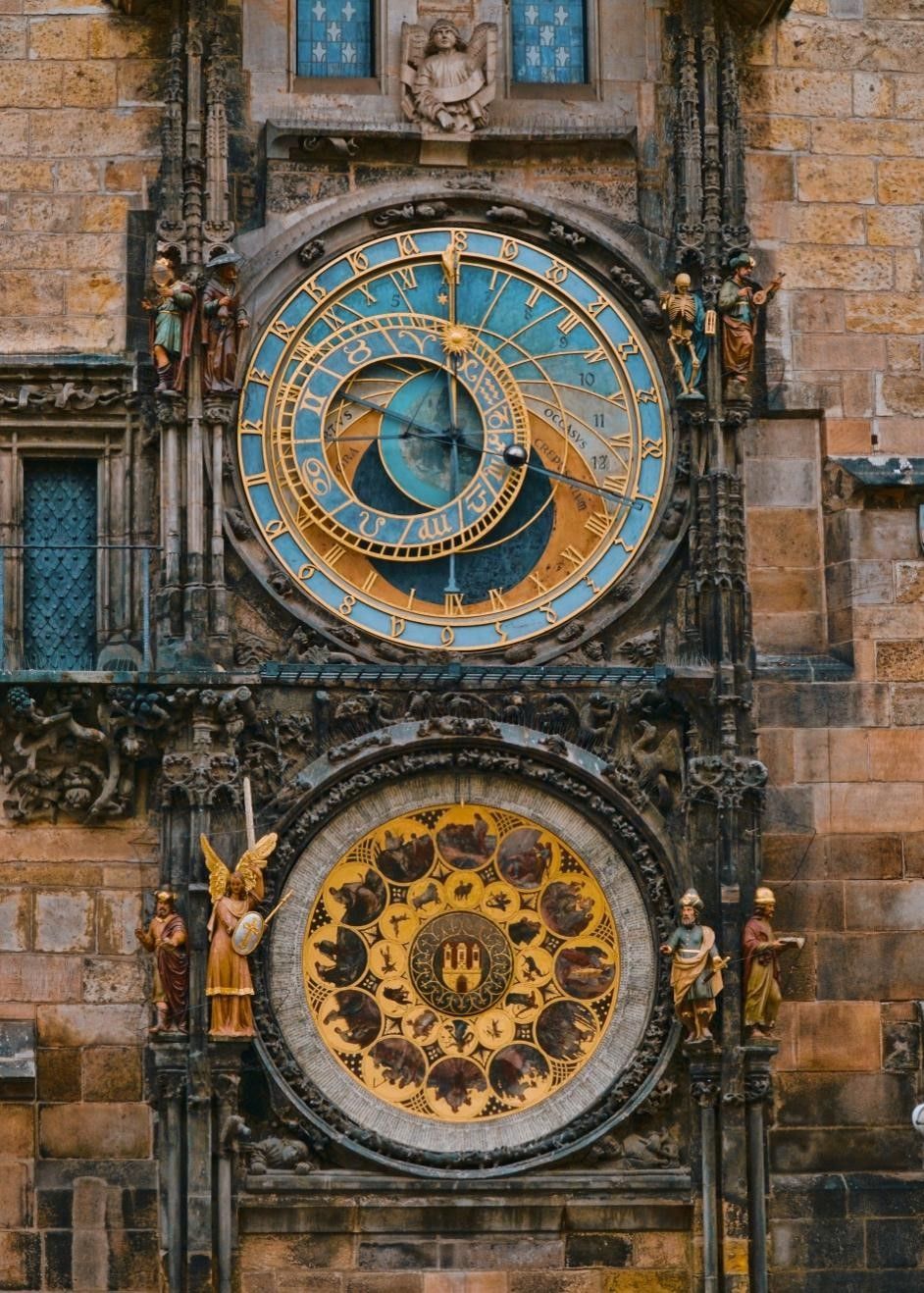
Prague clock face. Image source: Freepik.
The Prague Astronomical Clock has weathered centuries of challenges, from natural decay to war damage, and has undergone numerous repairs since the 15th century, with one of the most critical restorations taking place in 1948, which brought the clock back into operation after World War II and the Prague Uprising. This milestone solidified its reputation as the world’s oldest astronomical clock that continues to function.
Today, hundreds of visitors gather in Prague’s Old Town Square each hour to watch its mechanical show.
The clock remains a testament to human ingenuity and a reminder that time is not only measured but also experienced, inviting observers to pause and reflect as its gears continue their steady motion through history.
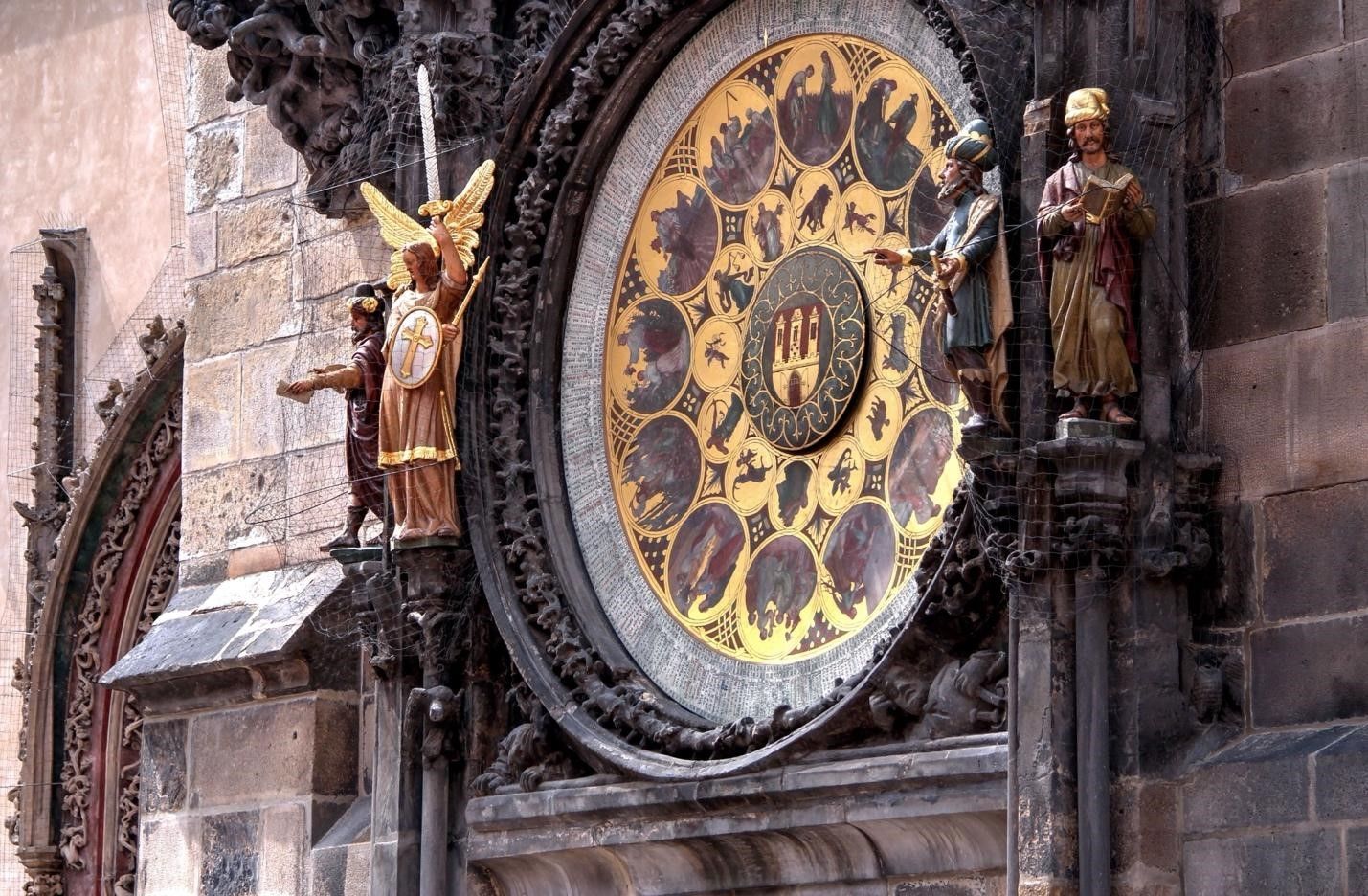
Calendar disc for Prague clock. Image source: Freepik.