A/C Ecologies: Cooling, Control, and the Unintended Life of Water
‘Technical Malfunction.' Saeed Gamhawi. 2024. Photographed by Aria Alnomay and images courtesy of the artist.
In an era defined by accelerating climate uncertainty, artistic practices increasingly turn toward instability as a condition to be examined, inhabited, and understood. Here we are looking at two contemporary art installations: Gamhawi’s Technical Malfunction and Shono’s A Forgotten Place.
Across both installations, air-conditioning, the most defining technological apparatus of contemporary life in arid regions, shifts from background utility to conceptual protagonist.
In these works, the A/C is no longer a neutral system of comfort but a generator of unintended environmental narratives. Whether through malfunction or byproduct, water emerges as the central agent: freezing into unstable ice in one instance and sustaining fragile plant life in another. Together, these practices articulate what Shono calls “A/C ecologies,” where the residues of cooling technologies become sites for rethinking human relationships with climate, infrastructure, and non-human life.
Both artists engage not with grand environmental spectacles, but with subtle, often overlooked processes: the drip, the freeze, the leak. In doing so, they reposition environmental art as an inquiry into systems already in operation, revealing how ecological meaning can be extracted from the margins of everyday technological function.
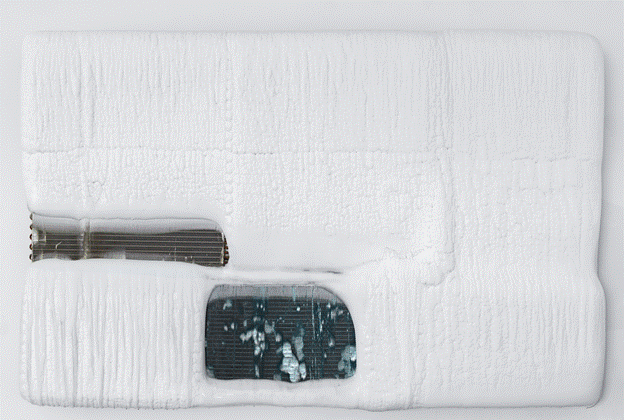
‘Technical Malfunction.’ Saeed Gamhawi. 2024. Photographed by Aria Alnomay and images courtesy of the artist.
Saeed Gamhawi’s Technical Malfunction operates at the intersection of environmental inquiry, sensory experience, and artistic practice, positioning water as a conceptual axis through which questions of memory, scarcity, and ecological urgency are explored.
Situated within the broader discourse of environmental art, the work engages water as both presence and absence, an element that shapes landscapes, bodies, and histories.
Constructed from aluminum cooling radiator panels and industrial tubing mounted on a steel frame, the installation simulates the freezing effect of a malfunctioning air-conditioning system. Beneath this technical façade lies a layered meditation on climate disruption, human intervention, and the fragile cycles governing natural systems.
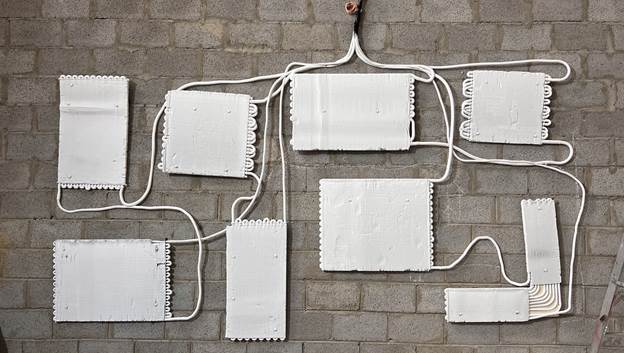
‘Technical Malfunction.’ Saeed Gamhawi. 2024. Photographed by Aria Alnomay and images courtesy of the artist.
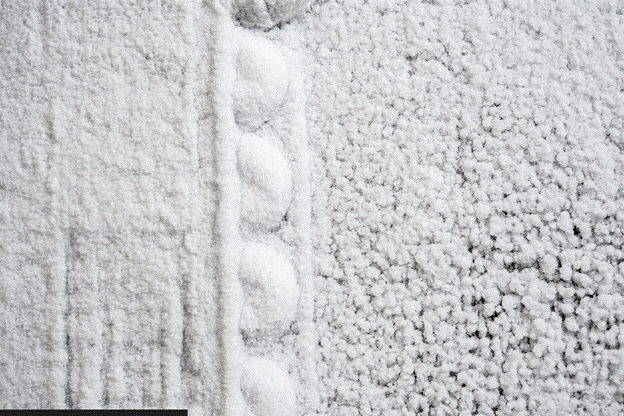
‘Technical Malfunction.’ Saeed Gamhawi. 2024. Photographed by Aria Alnomay and images courtesy of the artist.
At the core of the work is a deliberate contradiction: a machine designed to regulate temperature instead produces ice in an unstable and unnatural manner. As Gamhawi notes, “The malfunction becomes a metaphor for environmental imbalance.”
He draws a parallel between technological failure and environmental imbalance, suggesting that just as a faulty system disrupts its intended function, global climate systems, strained by pollution and overconsumption, have entered a state of unpredictability. The melting of polar ice caps, rising sea levels, and extreme weather patterns are reframed as symptoms of a broader systemic breakdown, a planetary malfunction driven by human activity.
Water within the installation exists in a continuous state of transformation. It freezes, melts, drips, and refreezes, producing a cyclical process that unfolds over time. These shifts highlight water’s resistance to control. Despite the rigid industrial framework attempting to contain it, water escapes fixed form, asserting autonomy through movement and change. This tension between containment and fluidity reflects contemporary environmental dilemmas, where technological systems seek to manage natural resources yet often intensify their depletion and distortion.
The work extends beyond visual form into sound, where the subtle rhythm of dripping water punctuates an otherwise quiet space. This acoustic element transforms the installation into a temporal experience. The steady dripping becomes an environmental pulse, marking time while evoking scarcity, fragility, and loss.
Gamhawi’s engagement with water is also personal and historical. The work draws inspiration from his daughter’s fascination with snow, an image that, in the context of Saudi Arabia, carries both wonder and dissonance. Snow, once rare in the region, has become more visible due to shifting climate patterns, prompting reflection on environmental change and its implications for future generations. This inquiry is further grounded in the historical memory of the Arabian Peninsula as a once-green landscape, supported by ecological and archaeological evidence. As Gamhawi reflects, “Water is both loss and continuity, what once existed and what may still be possible.”
Informed by environmental reports, documentaries, and global climate discourse, the work carries a critical awareness of contemporary ecological concerns. Yet rather than offering solutions, Technical Malfunction remains deliberately open-ended. It creates space for reflection and inquiry, inviting viewers to consider their relationship to natural systems and the consequences of human intervention.
The installation also resonates with the lived histories of the region, where survival and mobility were historically tied to the search for water. Gamhawi’s familial narratives of movement across landscapes in pursuit of this vital resource anchor the work in a collective memory predating modern infrastructure. In doing so, the installation bridges past and present, linking ancestral knowledge with contemporary environmental crises.
As part of an ongoing series, Technical Malfunction reflects Gamhawi’s sustained engagement with water as both subject and process. Each iteration becomes a variation on instability, an exploration of how material, environment, and concept intersect in a world increasingly defined by uncertainty.
Muhannad Shono’s A Forgotten Place (2024), commissioned for GCDN x Alserkal as part of the Global Co-Commission, operates through subtle observation and attentiveness to the overlooked.
The work begins with a humble yet continuous phenomenon: the drip of condensate water from air-conditioning units. In a region defined by water scarcity, this byproduct is typically dismissed as waste. Shono reframes it as a resource, an approach that resonates with what Tairone Bastien, curator of A Feral Commons, describes when he notes that “these artists are re-imagining the terms of public art in the face of climate change by making site-specific works that are not only aesthetically compelling, but that are also functional and generative.”
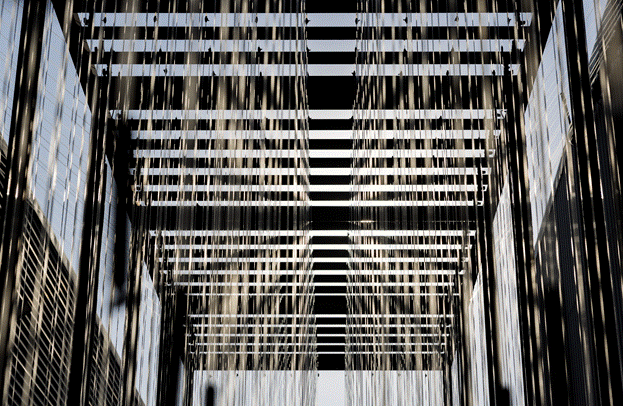
The installation consists of a network of tubes suspended within a steel structure, channeling condensate into patches of reclaimed soil. These plots host wild plants، species that grow without cultivation, often in the margins of urban environments. Rather than constructing a garden, Shono reveals and supports an ecological process already in motion, reflecting his own interest in what he calls “rebellious manifestations of the imagination.”
This approach aligns with the concept of “A/C ecologies,” referring to unintended environmental systems generated by cooling technologies that Shono describes as “representing nature’s resiliency and adaptation to anthropocentric climate change.” Emerging in overlooked spaces, along sidewalks, beneath buildings, and within infrastructural gaps, these ecologies challenge dominant urban design principles that prioritize control, uniformity, and aesthetic regulation.
The plants sustained by condensate resist such logics. Growing unpredictably in conditions that are neither fully natural nor artificial, they form a “postnatural” ecosystem shaped by human activity yet not fully controlled by it. The work reflects broader environmental realities, where distinctions between natural and artificial systems are increasingly blurred.
Water functions here as a connective medium. Its slow, rhythmic dripping contrasts with large-scale interventions like desalination and cloud seeding that dominate water management in the Gulf. By focusing on small flows and gradual accumulation, Shono proposes an alternative way of thinking about sustainability, one grounded in attentiveness to micro-scale processes.
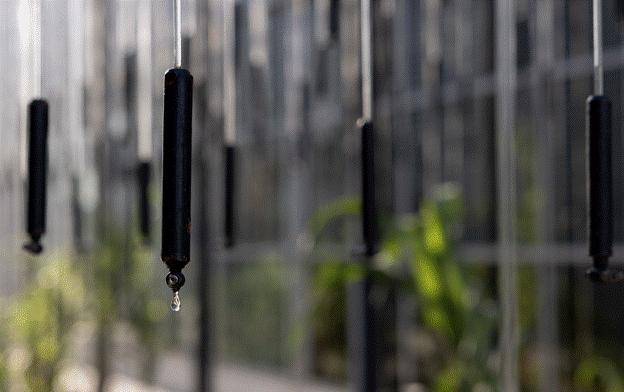
‘A Forgotten Place.' Muhannad Shono. 2024. Courtesy of Alserkal Advisory.
The notion of a “feral commons” extends this perspective. Traditionally understood as shared human resources, the commons are reimagined to include non-human actors, plants, microorganisms, and ecological systems that participate in urban life. The installation becomes a site of co-existence, where infrastructure inadvertently sustains other forms of life.
This challenges the idea that nature must be curated and controlled. In highly managed urban environments, plants are typically selected and maintained according to strict visual and ecological standards. The feral growth in A Forgotten Place disrupts this logic, foregrounding resilience, adaptation, and interdependence as alternative values.
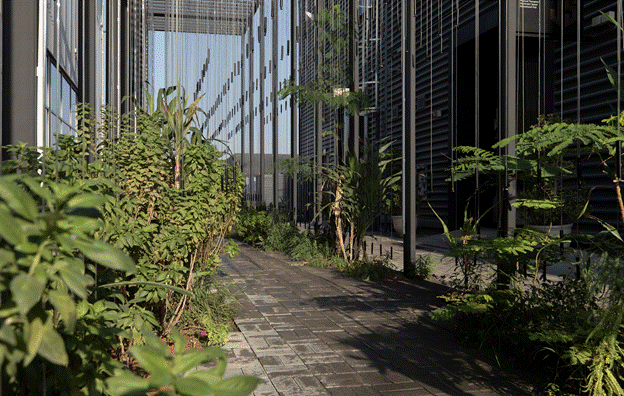
‘A Forgotten Place.' Muhannad Shono. 2024. Courtesy of Alserkal Advisory.
Shono’s work proposes an ethic of redistribution rather than extraction. By harvesting what is already produced, however unintentionally, he points to the potential of working alongside existing systems rather than against them.
There is also a psychogeographic dimension to the installation. As visitors move through it, they become attuned to processes that usually remain invisible: the movement of water from machine to soil, the gradual emergence of plant life, and the subtle cooling effect of moisture in an arid environment. The city is reimagined as a porous, dynamic network of relationships between human and non-human actors.
The plants nurtured here, often dismissed as weeds, challenge hierarchies that determine which forms of life are valued. By foregrounding them, Shono suggests that resilience and adaptability may be more meaningful measures of ecological worth than aesthetic perfection.
‘A Forgotten Place.' Muhannad Shono. 2024. Courtesy of Alserkal Advisory.
A Forgotten Place expands the definition of sustainability. It moves beyond efficiency and conservation to include perception, care, and coexistence. By working with what already exists, Shono transforms waste into possibility, revealing how even the smallest byproducts of urban life can sustain meaningful ecological relationships.
Artists Biographies:
Saeed Gamhawi is a Saudi contemporary artist whose work spans installation, painting, and conceptual practices; he is a co-founder of the Tasami Center for Visual Art in Jeddah and the founder of Raseef Studio in Riyadh, and has exhibited widely both locally and internationally, representing Saudi Arabia across Europe and the Middle East as well as at major platforms such as the Louvre Museum, Noor Riyadh, and Misk Art Week.
Muhannad Shono is a Saudi contemporary artist whose interdisciplinary practice spans drawing, sculpture, and large-scale installation. His work often explores themes of transformation, memory, and the relationship between humans and their environments. He has represented Saudi Arabia at major international exhibitions, including the 2022 Venice Biennale where he represented his country with the installation The Teaching Tree, and has participated in global platforms such as Noor Riyadh, and international biennials and institutional shows.
Gaida Al Mogren is an artistic Independent curator.
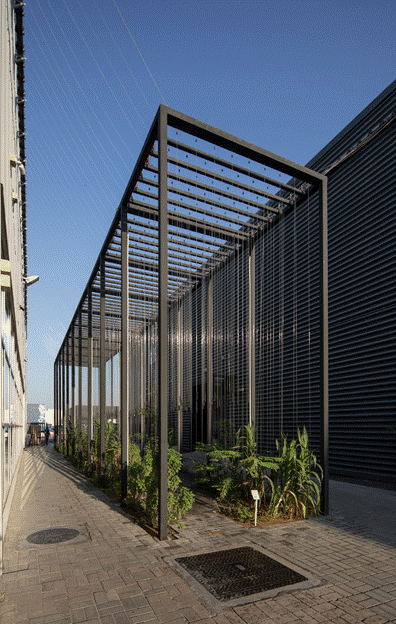
‘A Forgotten Place.' Muhannad Shono. 2024. Courtesy of Alserkal Advisory.