Water: The Memory and The Myth
‘Blue grotto, Capri Island, Italy.’ Photochrom prints Color. Source: Library of Congress.
The sea swallowed me one day. I set foot in its sands, and it seized me, pulling me into its depths and forcing its water into my mouth. Fishermen eventually rescued me from drowning, but the water claimed me from that moment on. It took my voice to defend it, and for years made me follow it, as the people of my island do. We follow the water faithfully, and whenever it turns away, we follow it.
This obsession led me, while writing my second novel, "The Forgotten Between Two Waters", to explore the relationship between water and place. I delved into my earliest memories of my connection to it.
My grandmothers used to cook rabbitfish with sugared rice, taking me with them to the spring amidst the palm groves to make vows to it and its guardian.
Myths and tales bound me to water, for the people of this island begin their memories with two waters: the water of a fresh spring and the water of the sea. "Who reflected himself so you could see what is unseen? Who revealed to you who you are?" Wasn't it water in the myth of Narcissus, when man discovered his features and gazed with pride upon himself? And the water revealed his identity to him, so he understood who he was?
In seeking to understand water and its generosity, humans have given it a sense of spirit, both fearing it and revering it, while creating myths and rituals from their bond with it. Water has always reflected the lives of those who dwell near it, appearing in all religions and recurring throughout mythology because the collective consciousness shares in the symbolism of water.
The water that carried Moses to his destiny is the same water that carried Romulus and Remus in Rome. The Sumerians, along with Sargon of Akkad, were associated with the Euphrates River. In the inherited customs in China, mothers throw their illegitimate children into the surface of the river so that the husband will not kill them. Here, water leads the destiny of man. Mothers across different civilizations used to hand their children over to the water. The man saw water as evil and feared it, and the mothers believed that it was the protector of the children, and that it would decide their fate.
Votive rituals are common in many cultures. In Bahrain, children throw a small object called "Al Hayya Baya" on the eve of Eid Al Adha. Women also communicate with the sea by rubbing their hair against it when it fails to bring back their loved ones. Every spring, lake, or body of water is believed to have its own spirit and guardian.
Women in all cultures have a special relationship with water: they are the sacrificial offering, the guardian spirit, the one who speaks to it, and the male figure to whom they call for help. As is common in some cultures of peoples and Greek myths, salt water symbolizes the male, and fresh water symbolizes the woman because she is a symbol of fertility and giving. According to Sumerian mythology, this freshness originated from the saltiness of the sea. This is something I noticed during a visit to several regions of the Kingdom, organized by my literary partner. The stories and names of these springs are remarkably similar, all representing women who have been transformed into water.
The women who used to sing along the edges of the flood channels “al Saab”, with the water following their voices into the fields during periods of drought this relationship is repeatedly reflected in different cultures. In Greece, floods would engulf entire islands, and women would be seen dancing with the motif known as the “Greek key,” turning it in their hands to warn island and coastal communities that the water was coming to reclaim its space. A closer example to this can be found in Bahrain, where when the island’s trees dry out, the water returns to reclaim the land, as has happened on several islands, most notably Al Mazrou’iyah and Fasht Al Jarim, which was once a complete island during the Dilmun period.
This relationship with water led people, who feared it, to appease it with offerings. In Bahrain, our hope is that, when a flood comes, the water will recede, leaving us land to settle on. We will cut stones from it and build the foundations of our houses. When the tide returns, the sea will smell its scent in the stones, and then leave the land to us, defining new boundaries for itself. As for Sharjah, I stood before a canal that came from the sea. I didn't see any seagulls; the water itself had given them a memory of the place. I later discovered it was an artificial canal, and the sea wasn't there, just as the birds of Diriyah guided me to the valley and showed me its boundaries.
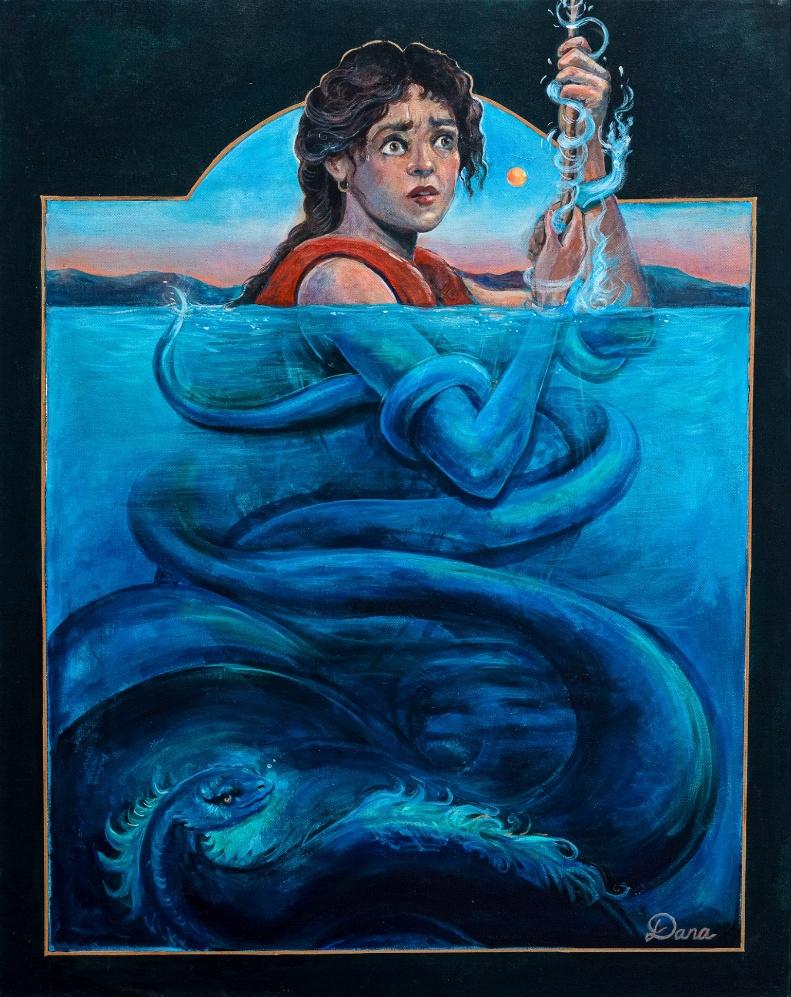
‘Sea Monster.’ Dana Abu Khalil. Jordan. 2024. Mixed media on canvas. This artwork is from the Permanent Collection of Jordan National Gallery of Fine Arts.
In an attempt to understand water and its power to restore life, humankind created the myth of sacred water. Drinking from a specific spring was believed to grant immortality. Thus, Gilgamesh came to Dilmun in search of immortality, which was said to be a luminous flower in the sea. Anyone who sees the water of the "Jawajeb," the freshwater springs flowing from the depths of the salty sea, will see that this water glows when the moonlight falls upon it. The Arabs called it a "star," just as they called anything that shines a star. Gilgamesh came to find these freshwater springs, from which, if he drank, would grant him immortality. Later, the island of Bahrain was named after these two waters: fresh and salt.
Japan is a country that doesn't believe in death. I stood before the spring gushing from the mountaintop at the Kiyomizu Temple, surrounded by autumn trees with their leaves illuminated by the sun. There was a kind of sanctity that the water bestowed upon the place. Before me were three spouts, and I had to take the large ladle and choose one: wealth, health, or luck. Whoever coveted and drank from all three would be cursed, for water hates greed.
I tasted the sweet water of luck, then the largest torii caught my eye. The torii is the boundary between the world of humans and the world of the gods; when you cross it, you move between the two worlds with ease. The enormous torii stood before the sea in a majestic display. Isn't water the path to destiny? Isn't it memory, the very thing that humanity has spent its life following? Wasn't humankind created from gushing water? Wasn't the first growth of this life in the amniotic fluid, and didn't its flow carry you to another world? Isn't it true that as a person approaches old age, water springs from their eyes, and they see only through it?
Laila Al-Motawa is a Novelist & Journalist.
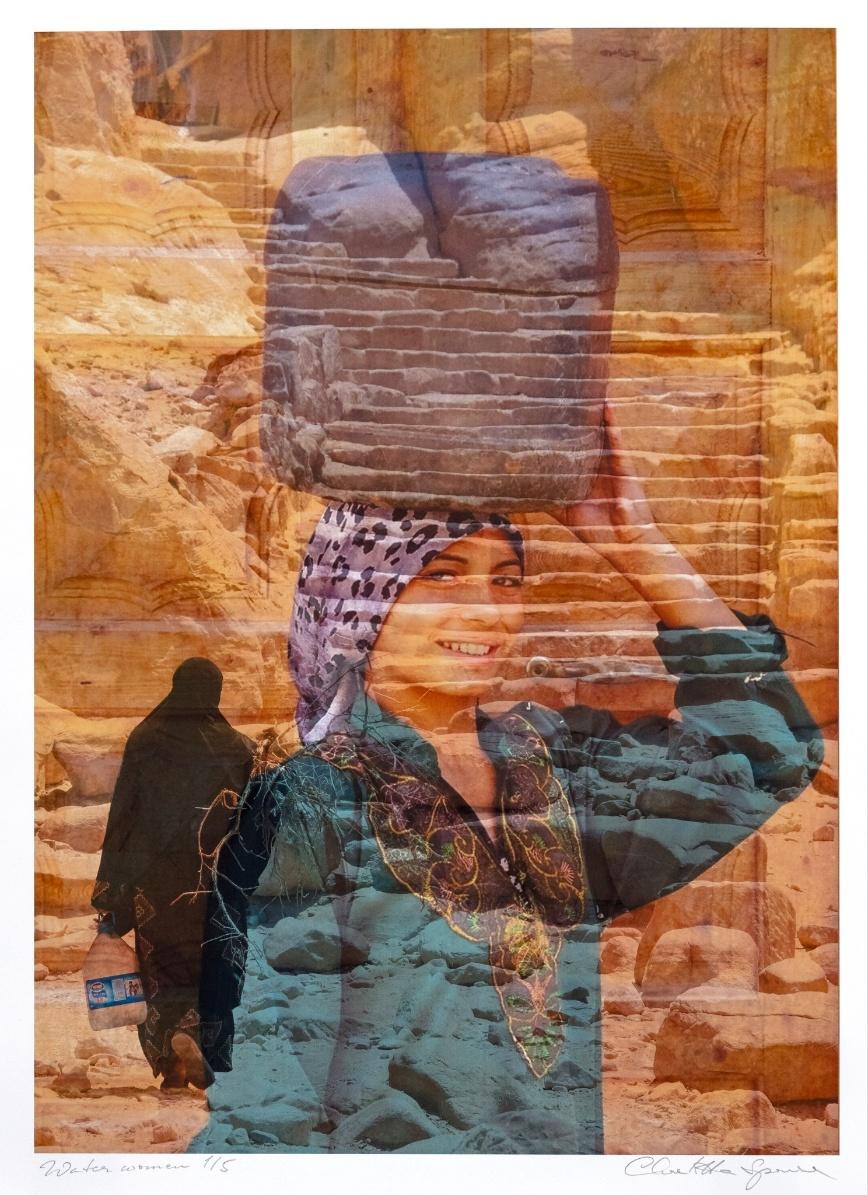
‘Water women 1/5.’ Charlotta Sparre, Sweden. 2017. Photographic giclée prints. This artwork is from the Permanent Collection of Jordan National Gallery of Fine Arts.