Art as Water, Shaped by Its Vessel
'Immortal Moment 2 (Post-Shock Faces).' Faisal Samra. 2024. Courtesy of the artist.
Saudi artist Faisal Samra is one of the leading pioneers of conceptual art in the Gulf and Middle East region, and an influential artistic figure whose work transcends geographical and cultural boundaries.
Samra was born in Bahrain in 1955 and graduated from the École Nationale Supérieure des Beaux-Arts in Paris in 1980. Since then, his practice has diversified to include photography, painting, sculpture, video, and performance art. His works are exhibited in prestigious museums and art collections worldwide.
Samra is known for his profound intellectual approach, which addresses issues of existence, memory, and the human experience, with a particular focus on deconstructing elements of popular symbolism and propaganda, without resorting to directness.
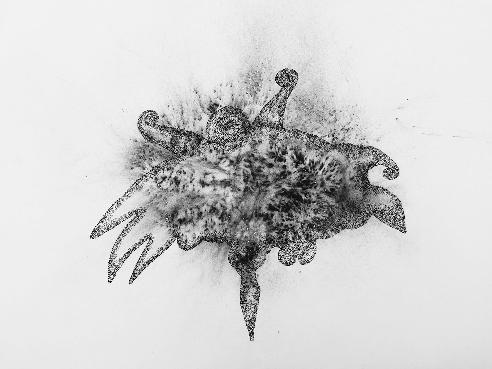
‘Immortal Moment 2 (Post-Shock Creatures).' Faisal Samra. 2023. Courtesy of the artist.
In this interview, Bin Samra takes us on an intellectual journey through his artistic and personal life, exploring the impact of his multicultural upbringing in Saudi Arabia, Bahrain, and France on shaping his identity. He talks about his concept of water as a substance that constantly changes shape, and about pivotal moments in his life, such as his early discovery of Michelangelo’s works, and how these experiences influenced his vision of art. He reflects on his philosophy about the relationship between the body and covering (clothing), and the role of masks in revealing and concealing.
Samra says that the cultural diversity of his birth to a Saudi father and a Bahraini mother gave him a profound awareness of his own identity. This led him to refining his tools for travel. He explains, “Even on a practical level, my travel bag is always light; I only carry the essentials, without burdening it with anything unnecessary. This approach is also reflected in my artwork, where I use very minimalist tools that achieve the desired effect precisely.”
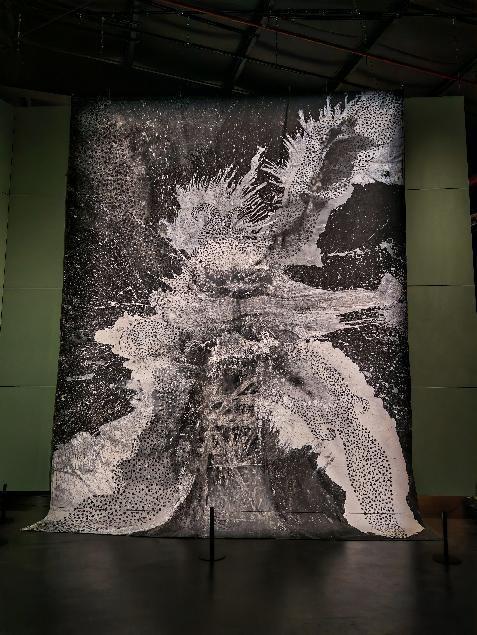
‘Immortal Moment 03 (Post – Shock Creatures 02).' Faisal Samra. 2026. Courtesy of the artist.
Samra points out that “water remains water, no matter what container it's in.” He favors this expression, explaining that the essence remains true, while the forms it takes change, because appearances are inherently changeable. The basic concepts in life are constant, but their outward appearance changes across time and place. “I have applied the same rule in my artwork from the beginning; the essence of the artwork is constant, and it simply revolves around man, his relationship with himself, with his surrounding environment, and his interaction with what is around him. This is the basic essence of my art.”
He recalls a pivotal event in his life, which occurred in 1968, when he was 13 years old, after receiving a book about Michelangelo as a gift from someone returning from London. “It wasn’t so much a shock in the literal sense as it was an opening to a different perspective on how to draw.”
The book discussed Michelangelo’s sketches and the concept of treating the paper as a space while creating the drawing, or the lines within that space. “Through drawing, I control and shape through shadow; my pen becomes the shadow within this mass of light to extract certain forms, or to draw the model.”
This book was very important to his career, but it wasn't so much a shock as it was an enlightenment about something he hadn't been aware of, according to him. Then came the second shock that affected him when he boarded a plane for the first time, traveling from Bahrain to Saudi Arabia: “I was about six years old, and I saw the vast expanses of the desert from above. But the shocks that affect and leave a mark are the lived experiences, whether visual or psychological.”
In the relationship between the body and clothing, Samra recalls a project about folds that he carried out in 1990, where he sees folds as essentially a measure of a certain temporal accumulation. The fold itself is an act, documenting the time of folding this paper or this fabric. This fold is what remains of the time of the act of folding.
Masks, however, have a different significance. Masks, or veils, featured prominently in the Distorted Reality project, conceal and reveal something else. “They reveal what's inside us, what we intend to do. The mask covers our faces, but it reveals that we're covering something, disguising ourselves. We wear masks all the time. I made a video that shows how, from wearing masks so much, we've forgotten our true faces, and the mask has become our true face.”
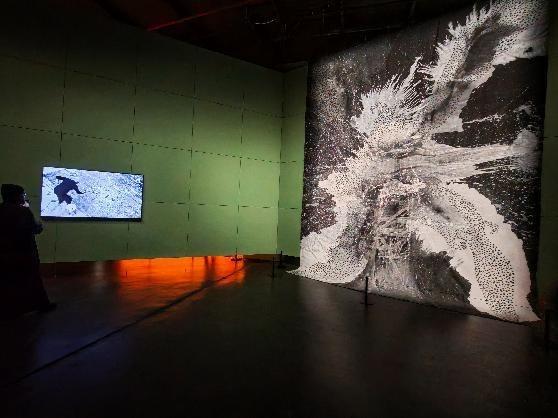
‘Immortal Moment 03 (Post – Shock Creatures 02).' Faisal Samra. 2026. Courtesy of the artist.
He speaks about deconstruction in his artwork: “I deconstruct, but I deconstruct the subject I’m working on. If there’s a particular subject, I try to deconstruct it, reformulate it, and reconstruct it according to my visual vision and my approach to the artwork, as has happened in most of my projects. Deconstruction makes things clearer and leads to identification and revelation. In my opinion, when we deconstruct things, they begin to reveal themselves more.”
He emphasizes avoiding directness and its pitfalls: “I never fall into directness. On the contrary, through deconstruction and reformulation, I delve into different, deeper levels of treatment, encompassing several layers: from the initial visual level, then the intellectual level, the sensory level, and so on. For me, a work of art always allows for multiple levels, but it begins with the visual level. Initially, I don't reveal all the levels. I only give the starting point to the visual, formal level that imposes itself. Then, if we want to explore other levels—conceptual, intellectual, philosophical, and so forth—they are present, and we can access them within the work.”
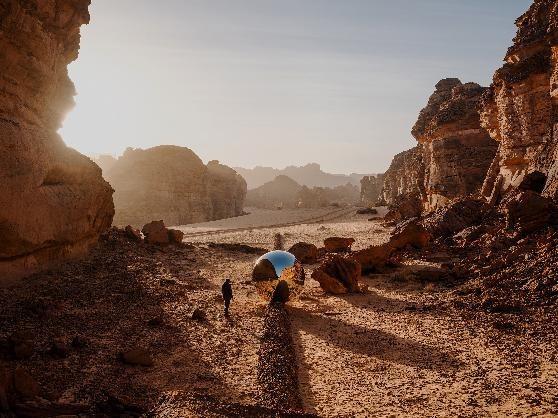
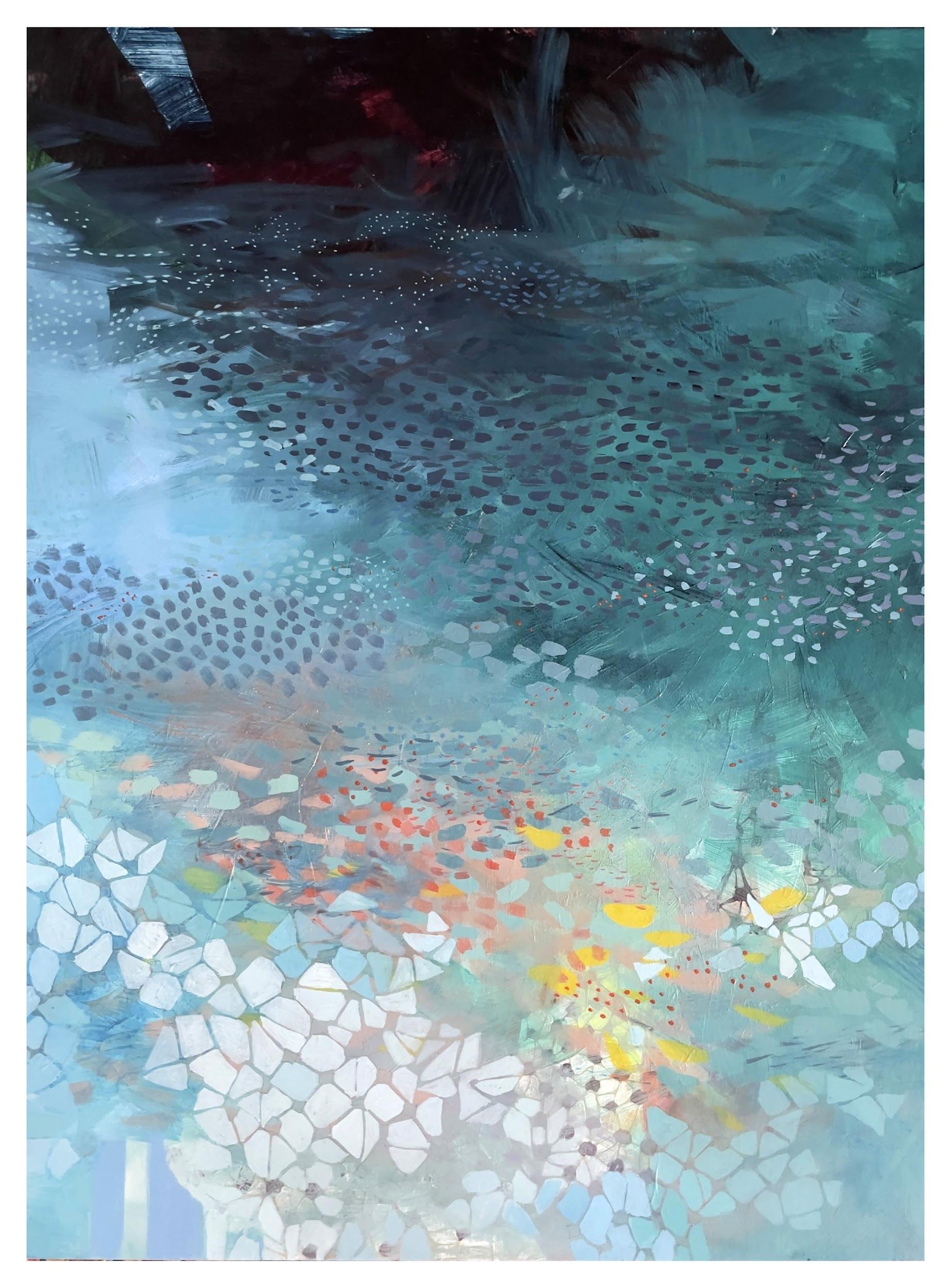
‘The Dot Desert x Al-Ula.' Faisal Samra. 2024. Courtesy of the artist.
Bin Samra sees the desert as a “lifesaving emptiness,” a place where he finds peace and serenity, far removed from the clamor of city life and the clutter of images. “In the desert, I can see things more clearly and listen to my inner voice without distortion. It's a space for contemplation and deep reflection, where simplicity and beauty are revealed in their most sublime forms. It's a spiritual haven that renews my energy and sharpens my artistic vision.”
He tends to believe his works offer a rich aesthetic experience: “Let me compare it to a healthy, substantial meal—one that is tasteful, flavorful, and wholesome—unlike those works that offer heavy, fast-food meals that are harmful to the eye." He adds, "I don't create my work for an elite audience; I create it for everyone, for those who want to enjoy art, for those who try to create space for reflection and ask themselves questions. Yes, I want to provoke the viewer to think about different things.”
Bin Samra believes that there is no certainty in art, that it is a continuous process of questioning, experimentation, and exploration. He sees resistance as having many forms, and art as one of them: “I believe that art is like malleable material that can be shaped, and the artist is the one who determines its nature. Art can be a means of conveying specific propaganda ideas, or promoting a political ideology, like the art that was used in the Soviet Union to promote the regime at the time, or even in other ways, as in capitalism. Art is fluid and adaptable in many ways; it finds its way wherever it flows, like water. True, independent art is that which is not employed for any particular purpose, but rather belongs to the artist and to humanity in every place and time.”
Upon returning from France in 1980, he didn't find the artistic milieu he desired—one that engaged with critical thinking, posed questions, and provoked thought. “I was almost alone back then. Now, I see this vast artistic community that thinks, asks questions, and tries to delve into different depths. This is the successful artist now, not just in the Kingdom, but globally. The artist is present in all art circles, museums, and other venues.”
“I am very attached to my reality. If we want to be honest in our artwork, we must be honest. We produce art because it is essential, not something secondary or for entertainment. As Kandinsky said, ‘Art is an internal necessity.”
Mutaz Qutaniah is a Writer & Consultant in Culture and Media.