From Still Waters to Raging Seas: The Many Faces of Water in Art
‘Water Lily.’ Claude Monet. 1899. Source: The Metropolitan Museum of Art.
Rivers, seas, springs, lakes, rain and snow… it is fascinating to explore the significance of water within the compositions and philosophical structures of world-renowned paintings.
In many works of art, the presence of water transcends mere visual representation and becomes a tool for generating meaning. Throughout its history in art, water transforms into a narrative space within which stories unfold, and through which the relationship between time and image, between the body and absence, and between nature and human experience is redefined. This presence can be approached as a flexible structure, transforming the scene into an open horizon for multiple interpretations.
Referring to his later works in which he drew inspiration from the waterscapes of a garden in Giverny, Monet said: "One instant, one aspect of nature contains it all."
These works were built upon various contemporary themes of paintings he created in the 1870s and 1890s, forming an important theme for him: “Water Lilies”. It is a painting in a series that reflected the artist’s favorite flower garden, which included a pond with a Japanese pedestrian bridge.
Monet depicted the pond's environment, with its plants, bridge, and trees, meticulously divided by a fixed horizon. Over time, the artist became less concerned with traditional pictorial space. In his painting “Water Lilies”, he cultivated spatial ambiguity, dispensing with the horizon line and focusing his gaze solely on the pond's surface. A collection of plants floats amidst the reflections of the sky and trees, merging a horizontal surface with a vertical one, and transforming the water, at that moment, into an open temporal space.
Here, the water becomes what might be called “the memory of light”. Water does not retain the form of objects, but rather the trace of their passage. It does not present a static image of the world, but a series of momentary transformations that redefine the relationship between time and perception, so that the painting becomes a record of the experience of perception, not a representation of an external subject.
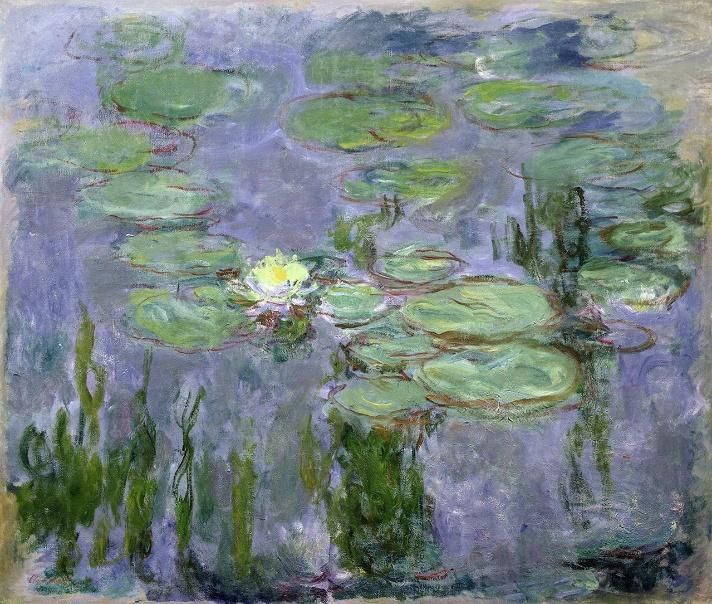
‘Water Lilies.’ Claude Monet. 1915. Source:Musée Marmottan Monet.
John Everett Millais crafted the painting "Ophelia" in two separate stages, first by depicting the landscape, and then returning later to add the figure of Ophelia. After choosing a suitable location to paint, he spent a long time on the banks of the River Hogsmill, where he worked for about eleven hours a day, six days a week, for five months in 1851.
In this painting, water separates two worlds. The figure Ophelia is derived from William Shakespeare’s play Hamlet, but who has gone mad with grief at the death of her father. She climbs a willow tree whose branches hang over a stream of water. The branch breaks under her feet and she falls to drown in it.
In this painting, Ophelia is not merely presented as a drowned body, but as a self suspended in a moment of transition between life and death. The river becomes an existential passage (a liminal space), and the surrounding nature becomes an extension of the event, not its setting; the water is the event itself, not simply its location.
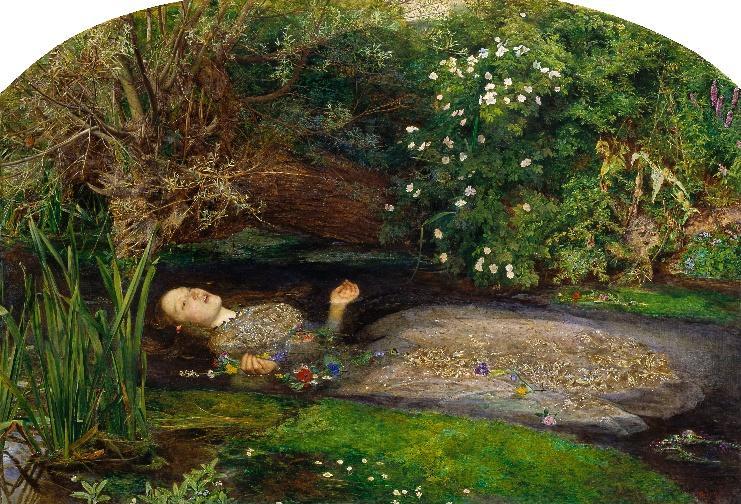
‘Ophelia.' John Everett Millais. 1851. Source: Tate Gallery.
Katsushika Hokusai's painting, "The Great Wave off Kanagawa," depicts three fishing boats tossed about by raging waves, a powerful surge threatening to engulf them, while in the distance, the sacred peak of Mount Athos looms serene and isolated.
Water, in its narrative presence, emerges as an independent dramatic force. The wave does not function as a mere marine backdrop, but as a visual agent threatening to reshape the entire scene, as the power of nature clashes with the fragility of human existence. The painted moment becomes a suspended time preceding the catastrophe, as if the painting preserves the tension before the explosion, not the explosion itself. This imbues the water here with a predetermined dimension that transcends mere representation.
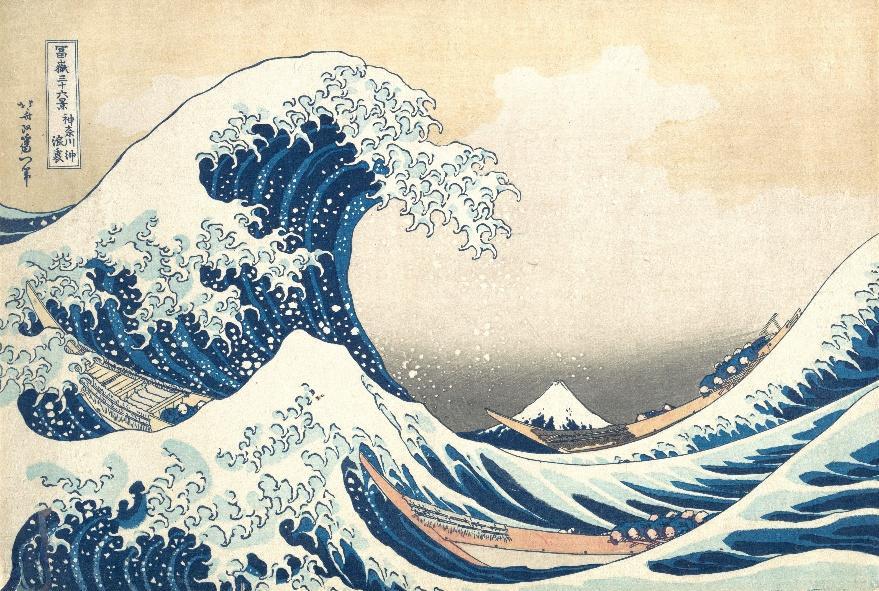
‘The Great Wave off Kanagawa.’ Hokusai Katsushika, from the series “Thirty-Six Views of Mount Fuji.” 1832. Ukiyo-e woodblock print. Source: Sumida Hokusai Museum.
Greek mythology tells the story of Narcissus, a young man who saw his reflection in a pool of water. So captivated was he by his own image that he lost his balance and fell in. The story goes that the pool later dried up, and a flower known as “the Narcissus” grew in its place.
In this painting, water takes on a completely different function; it becomes a reflective surface that closes in on the self, reflecting not so much the world as the confinement of identity within its own image. Thus, it becomes a circular, internal space, based on repetition and circling around the ego, transforming from a natural element into an existential mirror that reveals the fragility and limitations of self-awareness.
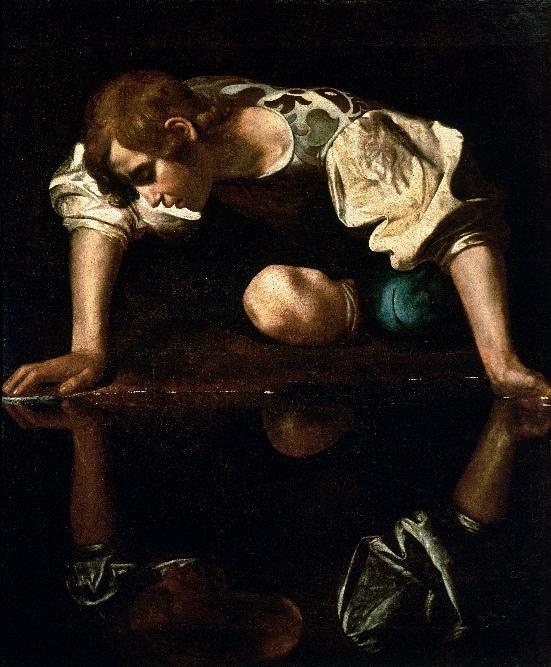
‘Narcissus.' Caravaggio. 1597. Source: National Barberini Corsini Gallery.
William Turner's painting “Fishermen at Sea” seems like a visual embodiment of the sea's cry as expressed in Ernest Hemingway's "The Old Man and the Sea," but here it is not articulated in words, but rather manifested through the tension of light and shadow, and the trembling of color across the canvas. In this turbulent space, nothing remains constant; clouds thicken, and the sea erupts in uncontrollable fury, its waves rising like a perpetual declaration of nature's rebellion, while the small boat wobbles like a fragile creature cast into an unknown fate within this chaos.
Turner places humanity in an unequal confrontation with the universe: a small lamp glowing inside the vessel faces the light of a moon shrouded in thick black fog, as if reflecting hidden forces lurking in the darkness. The conflict transcends nature, becoming a confrontation between a transient human existence and an immense cosmic power that can only be countered by a faint glimmer of light.
The boat, in all its fragility, remains suspended between two contradictory possibilities: that a wave will lift it towards salvation, or that another will swallow it to a bottom from which there is no return, where everything ends in the absolute silence of the sea.
All of this tells us that water in art is not a fixed, objective element, but rather a fluid narrative structure that provides contemplation, reflection, and power. In this sense, water transforms the painting from a mere representation of the world into a space for experiencing time, meaning, and existence.
Sabah Deebi is a Critic and writer.
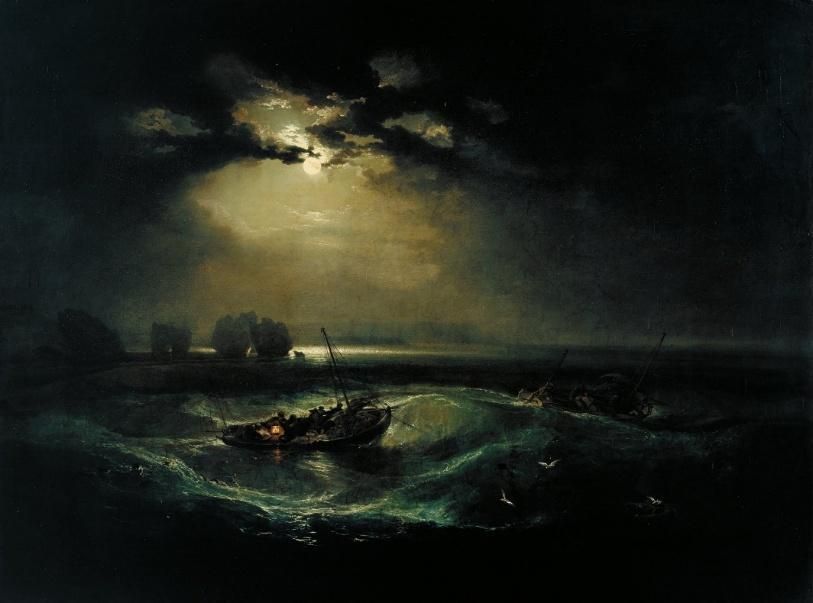
‘Fishermen at Sea.’ J. M. W. Turner. 1796. Source: Tate Gallery.
References:
- The Story of Art, E. H. Gombrich. Phaidon Press. New York.
- Monet in the Twentieth Century, Charles Stuckey, Apollo: an international art magazine, February issue, 1999, p. 20.
- Berger, S. (2020). From Narcissus to narcosis: Vision and self-reflection in Caravaggio’s Narcissus. Art History, Volume 43, Issue 3, June 2020, Pages 612–639.
- Turner and the Sea, Christine Riding and Richard Johns, Thames & Hudson, 2013.