The Fading Song of the Seas
‘Or, The Whale.' Jos Sances. 2019-2020. This section features the front of the majestic whale piece that measures roughly 4 by 15.5 meters (119 panels of 5 x 7.5 cm). Courtesy of the artist.
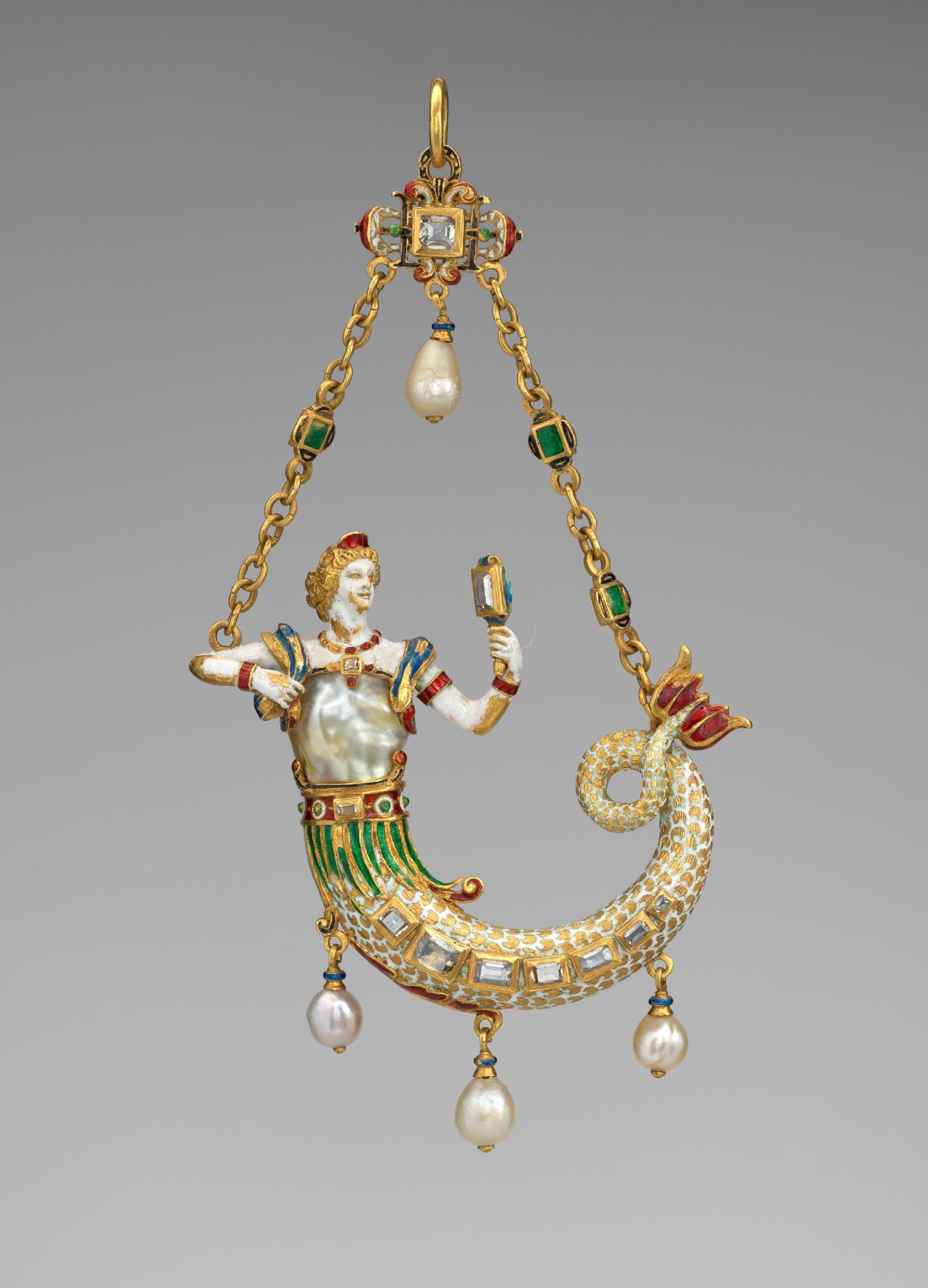
Pendant in the form of a mermaid, probably based on a design by Reinhold Vasters. Circa 1870-1895. Baroque pearl with enameled gold mounts set with diamonds and pendant pearls. Height of 12.4 cm. Credit to The Jack and Belle Linksy Collection, 1982.
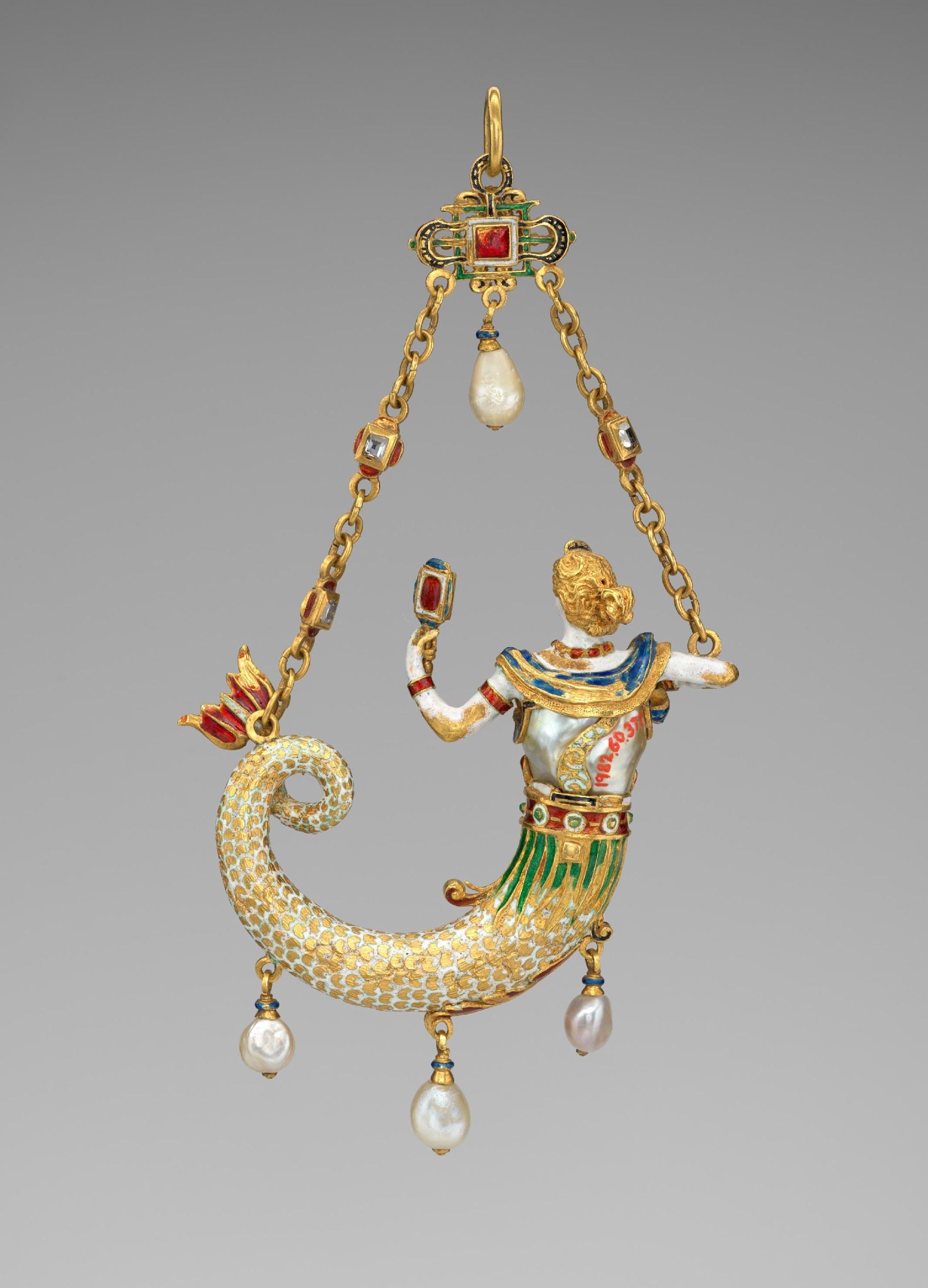
Pendant in the form of a mermaid, probably based on a design by Reinhold Vasters. Circa 1870-1895. Baroque pearl with enameled gold mounts set with diamonds and pendant pearls. Height of 12.4 cm. Credit to The Jack and Belle Linksy Collection, 1982.
Since the first time we contemplated the sea and marveled at its wonder and awe and mystery, the human race has always gone back into the water out of love, curiosity and most importantly necessity.
Communities have always lived on precious gifts from the sea: on its pearls for trade, on its fish for food, on its seaweed for medicine, and on its stones and corals as building blocks for homes. Even its empty shells were used as decorations, accessories, or even as 'suckling shells' which mothers used as feeding bottles.
There is no limit to the gifts from our precious waters that also heal and revive the spirit.
At the same, the ocean has been a place of mystery, inspiring myths of beautiful sirens, restless sea monsters, and haunting ‘ghost ships’ that are believed to sail the eternal currents. Ancient mariners spoke of the ‘selkies’ or ‘seal folk’ ‘of the North Atlantic—seal-like shapeshifting creatures who could shed their skins to walk on land—and the terrifying kraken feared by pirates that rose from the abyss to pull vessels down to their doom. These stories, passed down in the folklore of seafaring nations, attempted to explain the powerful, unseen world beneath the waves.
Yet, the most profound and mysterious being is one famous for its song: the whale. Its low, resonant hums, whistles, pulsed calls and clicks help them navigate through the dark. This symphony of the deep evolved over millions of years, allowing the ocean’s giants to communicate across entire ocean basins. But today, a new, harsh noise is rising from the depths, a cacophony of human-led, industrial and destructive activity that are disrupting the music of the sea, and silencing the voices of the whales and other sea creatures; disrupting the ancient rhythms of life on Earth and its waters.
Unable to communicate properly causes these wonderful giants to get lost, symbolic of a world that has forgotten how to co-exist with nature and its many creatures, imposing itself on other species.
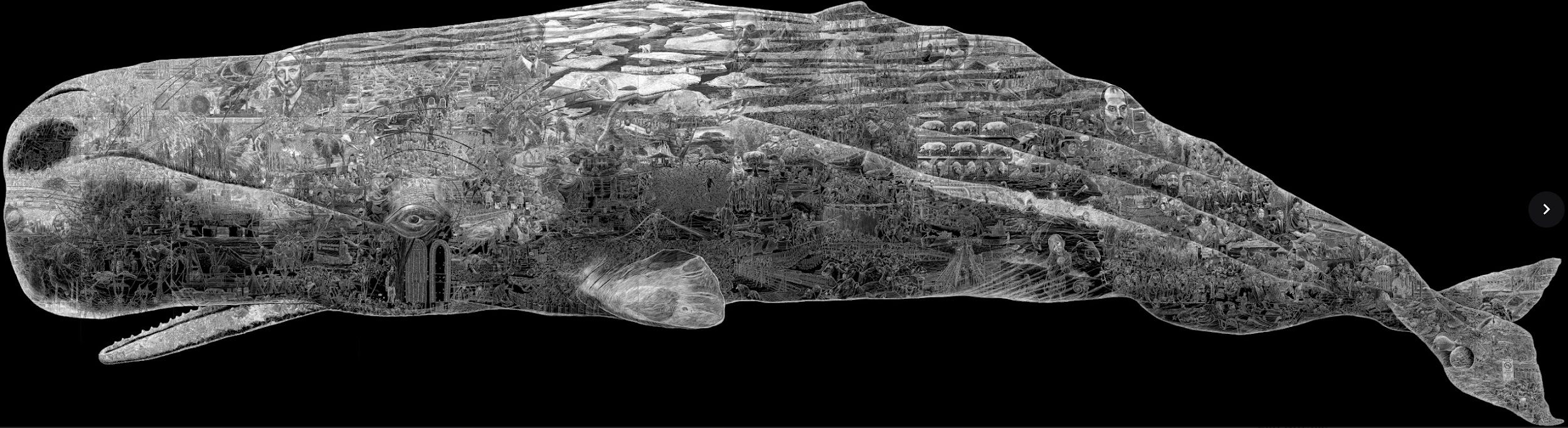
‘Or, The Whale.' Jos Sances. 2019-2020. The majestic whale piece measures roughly 4 by 15.5 meters (119 panels of 5 x 7.5 cm). Courtesy of the artist.
Honoring this beautiful gentle giant and all it represents is a profound panoramic scratchboard mural called ‘Or, The Whale’ by the renowned American artist Jos Sances. Born in 1952, he is famous for his printmaking and tile murals and public art for more than 45 years. He has had many accomplishments, most notably in 1980 when he co-founded Mission Gráfica at San Francisco’s Mission Cultural Center, and worked there until 1988, at which point he founded Alliance Graphics in Berkeley, California, a successful, union screen print shop.One of his prominent works, it alludes to the subtitle of Herman Melville’s Moby-Dick (1851): ‘Or, The Whale’. And yet, it distinguishes itself from Captain Ahab’s infamous quarry by giving priority instead to the whale itself as a creature of nature.
On this massive animal canvas, Sances inscribes a diversely populated visual counter-narrative that critiques Ahab’s monomaniacal attempt at mastering nature.
“I choose the whale because it symbolizes the natural world in its pure form, without human intervention,” Sances told Ithraeyat.
“As the planet’s largest mammals, they have existed here for 50 million years, much longer than humans. The Whale also symbolizes the imperiled body of the world as it currently stands, a world of exploited peoples and natural resources whose beauty and dignity persist in the face of oppression and ecological catastrophe,” he said.
Whales throughout history have been and continue to be hunted down, even though they are endangered and critical to the very survival of the oceans. They are the sea's gardeners and ‘ecosystem engineers.’
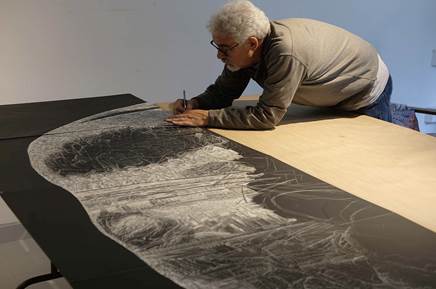
The renowned American artist Jos Sances. Courtesy of the artist.
“Whales play a real, measurable role in keeping ocean ecosystems stable. Their movement helps circulate nutrients, which supports plankton growth—and plankton produces a huge portion of the oxygen we breathe,” said Sances. “So when whale populations decline, it’s not just a loss of wildlife; it weakens an entire system that human life depends on. Degrading the ocean is ultimately self-destructive for all life on the planet.”
The origins of Or, The Whale are traceable to Sances’s encounters with whales in the waters off Todos Santos in Baja California, a place Sances has visited regularly since 2014, often with family members and sometimes teaching tile mural workshops at Todos Artes and doing regional art commissions. Seeing whales up close, from the small pangas of local fishermen, proved a transformative experience, deepening Sances’s connection with the natural world and informing a number of prints and ceramic works that celebrate sea life and the marine environment.
Their mighty role is also confirmed by research that shows when the ocean gets sick, the whales stop singing, and with that eerie silence, we lose a part of ourselves and our world.
“But all is not hopeless,” insisted Sances. “There are success stories—whale populations like humpbacks have rebounded after protections were put in place. That shows intervention works when it’s taken seriously.”
As we take a moment to embrace silence, and enjoy the blessings of water in every form, with stories of it keeping memories of the last words uttered near it, if positive it stays clear, and if negative it darkens, we hope for a clear, silent water, one that welcomes back the healing songs of its many species.
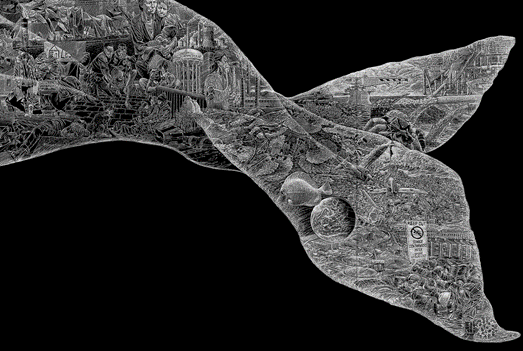
‘Or, The Whale.' Jos Sances. 2019-2020. This section features the end of the majestic whale piece that measures roughly 4 by 15.5 meters (119 panels of 5 x 7.5 cm). Courtesy of the artist.