The Village that Wove the Threads of Imagination
‘Palm Trees on the Canal.’ Weaver Nawara Radwan. 2025. Piece no. 98. 125 x 190 cm. Photo by Ikram Noushi. Courtesy of Suzan Wissa Wassef Studio, Ramses Wissa Wassef Art Center.
In 1951, Ramses Wissa Wassef arrived in the village of Harrania, near the Giza pyramids, carrying a big dream and the idea of an artistic project that he built with love, passion, and faith that everything that can be imagined can become a reality.
There, he founded the Ramses Wissa Wassef Center for Arts, believing that creativity was not an exceptional talent belonging to a select few, but rather a latent energy that could be uncovered and refined. Children were the focus of his experience, where the first group of about 15 kids were all under 12 years old. The selection criteria were not only talent, but also perseverance and interest. With this first generation, the weaving journey began.
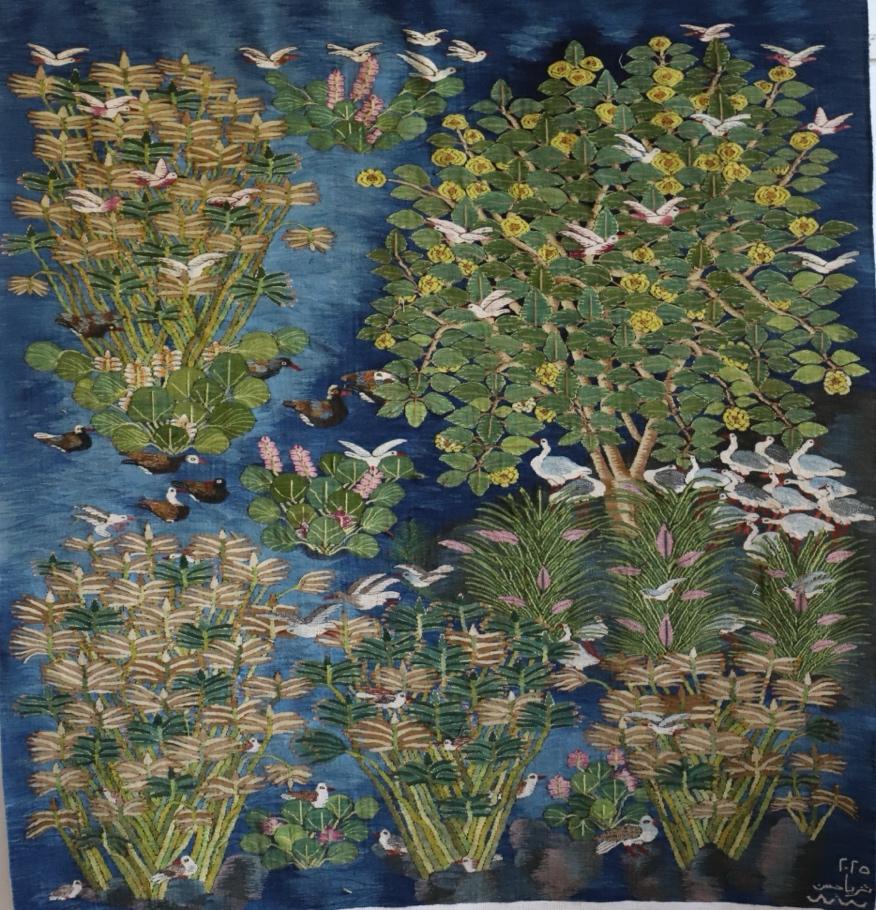
‘The Lotus and Papyrus Pond.' Weaver Thuraya Hassan. 2025. Piece no. 140. 165 x 180 cm. Photo by Ikram Noushi. Courtesy of Suzan Wissa Wassef Studio, Ramses Wissa Wassef Art Center.
Ramses established some fundamental rules: no pre-drawn sketches, no ready-made designs, no external influences through imitated models, and no criticism that would stifle the children's imagination. The children sat before large looms without plans, relying solely on the threads, their imaginations, and experimentation. Gradually, scenes began to emerge on the carpets: villages, birds, fish, ducks, palm trees, and scenes from daily life. These weren't works of art in the academic sense, but they were vibrant, reflecting the child's initial wonder at the world.
Over time, these works were no longer confined to a small village. Beginning in 1954, they toured the world and traveled to exhibitions.
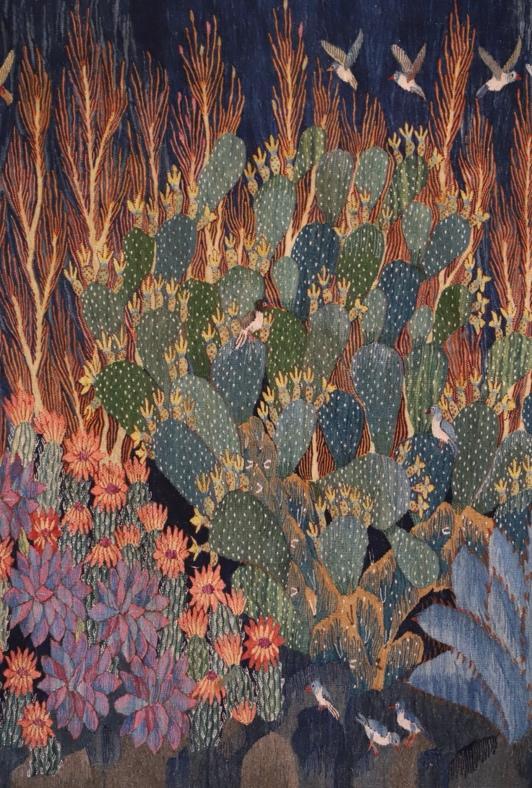
‘The Cactus.’ Weaver Sayed Mahmoud. 2026. Piece no. 121. 188 x 110 cm. Photo by Ikram Noushi. Courtesy of Suzan Wissa Wassef Studio, Ramses Wissa Wassef Art Center.
Weaving is not only about threads, imagination, and looms, but also color. This led Ramses to research natural dyes extracted from plants, drawing on the history of ancient Egyptians and their use of natural pigments. In 1956, he began cultivating these plants within the center. Since then, once a year the weavers go to the center's garden to prepare the main dye that will be used throughout the year.
After Ramses' death in 1974, his wife Sophie and daughters Suzan and Joanna continued the work. The second generation began in 1973, and this is the same generation working there today! The center currently employs around 27 artists, both men and women, who work in wool and cotton weaving, as well as practice batik (wax painting on fabric). Their work continues to tour more exhibitions, and are held in the collections of more than 26 museums worldwide, including those in Europe, Egypt, the UAE, Saudi Arabia, and Qatar.
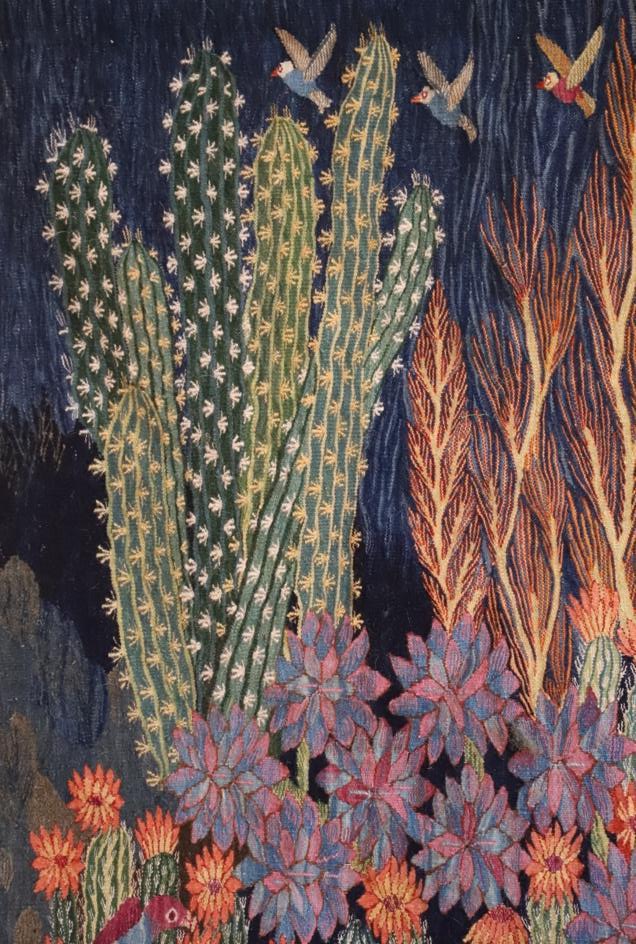
‘The Cactus.’ Weaver Sayed Mahmoud. 2026. Piece no. 121. 188 x 110 cm. Photo by Ikram Noushi. Courtesy of Suzan Wissa Wassef Studio, Ramses Wissa Wassef Art Center.
The center's experience is unique, not only for its art but also for its impact on people's lives. It has been a source of livelihood for families, opening its doors to women and children and offering them a new way to understand themselves and the world around them; making art an integral part of their daily lives.
Today, more than 70 years after its founding, the looms still operate in Harrania, the threads still yearn to be harnessed by the weaver's imagination, and the center remains home to a unique and unparalleled experience in the art of hand weaving, so don't miss the opportunity to visit it!
You may also visit their art exhibition, on display in Sweden until December 2026: Harrania — Where Weaving Remembers.
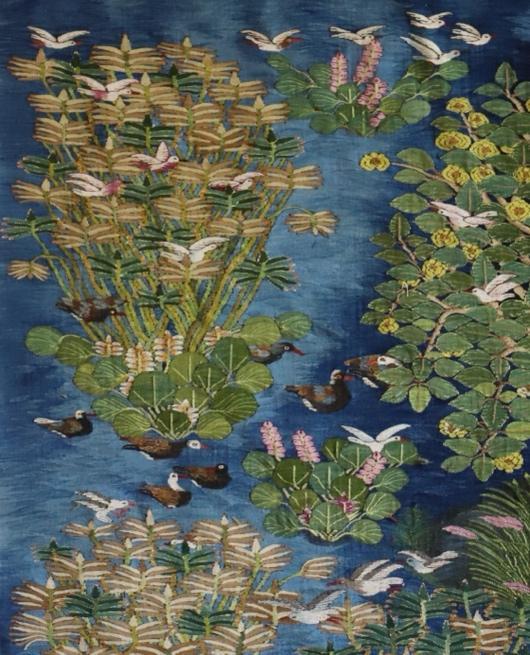
‘The Lotus and Papyrus Pond.' Weaver Soraya Hassan. 2025. Piece no. 140. 165 x1 80 cm. Photo by Ikram Noushi. Courtesy of Suzan Wissa Wassef Studio, Ramses Wissa Wassef Art Center.
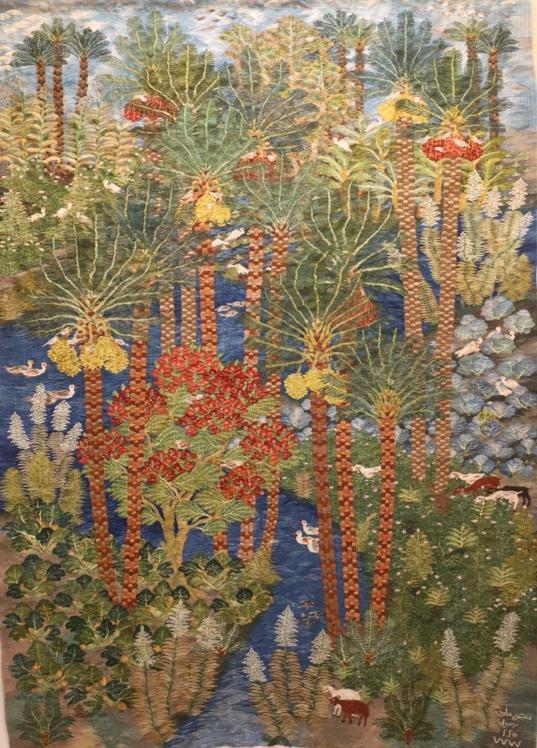
‘Palm Trees on the Canal.' Weaver Nawara Radwan. 2025. Piece no. 98. 125 x 190 cm. Photo by Ikram Noushi. Courtesy of Suzan Wissa Wassef Studio, Ramses Wissa Wassef Art Center.